Showing posts with label I and The Bird. Show all posts

Saturday, 19 June 2010

High-octane Bird-photography

I guided a high-octane bird-photography tour from 24 January to 9 February, 2010. It was with Felix Ng, and two trigger-happy lady friends of his, all from Hong Kong.

Plum-headed Parakeet—one of the highlights.

As blogged before, Felix wielded the latest Canon EOS 1D Mark IV camera. He coupled it with Canon EF 500mm f/4L IS USM super telephoto lens. They were mounted on a serious tripod. All these made up his carry-on kit. When the subjects were too close, and likely to stay on—just as any thoughtful bird photographer would do— he pulled out his Canon EF 300mm f2.8 L IS USM telephoto lens for hand-held shots.

They say that one of the features that defines a successful birding tour from an ordinary one is the quality of night birds seen. Well, this being a bird-photography tour, the challenge was more daunting, as seeing and photographing are two entirely different kettles of fish when it comes to night birds. And Felix & co., carried no binoculars—no room for them, anyway.

I think it requires a lot of patience and an equal measure of skill to pull off good shots of night birds in untamed field conditions. In the quest for Sri Lankan specials, a birder has to find two species of owls to make a clean sweep of the 33 endemics. The first is the Serendib Scops Owl—discovered in 2001, with an estimated total population of 200-250 in the wild; plausibly classified as 'endangered' by conservation bodies.

The other owl on the wanted list of endemics is the Chestnut-backed Owlet.

We did well during the first couple of days at Kithulgala, getting photo ticks of most of our targets. After an easy morning's birding, we crossed the Kelani River in a dug-out-canoe to reach the verdant rain forest at Kithulgala in search of our pending targets. I first visited this forest in 1991. It take just an hour and a half to reach there by public transport from my place. As a budding birder, I had done many trips to this 'patch'.

Opting to travel light, I carried no camera with me when I entered the rain forest with Felix & co. Actually, I had an ulterior motive to this—to veer off the main track in a deep penetrative operation—to see whether I can find a Serendib Scops Owl in a daytime roost. Lugging a camera along for such adventures, slows me down.

So, I left my visitors at a bird-rich spot, and made a beeline to a spot that I long suspected would hold a roosting Serendib Scops Owl. Despite previous attempts, I had not found a day roost of this bird at Kithulgala. It was nearing midday. The scorching sun had lulled the bird activity though this was not a hindrance to the job at hand.

First, I penetrated the forward defence line made up of the Bamboo Ochlandra stridula, enduring cuts delivered by their sharp leaf blades, while keeping my radar on other potent dangers. And owls.
Barely two minutes into scanning a targeted area, an elongate dead leaf stuck in a thicket—how the Serendib Scops Owl would appear when it is roosting—caught my attention. After a close inspection through my Swarovski EL 8.5 x 42 binoculars, it turned out to be what it was—a dead leaf.

Moving on, I came near a clump of tree ferns Cyathea sp., and more bamboo with their interiors overrun with vines, holding dead leaves and good promise. Scanning it to find a matching target, I drew a blank, again. A moment later, now about three minutes into searching, a vertical leafy profile in another thicket beckoned me. Surely this must be it, I thought. Upon close inspection, it turned out to be—would you believe—another leaf.

Undeterred, I kept scanning. Now about five minutes into searching, a strikingly rufescent leaf with well-marked dark spots, caught my attention. Closer look, and lo—this time, it turned out to be a Serendib Scops Owl!

In a flash, I noticed second bird, perched on a different branch about a foot away from it—a truly momentous day for mankind!

Soon, I showed them to my visitors. Frame-filling shots, and more jaw-dropping views followed. The gentleman mildly complained that it was "too clOse" though. I left no room for such complaining when I found Chestnut-backed Owlet below, hunting during day time, as glaucidium-owls do. This was at a home garden in Kithulgala.

Chestnut-backed Owlet

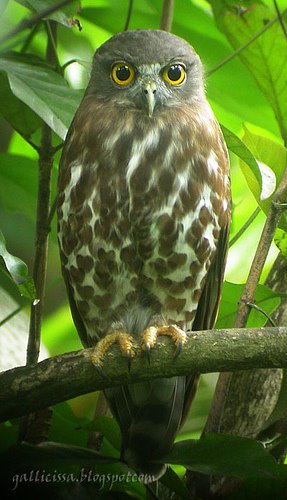
We had six different sightings of the Brown Fish Owl at various sites. The best was the one shown below. Arriving at this crime scene at the amazing Yala National Park, we found this Brown Fish Owl looking rather guilty.


Brown Fish Owl

I am no avian forensics expert, but circumstantial evidence suggested to me that this had just arrived at the scene to scavenge on the scraps left by a diurnal predator—something like a Crested Hawk Eagle. I can't be totally sure.

We saw over 230 species of birds during this tour including all 33 endemics. We had 9 out of the 15 resident night birds—didn't try for some. Felix and co., took home over 18,000 photographs of birds among them.

Remember the Black-backed Dwarf Kingfisher that I shared sometime ago?
I bagged it on this tour.

Friday, 8 May 2009

Bagging the Blue Whale


Sri Lanka is one of the best places to see the Blue Whale Balaenoptera musculus—according to Marine Biologist Dr. Charles Anderson. He is based in Maldives since 1983 and his research on whales in the Indian Ocean led him to believe that Blue Whales should be present off the south coast of Sri Lanka in April—a hypothesis he confirmed with pelagic trips done in April 2007 and 2008. In the last of these trips, he has had Blue Whales on all 14-days he spent looking for them, with an average of 4.5 sightings per day!


Sri Lanka, as you may be aware, is a continental island, which had been connected to India for much of the geological past through epocs of lowered sea levels. The continental shelf that it sits on begins to slope after 3 nautical miles off Dondra in the southernmost tip of Sri Lanka, which is also the southernmost point of the whole of Indian subcontinent. Because of this oceanographical reality, ships plying between east and west have to circumnavigate Sri Lanka, passing by Dondra instead of cutting across the northern Sri Lanka, where seas are shallower.

According Dr. Anderson, the cetaceans migrating between feeding areas in the east and west of the Indian Ocean also take the same route as the ships. This, according to him, happens between December to April—with clear peaks in December and April.


With this beging the state of affairs Peter Kaestner, who at present is the world’s 7th ranked birder, came to Sri Lanka on a 9-day holiday with his family in early April—with wathcing the Blue Whales being central element of the tour. According to the latest numbers listed in Surbirds.com, Peter has got a whopping 8,180 species of birds, out of 10,000 or species found in the world.

In 1989, he was fortunate to discover a bird species entirely new to science, from Columbia, which came to be known as Cundimarca Antpitta Grallaria kaestneri.


This was Peter’s second trip with me. The first was in Sep, 2007 when he came on 3-day weekend birding trip wanting to clean up 8 Sri Lankan endemic birds missing in his world bird list. Before this, he had been on a solo birding visit to Sri Lanka in 1981—round about the time when I was getting ready to go to the kindergarten!

In the 2007 trip, we managed to see 7 of those 8 targets: Serendib Scops Owl, Ashy-headed Laughingthrush, Red-faced Malkoha, Sri Lanka Spurfowl, Green-billed Coucal, Sri Lanka Bush Warbler and Sri Lanka Whistling Thrush—the toughest endemics, with two being in the “endangered” club.

The one we missed out was the not-so-elusive Brown-capped Babbler. This miss was because some of those rare species we sought were found in two ecological zones – the lowland wet zone and highland wet zone respectively, and because some of them being rare birds didn't show up easily, demanding more time.

Oh! And because, we encountered foul weather throughout in this particular tour due to the period of travel coinciding with a monsoonal high.


We commenced our 2009 trip in the southeastern Sri Lanka with two game drives to the spectacular Yala National Park hoping to go 1-nil with the Leopard. Unfortunately, we drew a blank with this big cat this time.

But, to make amends, I managed to find the Brown-capped Babbler!

Next came the pelagic leg—the most important one—of the trip to see our main quarry, the Blue Whale.

Having started from Mirissa at 7.15 a.m., on 5 April, we had the first evidence of our first Blue Whale after travelling 4 nautical miles, towards—well—Antarctica. It was a distant but unmistakable view of a characteristic high vertical blow.

Tickable views were obtained around 5.5 nautical miles off. We had at least 4 good sightings of just an individual after we reached the hotspot and started looking intently. We knew it was the same one as it had a characteristic white marking in the tail, which showed up clearing with each surfacing. Here's a crude video of our Blue Whale. I should stress the word: crude.


At one point it was seen as close as 20-30m from our boat as it surfaced to breathe, almost taking our breath away. It performed well for us as well as for people aboard 3 other boats that converged at this hotspot for the same purpose. One of those was full of familiar faces with members of a local nature club. They, at one point, were pretty close. By the way, the terra firma you see in the picture below is Sri Lanka, just in case if you are wondering whether it is Antarctica.


I did not take my dSLR for this trip. That's because all my lenses are macro types. And the Blue Whale was not really a macro subject.

So, all these pictures shared here were taken by my trusty Panasonic Lumix FZ-18, which is also the model that Peter currently uses as his carry on camera. I bought mine after seeing this amazing shot he got by photographing the Serendib Scops Owl at night (using an older Lumix version).

A day trip we did following this to Sinharaja rain forest to see Sri Lanka Scaly Thrush and Crimson-backed Flameback was successful. The former responded aggressively to my rendition of its contact call by flying straight towards my head, indicating it may be busy nesting. These two birds together with Sri Lanka Woodshrike and Common Hawk Cuckoo seen on this tour by Peter went as ‘bank birds’—ones which do not get added to his bird list immediately as the ‘Clements' checklist’ that he uses to keep track of birds species seen, has not yet accepted these recent taxonomical splits/potential spits as valid species yet; and now that he has seen them, they would increase his tally once they are accepted as valid species in the future.

I nearly forgot, Peter became the first birder to see my garden's roosting Brown Hawk Owls.

Brown Hawk OwlA related post: Finding lifers for Peter Kaestner

Monday, 16 March 2009

Leopards galore

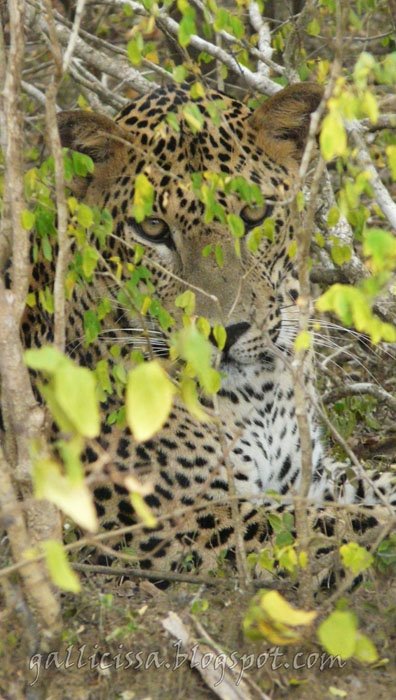
Leopard at point blank range, Yala National Park
I am a firm believer that for getting ‘tickable views’ of rare species on tours that are usually limited in duration, you need lots of good luck. You can be a birder or a naturalist with good field craft & have all the latest tools in the trade, but if you don’t have enough luck, you are bound to head back home empty-handed.
Over the years of guiding birders and naturalists I have met persons of varying levels of field craft. Some of them were extremely skilled naturalists but they just lacked that luck factor while others were average as far as field craft was concerned but brought with them lots of luck to the equation. Naturally, with the latter types we end up seeing lots of specials, surpassing expectations. No other person that I have guided so far had bought field craft and luck in equal high measures as Dr. Andreas Prevodnik of Swedish Society for Nature Conservation.
Leopard at Yala National Park
I had the fortune of guiding him on what turned out to be a high-adrenaline ‘Bird and Natural History’ tour from 10-17 Feb. This tour came to me through Red Dot Tours, a British Tour Operator to which I freelance in between my tours. It turned out to be an absolutely fantastic trip in terms of both numbers and quality of sightings. We both worked tirelessly and ended up bagging a whopping 216 species of birds including 31 of the 33 endemics currently recognized, which was quite something given the short duration of the trip. We missed out on the Sri Lanka Wood Pigeon and Sri Lanka Small Barbet. Our best efforts to see them failed, driving home, another crucial fact - you sometimes need time too!
Our final bird tally included 6 of the 15 resident night birds, which included Serendib Scops Owl, Chestnut-backed Owlet, Brown Wood Owl, Indian Scops Owl, Indian Jungle Nightjar & Sri Lanka Frogmouth – another brooding male shown below cooperating to offer stunning views.

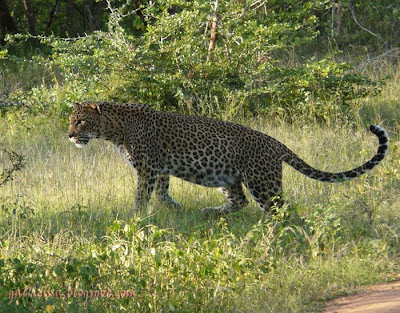
A special natural history highlight of the trip was seeing 7 Leopards in 2 game drives at the amazing Yala National Park. Four of these were recorded on the first game drive. We just couldn’t stay away from Leopards at Yala on this tour as they turned up every time we were after other targets. I hate to admit this, but Leopards were a big distraction on this tour!
The first of the Leopards to grace our visit to Yala (shown at the top) settled under the shade of a tree by the roadside at the beginning of the Uraniya road and gave us stonking views just, 2.5m away from our safari - after 30 minutes from entering the park.
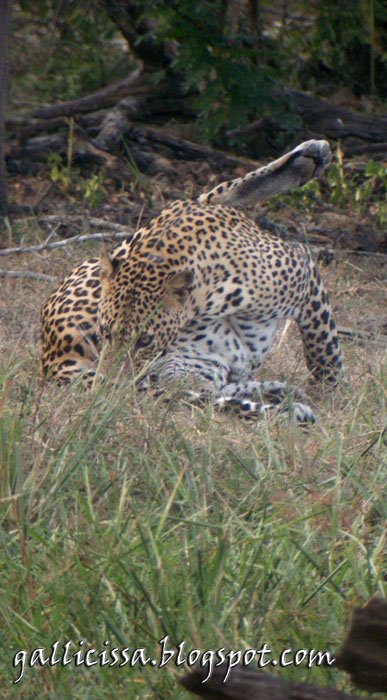
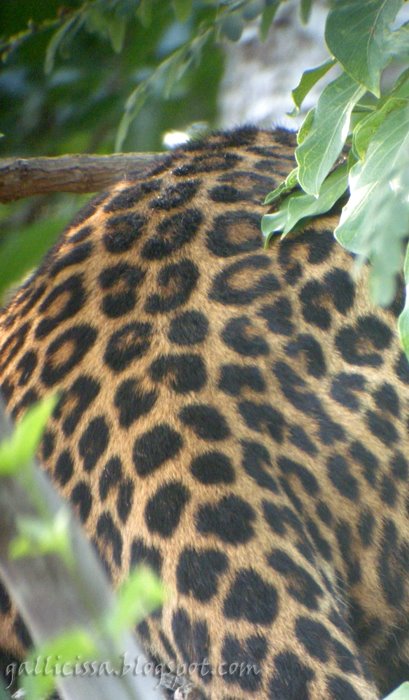
Our second Leopard found at an area casually named as ‘Ahelagas-wala’ at the famous Leopard zone, Meda-para was this stubborn cub, who refused to give us any decent look at it except a bum view.
Leopard at Yala National Park
Our third Leopard only offered a fleeting glimpse as it crossed the track a bit ahead of the location where the above brat cub was 'misbehaving'. Our fourth and final Leopard was sighted in full view close to Uraniya road when it came down to the ground from a Palu tree when we were exiting the park.
Our 5 & 6th Leopards were spotted together on our second safari, guarding over a Water Buffalo kill from a safe distance. Despite their intimidating presence near the carcass, a Golden Jackal, and a Wild Boar and several birds crashed the party and helped themselves for a quick McBuffalo meal. Here’s what happened, shot from about 70m away.

When we were observing this, news arrived that a male Leopard is out in the open at the nearby Palugaswewa No.1. We wasted no time in going for it to find this beautiful Leopard. (note: the colours are wrong.)
Leopard at Yala National Park
It was well worth it as this male really put up a show for us with a curious male Sri Lanka Junglefowl also playing a support role. Check this out.

We also chanced upon 2 Jungle Cats outside the park while returning to our accommodation on the 2 days that we visited the park. Andreas photographed one of them at point blank range.
Apart from the endemics, our other birding highlights include Black-backed Dwarf Kingfisher, Malayan Night Heron (adult in clear view – easily my best sighting ever), Painted Snipe, White-cheeked Tern, Western Reef Egret, Western Marsh Harrier, Ruddy-breasted Crake, Watercock, Black-necked Stork, Pied Thrush, Fork-tailed Drongo Cuckoo, Small Pratincole, Broad-billed Sandpiper, Red-necked Phalarope, Malabar Pied Hornbill, Blue-faced Malkoha, Indian Pitta, Indian Blue Robin, Rufous Woodpecker, Marshall’s Iora, Black Bittern, Yellow Bittern & Streaked Weaver.
Sri Lanka Frogmouth

Saturday, 21 February 2009

Birding with Keith and Julie Ellis

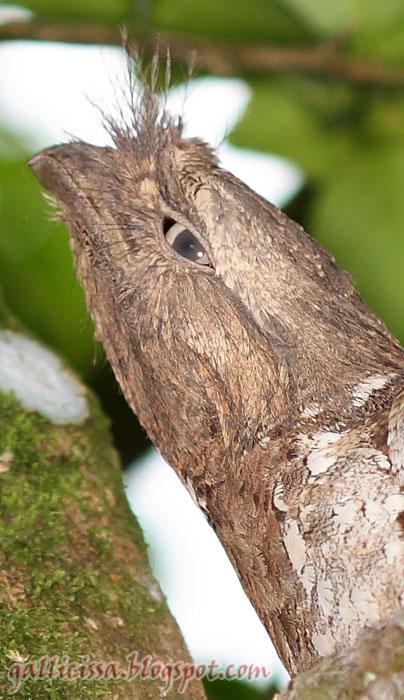
Sri Lanka Frogmouth male
I led an 18-day 'birds, wildlife and culture tour' with Keith and Julie Ellis from Kent, UK from 23 Jan – 9 February. Keith was a serious birder with over 3,000 world birds in his life list. He knew most of the species that he wanted to see by their scientific names and was a sharp birder. Julie had broader interests, which included culture. She was supportive and tolerant—two traits that I admire in non-birding spouses accompanying serious birders! A cultural extension added to the tour to please her took us to several Unesco world heritage sites that included Anuradhapura—the first capital of Sri Lanka from 4th century B.C to early 11th century AD, Polonnaruwa—the medieval capital from 11-13th century A.D, Sigiriya—popularly, a pleasure capital of a single king named Kashyapa in the 5th century A.D, and Kandy—the last Sinhalese capital from 16th to 19th century A.D, which is home to the Temple of The Sacred Tooth Relic, where a Sacred Tooth of the Buddha is encased in jeweled caskets that sit on a throne. In Anuradhapura, we also visited Mihintale—the cradle of Sinhalese Buddhist civilization and birded in the world’s first declared wildlife sanctuary, announced as early as in the 3rd century B.C.!

The 'World Heritage' Sigiriya Rock Fortress
We were quite lucky with the weather, and experienced nice dry conditions throughout the tour, which was perfect for birding. In total, we bagged 253 species of birds including all thirty-three endemic birds currently recognized. Nineteen of these endemics were bagged during our first two days at Kithulgala—in the "power play" stage of the tour. And this reduced the ‘asking rate’ during the rest of the tour considerably!

Some of the high-profile endemic targets bagged at Kithulgala included Serendib Scops Owl, Sri Lanka Spurfowl, Crimson-backed Flameback, Red-faced Malkoha, and Sri Lanka Blue Magpie.
The latter two species are usually considered as Sinharaja specials, but we made good ground by bagging them in advance to free up time to look for bonus birds. Our last endemic to be seen on the trip, Sri Lanka Bush Warbler was the one that gave us the hardest time. As it was proving elusive at my regular sites at Nuwara Eliya, a pre-dawn visit was undertaken to the cloud forests of Horton Plains National Park just to see it. The temperature at at the site we settled to look for this LBJ at the Horton Plains was just about 3 degrees centigrades! Not my cuppa tea! It was so cold that there was ground frost. Jesus Christ!

After 45 minutes of searching, I managed to spot one Sri Lanka Bush Warbler skulking in low bamboo thicket, thus making a clean sweep of the endemics. I suspect the reason for its inactivity at elevations low-down probably may be due to the very dry weather experienced at those sites.

Painted Stork
Painted Stork
A special highlight of the tour was seeing ten out of the fifteen resident night birds—with most offering multiple orgasmic views! This figure comprised of seven owls, two nightjars and the only frogmouth species found in Sri Lanka. This night bird number beat a previous high recorded on my tours of nine—seen on a 15- day birding tour in February, 2008 with four crack team of British birders.

Touching in the specifics of the haul of night birds and other things, our first owl of the trip was Chestnut-backed Owlet (shown below), and it was spotted by Keith while it was actively foraging at daytime close to our accommodation. The same species was seen moments later in another patch close by, with its characteristic call betraying its hide-out in the dense vegetation.

Chestnut-backed Owlet
Our second species of owl for the trip, a roosting Indian Scops Owl was picked by me quite by chance moments later, when I was looking for the skulking endemic, Green-billed Coucal in a thicket. We got decent views of the hoped for coucal and as dusk approached the scops owl cooperated at a more open branch to present us full view of its profile. Indian Scops Owl was recorded again at a nest hole towards the tail end of the holiday (that's like, work, for me) at Anuradhapura during the cultural leg.

Our day 2 at Kithulgala saw us getting cracking views of the highly-sought-after endemic, Serendib Scops Owl. This rain forest owl was discovered in 2001 and is one of the 2 ‘endangered’ endemics (which I believe should go up to 3 with Sri Lanka Bush Warbler added to it!). The other endemic bestowed with this conservation status, Sri Lanka Whistling Thrush gave an untickable view on our first dusk vigil, but did not disappoint us on our second attempt when a female showed up over 10 minutes. A change of strategy adopted by me did the trick for us: Keith and I occupying two different spots, at several metres apart, covering two vital angles. Both of us got it almost at once when the bird emerged secretly.

Our fourth Owl species for the trip and second for day two came in the form of a vocal Brown Fish Owl in flight. The same species gave cracking views at Nuwara Eliya, Sigiriya and Anuradhapura, the last at daytime courtesy of a mob of smaller birds harassing it.

Our fifth resident night bird for the trip came in the form of a brooding male Sri Lanka Frogmouth (shown below and again, at the very top) at Sinharaja on day three. Rather sadly, we learnt the on the following day from our local guide, Ranjaka, that this nest had been ‘predated’ under mysterious circumstances. A Human involvement was suspected, which if true, was very very sad.

Sri Lanka Frogmouth - a brooding male
The day three also brought us the ultra-elusive Brown Wood Owl, which was our fifth owl and sixth night bird for the trip. We manage to see the same species on the following day too courtesy a mob of short-tempered Sri Lanka Crested Drongos. They dive-bombed it with no mercy at dusk pin-pointing us of the exact location!

Several Indian Jungle Nightjars seen at Udawalawe on day six proved to be our seventh night bird for the trip. This species offered very good views at close range at Yala too. Our eighth night bird and sixth Owl for the trip seen at Sigiriya saw us cleaning up all three Scops Owls of Sri Lanka, when Keith expertly zeroed in on an Oriental Scops Owl on day thirteen. It was calling teasingly close for over fifteen minutes. Its location remained hidden in the dense foliage for most angles available. When we found it, we had to make do with unsatisfactory back views of it due to the location of its perch.

The following morning saw us making a return visit to this site for it. After a bit of hardwork, I spotted a pair of this cute little Owls at dawn to give absolutely stonking views within three metres. Sadly, we had no camera with either of us to record this moment of magic. (Isn't that typical!).

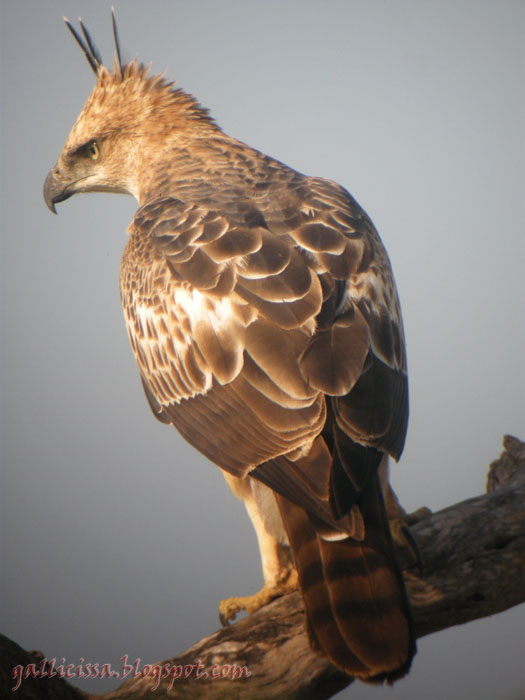
Crested Hawk Eagle Crested Hawk Eagle
Jerdon’s Nightjar spotted by Keith on a snag high up became our ninth night bird of the trip. That was again seen on day thirteen. A prolonged sighting of the same species in a low perch bettered this sighting three days later at Anuradhapura. Our last night bird for the trip was Common Barn Owl, a pair of which was recorded in a stake-out inside shrine in Polonnaruwa.

Concerted attempts at seeing Spot-bellied Eagle Owl, Brown Hawk Owl, Jungle Owlet and Sri Lanka Bay Owl failed on this tour. However, we came agonizingly close to seeing Sri Lanka Bay Owl, twice, but it just did not show up being vocal but staying uncooperatively hidden in dense foliage despite our best efforts to obtain an angle of view. This ultra secretive owl caused a mega twitch in Sri Lanka when it turned up in a daytime roost at Sinharaja in 2007. It is in public domain that at least one local bird watcher took a tuktuk tour all the way from Colombo to see it.

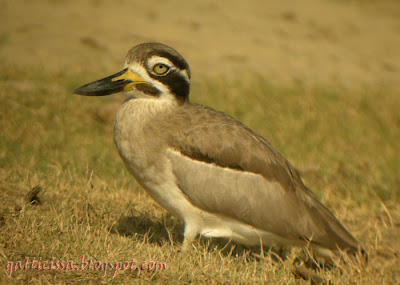
Great Thick-knee
Great Thick-knee on its knees
Our other birds of note recorded during the trip included Grey-headed Lapwing (vagrant & lifer for me seen at Yala thanks to US of Ceylon Bird Club who conveyed the news), Western Reef Egret (white morph one picked skilfully by Keith at Bundala, shown below), Legge’s Hawk Eagle (formely Mountain HE, great overhead views at Sinharaja), Chestnut-winged Crested Cuckoo (a lone individual outside a flock at Sinharaja), Fork-tailed Drongo Cuckoo (spotted expertly by Julie at Kithulgala), Black-backed Dwarf Kingfisher (seen & photographed at point black range at Kithulgala), Indian Reed Warbler (in song at Bundala), Slaty-breasted Rail (Scarce resident with possible migrant populations supplementing resident populations during migratory season, seen at Tissamaharama), White-naped Woodpecker (punctual!), Kashmir Flycatcher (at least 4 sightings with the first being of an adult male), Pied Thrush (great views at Nuwara Eliya) Common Ringed Plover (a scarce migrant, not too exciting to Keith), Dollarbird (seen thanks to G. de Silva Wijeyeratne at Kithulgala) and Eurasian Collard Dove (a scarce resident in Sri Lanka seen at Annaiwilundawa RAMSAR wetland, not too exciting to Keith). A Slaty-legged Crake at Sinharaja, seen only by yours truly, was the only bird species that eluded Keith.

Western Reef Egret - white morph
We had exceptional views of the ultra-elusive Sri Lanka Spurfowls when a female followed by a male were seen over five minutes, walking in the dimly-lit forest floor, totally unaware that we were observing them from a ridge higher up! Such heart-melting sightings of this game bird are rare, and this was one of the best views that I have had of it for quite a long time guiding an overseas birder. Before that we had brief view of it at Kithulgala. It was a case of BVD.

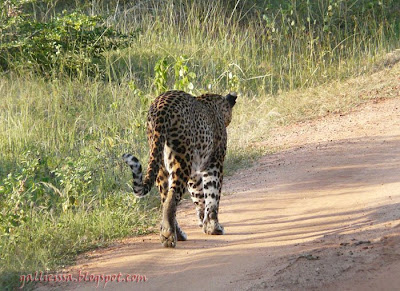
Moving on to non-birding matters, the Leopard shown below (same individual as in the previous post) was clearly our top non-birding highlight. We were the only jeep at the site when we found it. It was first sighted at 5.30 p.m., while resting in a shady spot near a water hole named rawung-wala (meaning circular water-hole) at Meda-para at the Yala National Park—the premier site for Leopards in Sri Lanka. The cat was about 25 m away when we found it first. Soon after we killed the engine of our jeep to observe it, the cat stood up and walked towards the track in front of us. It then continued to walk along it for a while like this, soon going out of view in the bend ahead.

Leopard at Meda-para, Yala National Park
We then approached it to find it again, this time within 5 meters or so from it, enabling us to photograph it at close range. Finally, after giving a good long glance at our jeep, it retreated into the jungle and disappeared out of radar.
Leopard at Meda-para, Yala National Park
More non-birding specials, we saw a pair of Barking Deers (Indian Muntjak) at Welimada. My previous sightings of this deer species has always been at the massive Wilpattu National Park. We exchanged glances with a pair of these before they retreated to the woodier interiors.

Monday, 20 October 2008

Sticky matters.


I led a 17-day "Christmas Bird watching Tour" in December, 2004, for a reputed British nature tour operator. Its ground handing was done by a local travel agency to which I freelanced at that time. This tour stays in my mind for a number reasons.

First, the unfortunate reasons:

1. Briefed and given in writing as a "mostly bird watching oriented tour," this tour had five English people that included:

i. A nature photographer with a keen interest in wild flowers.
ii. A walking enthusiast who just liked to keep on walking.
iii. A natural history enthusiast with a passion for photography and a passing interest in birds.
iv. A hardcore birder who was heavily into listing.
v. A person who didn’t fall into either of the above categories.

It was like a challenge that Donald Trump would have chosen for the final episode of the Apprentice. I did my best to juggle all the balls without dropping any. What can I say,  it was a good learning curve!

2. The Boxing Day Tsunami, which caused havoc killing over 40,000 people in Sri Lanka alone, happened during this tour. We were mopping up the montane endemics at the cloud forests of Horton Plains National Park—the tallest plateau in Sri Lanka some 2,100 m above sea level—when the killer tidal waves devastated the coastal lowlands. And we were to visit this area in two days’ time!

I had the tour rerouted thereafter to stay away from the affected lowlands. I also decided to spend more time in the unaffected endemic rich wet lowlands.

And now, the fortunate reasons:

1. More time in the wet lowlands didn’t harm our burgeoning bird list one bit. This was the first tour in which I showed the avian jewel Serendib Scops Owl Otus thilohoffmanni to an overseas bird watching audience, after its discovery in Jan, 2001. Needless to say, it was a momentous day for mankind!

2. I made a clean sweep all 33 endemic birds on this trip—for the first time having started my guiding career in January in the same year. As a budding bird guide, it was an important rite of passage.

3. An observation that I made at Sinharaja "world heritage" rain forest became the subject of my maiden paper to a peer-reviewed ornithological journal. It is—

Salgado, A. (2006). Some observations on the diet of Red-faced Malkoha Phaenicophaeus pyrrhocephalus in Sri Lanka. Sandy (UK): Forktail Journal of Oriental Bird Club. 22: 122-123.

Click here to download a PDF of it.

Anyway, what I am trying to get at like Sir. Humphrey Appleby is to correct an error that had slipped in the above article by me.

In it, I had a ‘giant stick insect’ preyed upon by a Red-faced Malkoha identified as Palophus sp (Order Phasmatodea) after comparing it with what I thought at that time to be a reliable source of reference.

On 14 October, 2008 its identity was corrected by a world authority on stick insects: Dr. Frank H. Hennemann from Germany, thanks to intervention by Dr. Priyantha Wijesinghe who is a Sri Lankan Entomologist/Systematic Biologist based in the USA.

Accordingly, it is an adult female of Phobaeticus hypharpax (Westwood, 1859).

The classification being:
Order: Phasmatodea. Suborder: Anareolatae. Family: Phasmatidae Subfamily: Phasmatinae Tribe: Pharnaciini.

A better view of the Giant stick insect. Note the rear left limb is a result of an optical illusion created by a limb like branch behind. The actual left rear limb was broken off by the time I took this shot as this was photographed after the above
Dr. Hennemann disclosed that the locality data for all but one of the specimens lodged in the world museums including the type specimen from which Westwood named this species bear nothing beyond "Ceylon."

Therefore, he, was quite happy to receive the locality data of my Phobaeticus hypharpax that eventually ended up in the gut of the above Red-faced Malkoha.

Very interestingly, on 15 October, a day after this e-mail communication, Dr. Hennemann had a revision of the very Tribe: Pharnaciini published in Zootaxa in the form of a 316 paged paper, which included, the above species.

The reference is:
Frank H. Hennemann & Oskar V. Conle (2008). Revision of Oriental Phasmatodea: The tribe Pharnaciini Günther, 1953, including the description of the world's longest insect, and a survey of the family Phasmatidae Gray, 1835 with keys to the subfamilies and tribes (Phasmatodea: "Anareolatae": Phasmatidae. Zootaxa 1906: 1-316 pp. Auckland, New Zealand: Magnolia Press.

According to the above, and as per a personal communication by Dr. Hennemann, in addition to the above species, Sri Lanka has one more species belonging to the tribe: Pharnaciini, which is Phobaeticus lobulatus (Carl, 1915). Its body length is 162.0 mm and is a very similar species to P. hypharpax, which has a body length of 185.0–236.0 mm. The former is only known from the female holotype with the locality data reading again as "Ceylon" only. So far, it has never been recorded since its original discovery in 1915 according to him.

By the way, the world’s longest insect, referred in the title of the aforementioned stick insect revision paper is (drumroll, please) Phobaeticus chani—Chan's megastick from Borneo—with a body length of 333.5–357.0 mm. Its overall length with the limbs stretched out is a whopping 567mm!

This is a completely new species described based on a specimen in the collection of a Malaysian naturalist and insect collector from Sabah Borneo, Chan Chew Lun, who had received it from a local collector. Dr. Philip Bragg named it in honour of Chan who had donated his world record holding megastick to the British Museum of Natural History.

If you are really into sizing up your megasticks, the former record holder for the world’s longest insect title based on body length was Phobaeticus kirbyi with 317.0mm., which is also found in Sabah, Borneo. So the newly described Chan's megastick is 40mm longer!

The former record holder for the overall length with the limbs stretched out was Phobaeticus serratipes distributed in Peninsula Malaysia, Singapore and Indonesia of which one has been measured at 555mm.

The new megastick on the block has beaten that record too by 12mm. However, this recorded would have been greater by 7–10 mm if the specimen of Phobaeticus chani donated by Chan Chew Lun had not been damaged according to Hennemann and Conle, 2008.

So no matter how you size up, the Malaysians get to retain the coveted world record title for the world’s longest insect by a long margin. I am sure Tabib, who is a regular visitor to my blog from Malaysia, will be proud about this.

I’d like to conclude this post by saying a big thank you to Dr. Hennemann for taking his valuable time to help with the identification of my megastick. Last but not least my profound gratitude is due to Dr. Priyantha Wijesinghe, for sending my images to Dr. Hennemann to seek his expert opinion and communicating to me the same and putting me in touch with such a world authority.

Wednesday, 24 September 2008

CSI

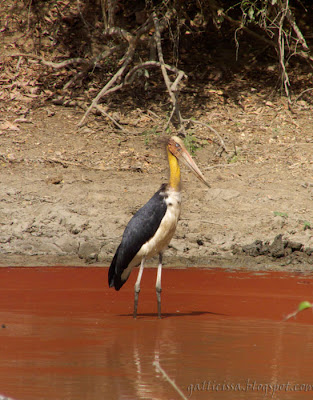
Lesser Adjutant at the Yala National Park
A serial killer in a pool of blood?

We arrived at this crime scene at the Yala National Park during the photography tour that I guided last month. The cold look of the murderer, the bloody scene and eiry silence; we could just about connect the dots. Was it as bad as it seems?

No!

The reddish hue in the water was painted by floral elements falling on it from nearby tree—Tamarind Tamarindus indica. Our prime suspect, the Lesser Adjutant, although has a criminal record of preying on unsuspecting birds, reptiles and small mammals, was innocent at this particular occasion.

Lesser Adjutant is a member of the Stork family and in Sri Lanka, it is mainly found in the dry zone where it is considered a scarce breeding resident. Its bare head almost like that of a vulture is an adaptation to deal with carrion, which account for its severe appearance deficits.

Monday, 25 August 2008

Pure Gold!

I bagged three golds during the Olympics.
I mean during the time when Olympics was on. They were

1. Dancing Dropwing Trithemis pallidinervis

Dancing Dropwing 2. Leopard Panthera pardus kotiya

Leopard 3. Serendib Scops Owl Otus thilohoffmanni

Serendib Scops Owl
They were seen on an 18-day photography tour from 2-19 Aug, 2008. That was with Thierry and Maree-Andree Becret and Michelle Gerner from France.

The first gold was bagged at the dragonfly-rich wetlands at Tissamaharama.

The second gold was won in a photo-finish during our very first game drive at Yala National Park—one of the top locations to see this big cat in the world.

We had this male Leopard for nearly 15 minutes with only a partial view of the head visible through the dead brush. It then rewarded our perseverance by coming out of its lounging spot to sit in a more open patch, affording us a brief moment of magic. After a brief show up, it retreated to same spot as earlier. About 10-minutes after, it again stood up, came out to the open, glanced at us and disappeared into the thick cover to the sound of camera clicks.

Being the only big cat, Leopard is the apex predator in Sri Lanka. And thanks to the protection afforded to Sri Lanka’s Yala National Park, especially to its prey species, Leopards are bolder in Yala. Therefore, daytime sightings are quite regular at Yala compared to other parts of Sri Lanka, and outside it, where human-related pressures have pushed them to be nocturnal and ultra-secretive.

Finally, our the third gold was bagged outside Sinharaja ‘world heritage’ rain forest. This one, of course, was very special because it allowed my first proper photograph of this avian jewel taken at nighttime—when it is at its element. Click here to see a picture of it taken by Peter Kaestner in Sep., 2007, which inspired me to buy my Panasonic Lumix FZ-18.

The Serendib Scops Owl was discovered only in Jan, 2001, and formally described in June, 2004.

It was first seen after its discoverer, Deepal Warakagoda, had been looking for it for 6 years since first hearing its call in 1995. The last endemic bird discovered before this was the Sri Lanka Whistling Thrush - 132 years ago in the colonial era of natural history explorations, which made this discovery all the more special.

One of the reasons why it eluded bird watchers for so long is due to its unobtrusive and ventriloquial call, which is so simple in form and so infrequently delivered with a note length of 0.3 seconds repeated after 15-29 seconds. This makes it difficult to determine that it is originating from a bird, especially when it is mixed with the cacophony of calls that dominate the rainforest soundsape at night. Before its discovery, even some of the senior Sri Lankan naturalists had suspected its call to be of an amphibian of an unknown origin.

Big misktake!

This initial confusion over its call is not surprising considering that the island is rich in amphibians with over 100 new species discovered since the mid 90s. In fact a tree hole-dwelling frog species described in May, 2001, just four months after the discovery of the owl, named Nagao’s Ramanella Ramenella nagaoi, has almost identical call note to the Serendib Scops Owl that it has fooled me several times when I have been all ears trying to pick up the monosyllabic call of the Serendib Scops Owl from the other rain forest noises.
Serendib Scops Owl is recorded only in 5 lowland rain forest sites in Sri Lanka and due to its narrow range small numbers—estimated at 200-250 individuals, it is categorized as “endangered” in the IUCN of Red List of Threatened species.

Its vernacular name’s "Serendib" part is derived from a 14th century name of Sri Lanka used by the Arabs named "Serendip" (the "dip" part, is appropriate considering some birders dip out on this!) in place of the local name that existed at that time: Sihaladeepa – the island of the Sinhala people (note: some say that it derived from Swarnadeepa, which means the island of gold/gems).

The word Serendipity was coined by English novelist Horace Walpole (1717-1797) in a letter written in 1754 based on a Persian fairy-tale: The Three Princes of Serendip, the heroes of which "were always making discoveries, by accidents and sagacity, of things they were not in quest of."

The serendipity of its discovery, being endemic to ‘Serendib’ are why the new Owl was appropriately christened Serendib Scops Owl. The species etymology thilohoffmanni is to honour Thilo Hoffman a top conservationist who spearheaded a campaign to stop a government endorsed mechanised logging project carried out with the help from a Canadian logging company from 1971–1977 at Sinharaja rain forest, where the discoverer first laid eyes on this owl. By the way the logging activity was carried out under the euphemism “selective logging."

Serendib Scops Owl is so new that it is not even featured in the first comprehensive modern field guide of the birds of Sri Lanka “A Field Guide to the Birds of Sri Lanka” by John Harrison (1999) - ISBN 0-19-854961-X. 240 pages, 48 colour plates, 2 maps, 200x140 mm. £39.95.

After 9 years of publication, Oxford University Press, UK is now planning to do a second edition of this highly popular field guide to the birds of Sri Lanka. I was approached by OUP, UK for a review for the second edition, which I did to earn my reward of £50 worth of books of OUP in addition to a free copy of the second edition of the Sri Lankan Bird Guide when it is published!. For the immediate reward I picked
“A Field Guide to the Birds of Borneo, Sumatra, Java, and Bali” by John Mackinnon and Karen Phillipps (1993). ISBN 978-0-19-854034-2. 510 pages, numerous colour plates, maps, line drawings, 200x140 mm. £39.95. Click here for link.

and

“Dragonflies through Binoculars A Field Guide to Dragonflies of North America” by Sidney W. Dunkle (2000. ISBN 978-0-19-511268-9. 368 pages, 381 color illus., 216x138 mm. £17.99. Click here for link.
the books
Yes, this was slighly over their budget but the nice people at Oxford University Press made no fuss over it. Both books arrived in fine condition, and I am eagerly consuming them. The bird guide is quite timely as I am planning a private trip to Borneo. The dragonfly book is great—I think every American dragonfly enthusiast ought to have it.

Sunday, 27 July 2008

Steve in the fast lane


The sun was still struggling to appear through the thick carpet of grey clouds when we made our first leg stretch. We were on the way to Sinharaja rain forest. My client was Steve Lane—a keen British birder. With memberships in the British dragonfly society and the British butterfly conservation society, Steve was actually a bit of an all-round naturalist. He had arrived the day before and was based in the luxurious Blue Water Hotel in Wadduwa in the west coast when I picked him up.

On the way to Sinharaja we made a series of wayside stops. This was done just in case we run into 'rain forest weather', as the skies were gloomy. In such conditions, birding can prove tough, especially inside the forest. Our strategic roadside stops brought us some good birds namely, Layard’s Parakeet, Sri Lanka Hanging Parrot, White-browed Bulbul, Small Minivet, Orange Minivet, Crested Treeswift, Indian Swiftlet, Indian Robin, Yellow-billed Babbler, Southern Coucal, Long-billed Sunbird, Purple-rumped Sunbird, Brown-headed Barbet, Yellow-fronted Barbet, Sri Lanka Green Pigeon, Jerdon's Leafbird, Black-hooded Oriole, Green Imperiel Pigeon, Black-rumped Flameback, Crested Serpent Eagle, Crested Hawk Eagle.

All of these ensured that we met our RDA (recommended daily allowance) of birds even before reaching the ticket office of the forest.

Our jeep driver Ranji was awaiting our arrival at the ticket office, and soon after obtaining our permits and meeting our mandatory local guide, Dharshana, we drove up to Martin’s for a quick cuppa. Just as I experienced on the previous trip, the forest was absolutely teeming with life. I think the heavy rains we had in the last several days had helped. Despite the early signs of gloomy conditions, the weather held up when it mattered, and we didn't have to use our brollies even on a single occasion.

On bigger tours we can have luxury of taking this easy as often we have multiple chances to see thing during the course of the trip. However, on day tours, we do not have that freedom, so I try to show things to my clients on the first opportunity itself.  This worked well on this trip too. To give you a classic example, soon after entering the forest, we heard a Sri Lanka Blue Magpie at the back. It was tempting ignore it, hoping that we will encounter it later on during the walk. But, I decided go for it. And it turned out to be a good call as the sighting we had of it proved the only one for the whole trip. It was also Steve's top highlight of the trip, which made the decision to go for it all the more special.

So here's my Donald Trump like big statement:

Never put off things on day tours—there may be no second chance!

We were extremely lucky to encounter three full-blown mixed-species bird flocks, which afforded exceptional views of all our flock-associated targets in quick order. The first of this was had near the very hotspot we encountered the flock in making emma happy part 2. As in that occasion, we ran into minimal pains and the birds observed in this feeding frenzy included Orange-billed Babbler, Sri Lanka Crested Drongo, Malabar Trogon, Red-faced Malkoha, Velvet-fronted Nuthatch, Bar-winged Flycatcher-shrike, Dark-fronted Babbler, Square-tailed Black, Yellow-browed Bulbul, Black-capped Bulbul, Common Iora, Legge’s Flowerpecker, Orange Minivet, and Black-naped Monarch.

Soon after the flock activity subsided, a pair of ultra-elusive Green-billed Coucals obliged to give jaw-dropping views in the scope. I was able to quickly capture my best record shot of this scarce endemic. This was my top highlight of the trip.

Our second flock was observed close to the spot we had our flock in MEH Part 1, and it had, among other things, a pair of Sri Lanka Scimitar Babblers. A Brown-capped Babbler was seen briefly by me but eluded Steve. One of the highlights of this flock was a stunning Malabar Trogon male, which waited long enough to offer prolonged views in the scope, and the digiscoped photo on top right.

This juvenile Legge’s Flowerpecker was safely placed in a mesh of branches that would have proved tough for an Accipiter to get at. It was awaiting parental attention.

Legge's Flowerpecker juvenile
Our other birding highlights included Sri Lanka Junglefowl, White-faced Starling, Sri Lanka Myna, and Emerald Dove. After a late lunch and a cuppa, we returned to the Blue Water Hotel by 7.30 p.m. On the way back, Steve braved to try Pol-roti with improvised-explosive Lunu-miris. Lunu miris is a chillie paste made with (a choice of) chillies and onionons; adding lime in the end. This version was made with Thai pepper. Putting them to his mouth, and after regaining his breath, Steve told me that it was the hottest thing ever tasted!

Non-birding highlights

Mammals:

Purple-faced Leaf Monkey Trachypithecus vetulus—a troop of this endemic folivorous primate afforded good views.

Layard’s Squirrel Funambulus sublineatus—in mixed species bird flocks as they usually do.

Giant Squirrel Ratufa macroura—following birds in the second flock encountered.

Butterflies:

Common Imperiel Cheritra freja—not a common species in Sri Lanka as the name suggests. We had brief but good views of this lycaenid butterfly sporting a long tail, which was a first for me at Sinharaja.

Common Imperiel
Blue Admiral Kaniska canace—we had good long looks of an individual settled on a broken concrete bridge. This again was my first sighting of this striking blue butterfly at Sinharaja.

In addition to the above, we had Red Helan, Cruiser (both sexes), Clipper, Sri Lanka Rose, Giant Crow, Tailed Jay, Bluebottle, Blue Glassy Tiger, Common Glassy Tiger, Plum Judy, and Glade-eye Bushbrown.

Dragonflies:

Newly-discovered Lyriothemis sp.—we had good looks of this rain forest dragonfly, which awaits formal description. Here is the female.

Lyriothemis.sp - female
Fruhstorfer’s Junglewatcher Hylaeothemis fruhstorferi fruhstorferi—we encountered this highly scarce endemic on several occasions including a pair close together.

Fruhstorfer's Junglewatcher
In addition to the above, we had a few of the usual suspects including Shining Gossamerwing, Spine-tufted Skimmer, Black-tipped Flashwing, Marsh Skimmer and Green Skimmer (in tandem), and Blurry Forestdamsel.

Reptiles:

Sri Lanka Whistling Lizard Calotes liolepis—we had two encounters of this rare endemic agamid lizard. The one was when it was found on a lichen-covered wall to which it was merged well as shown here.

Sri Lanka Whistling Thrush
Green Forest Lizard Calotes calote—this young male wearing a fresh coat of skin looked to be at the prime of its youth.
Green Forest Lizard young male at itsbest years
Other reptiles seen were Common Skink, Kangaroo Lizard, and Sri Lanka Keelbacked Water Snake.

Friday, 18 July 2008

making emma happy - part 1

Emma and Alex were on the beach-leg of their Sri Lankan holiday when I picked them up from the Bentota Beach Hotel (on 8 July) for a 2-day trip to the Sinharaja rain forest.

On the way, as usual, we had several wayside birding attractions. The first was this juvenile Crested Hawk Eagle sitting on a post in good light. The picture below was a digiscoped one (using Kowa TSN 823 scope with Nikon Coolpix 4500 camera fitted with custom-made adapters).


Crested Hawk Eagle juvenile
A distant blob on a power cable at 30 times zoom realized into another crested type—this time, a male Crested Treeswift. Nearing the ticket office in Sinharaja, our journey came to a stop again when I picked up this False Lantern-fly Pyrops maculata glued vertically to a tree trunk, which was our first real rain forest highlight.
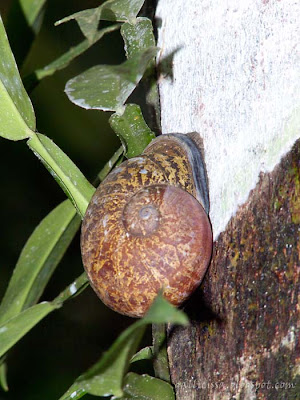
False Lantern-fly This endemic land snail Oligospira sp.—possibly waltoni, didn’t hold us for too long. And we reached the ticket-office to get our permits. Awaiting our arrival at this point was Ranji, a local jeep driver, to shuttle us 3km up a very bumpy road to our rain forest accommodation that faces the primary forest.

Oligospyra - land snailAfter obtaining our permits and meeting our local guide, Suda, we drove up to Martin’s Simple Lodge, our overnight accommodation. We had to take the old and longer route as the shorter one that we used on my visit in March had become impassable due to heavy rains.

After reaching our accommodation, we enjoyed a cuppa at the lounge area, enjoying views of the lush scenery in front. A male Blue Mormon Papilio polymnestor butterfly breached our personal pace several times, coming within touching distance. A Yellow-fronted Barbet perched atop a tall Shorea megistophylla tree in front, becoming the first endemic bird to be scoped. And then, a noisy flock of Sri Lanka Mynas vied for our attention, evicting the barbet. That was endemic bird no. 2, and the scope needed very little adjustment. A Pale-billed Flowerpecker waited just long enough to reveal all 8cm of itself. A White-faced Starling proved the endemic no. 3.

We detached ourselves reluctantly from such easy pickings to go on our first proper walk. Blue skies greeted us above; we were told that was the first time in 4 days of heavy downpours.

Emma broke to me that she only needed two things to make her happy:

1. Seeing a Sri Lanka Blue Magpie
2. Not getting bitten by a leech.

In contrast, Alex having read biology for his degree and having volunteered field work in the South American rain forests, had a more daunting list, which included a mixture of endemic birds and natural history specials.

We had a promising start with dragonflies: Green Skimmer Orthetrum sabina sabina, Asian Pintal Acisoma panorpoides panorpoides, Wall’s Grappletail Heliogomphus walli and a pair of Marsh Skimmers Orthetrum luzonicum reminding us the importance of walking slow in the forest.

Suda at his usual best, dazzled us by spotting this beauty in the form of a Five-bar Swordtail Pathysa antiphates, which was sitting on a Dicranopteris linearis (Old World Forked Fern; Kekilla in Sinhara).

Five-bar Swordtail
A Tree-climbing crab Ceylonthelphusa scansor was found dead. A Kandian Day Gecko Cnemaspis kandiana and a Green Forest Lizard Calotes calote delayed our 200m march from Martin’s to the barrier gate further.

Soon after we entered the forest officially, Suda was at his element once again spotting this Common Brozeback Tree Snake Dendralaphis tristis resting on a tree fern.

Common Bronzeback Tree Snake
A vocal pair of Square-tailed Black Bulbuls sounded as if they were ready to nest again for this year. This was confirmed by Alex, who saw one with nesting material. A few Black-capped Bulbul and Yellow-browed Bulbuls were seen soon after.

Square-tailed Black Bulbul with nesting material
The butterfly action inside the forest was also good as expected after rains. A Clipper Parthenos sylvia descended to the path to tease us before veering off. A Sri Lanka Birdwing Troides darsius female kept to the upper levels, while a courting pair of Tree Nymph Idea iasonia were busy doing a delicate aerial dance. A Red Helan Papilio helenus was on a non-stop flight along the track.

An Indian Skipper Frog Euphlyctis cyanophlyctis spotted by Emma was reining in a puddle on the track that almost never go dry.

Indian Skipper (Dhoni)Frog
A gaudy male of the dragonfly, Spine-tufted Skimmer Orthetrum chrysis was not too far, making regular sorties from a low twig.

After we had almost reached the point, where I was trying to reach on this pre-lunch session, we chanced upon a mixed-species bird flock. A half an hour vigil at this point, yielded our targets in quick order, with Orange-billed Babbler, Legge's Flowerpecker, Ashy-headed Laughingthrush, scope views of two pairs each of Red-faced Malkoha and Malabar Trogon , several Sri Lanka Crested Drongos, a lone Lesser Yellownape, five Orange Minivets, and a few of the bulbuls all making appearances.

A juvenile Tickell’s Blue Flycatcher was also seen here; it didn’t appear to be part of the big flock. By the time we reached Martin’s for lunch, our hunger index— counted in the ascending scale from 0-10—had reached an-all time high of 8.5 for some of us.

Why we went for an extended pre-lunch session was realized 15-minutes into our post lunch walk as the heavens really opened as it is so typical at Sinharaja. It necessitated a hasty retreat to a shelter nearby. This was not before we bagged two more dragonflies to our growing tally in the form of a Shining Gossamerwing Euphaea splendens and this beautiful Amber-winged Glider Hydrobasileus croceus.
Amber-winged Glider
Alex picked up a raptor just as we have reached the shelter. A close inspection revealed that it was the Crested Hawk Eagle no. 2 for the day. When the rains eased off after about 30 minutes, a couple of Green Imperiel Pigeons arrived at a dead tree to give decent views. They were soon outnumbered by a flock of 11 Sri Lanka Green Pigeons that came to share the same tree.

We resumed our walk when the rains stopped. A call of a Sri Lanka Blue Magpie filled the air. That helped to locate it, and Emma was happy. A Spot-winged Thrush came to the track to find a last meal. A Sri Lanka Junglefowl male too came on to the track.

It turned overcast again affecting the light and visibility prompting us to make a slow retreat to our base. A troop of Purple-faced Monkeys Trachypithecus vetulus proved our last highlight of the twilight, before we reached our base for a good hot water shower, drinks, day’s log and dinner to end a splendid day-1.

The day 2 will continue soon.

Related posts:
making emma happy - part 2
Related Posts with Thumbnails