Showing posts with label Blue Whale. Show all posts

Wednesday, 27 June 2012

Guiding Kate and John Holland

20 February to 5 March, 2012, saw me guiding a 15-day wildlife tour with John and Kate Holland, from England. Both were keen birders, and this was their first visit to Sri Lanka. Kate sported the latest Swarovski SLC 42 HD binoculars, which were superb in clarity. A birthday gift from John, it was on its first overseas trip.

Our final trip list of birds stood at 236 species and that included all 33 endemic birds and 10 out of the 15 resident night birds. Our top wildlife highlights included a couple of Leopards at Yala and several Blue Whales off Mirissa. The photos below show these highlights and more.

Lesser Adjutant

We saw this lone Lesser Adjutant at the Yala National Park, and it proved to be the only sighting of this rare resident bird for the whole trip. 


Asian Paradise Flycatcher

We had this species at several locations, and this individual obliged outside the Udawalawe National Park. The white coloured males of this species comes all the way from Northern India during the migratory season. I usually get one of these turning up in my home garden, but in the last season I had none.


Asian Brown Flycatcher

Another regular migrant, Asian Brown Flycatcher usually likes tops of trees with ample lighting. When we found this individual, we were on a second floor of a building, and from our position it presented us with nice eye-level views. 


Sri Lanka Blue Magpie

Some of the Sri Lanka Blue Magpies at Sinharaja are quite confiding. This one came to land on my scope, when we were having a break near the research station.


Here's a close up of his head. 


Sri Lanka Frogmouth

This juvenile Sri Lanka Frogmouth was huddled together with its farther at Sinharaja rain forest. It was too close for my lens.


The Blue Whale


We had aout fifteen sightings of Blue Whales, consisting of about eight individuals. This was one of them with a limora fish haning on its tail. The whale watches approaching from behind, scared it off.


The clay girl

At Tissa, this girl is the youngest member of a family that engage in pottery. Her play area borders the Tissa wewa, where we go birding. She used to have a pair of Indian Scops Owls in her garden. But as of recently the owls have vacated the roost.


Leopard

This female cub gave us prolonged views at Yala. For a good length of the time, we had it all for ourselves, which was nice. I hate the big crowds and traffic jams at Yala.


Asian Groundling

We saw a good array of dragonflies and this Asian Groundling gave an easy photo opportunity. 


Saturday, 30 April 2011

Owls, Leopards, Blue Whales, and Rapacious Flangetails

I am back after leading several exciting bird and wildlife tours.

My last tour for the season ended was a 15-day Natural History tour from 9 to 23 April, 2011 with Barry Barnacal, Gary Bellingham, Katrina Hay, and Andrew Vinson from the UK. The three gentlemen of this group were very keen photographers, and they carried serious photo gear, including Canon EOS 1D Mark 4s and lenses that ranged from 100mm macro to 500mm telephoto.

They came to me through a referral by Barry’s pal David Clugston—an avid birder and a worldlister with nearly half the world birds in his tally; he did an Absolute Birding tour with me in November, 2009. David was a pure birder, and did not do any photography while in Sri Lanka, opting just to watch birds and finding more of them. This explains why were able to rake in a massive 14-day tally of 252 species of birds, including all endemics.

The Brown Wood Owl Strix leptogrammica that I discovered thanks to a mobbing party of birds at Welimada.

Coming back to this tour, it was designed to focus on four aspects: birds, Leopards, Blue Whales, and other natural history.

After arriving in Sri Lanka, Barry, a former wildlife tour leader, wasted no time in briefing me that he and his group were not like their good friend back home! And that they certainly did not need to end up with a huge triplist. So, for them the success of the trip did not depend on making a clean sweep of special birds that most birders come here to see.

One of the main reasons why my visitors chose to visit Sri Lanka in April was to improve their chances of seeing the Blue Whale, as it is arguably the best month to see it, with almost a 100% success rate reported by whale watching operators. April also happens to be one of the best months for observing dragonflies and butterflies in Sri Lanka, as it sees most seasonal specials taking
wing. Being the tail end of the migratory season, April is not bad for birds either. And April is certainly not bad Leopards, which can be seen year round at Yala. So, the timing of the visit fitted perfectly with the broader requirements of the group.

So, with this rambling preamble, you may want to know how we fared.

Not too badly.

We ended up seeing 223 species of birds.
These included all 33 endemics and 10 out of the 15 resident night birds. And we bagged four Leopards at Yala, and four Blue Whales in the big pond 12 nautical miles off Mirissa.

Yes, it was real bagful!

As it is usual for April, we had good “viewing and photographic weather” in the first half of the day, with rains experienced during most afternoons. Which gave a lot of siesta time. This provided a nice balance because we found ourselves getting up early to take advantage of the conditions. And chill indoors during afternoon rains. Daylight was early, with the dawn chorus begining roundabout 5.30 a.m. At Sinharaja, the Blue Magpies coming to clean up the moths under lights at our lodge were punctual at 5.45 a.m. on both mornings we were there.

Gary wrote to me after the trip to say that he downloaded some 80GB of photos! I am sure others were not too far behind.
I too clicked a few here and there. Some of them are shared below.

Serendib Scops Owl Otus thilohoffmanni


I found a single bird in a day roost on day 1. Which, needless to say, got the tour to a terrific start. On day-2, there were two birds in the same roost, presumably male and female, and the picture above shows that.

The iris colour of the males of this owl is orangey, and yellowy in the females. After studying a picture taken by Andy, which he shot when the birds had briefly revealed a bit more of their eyes, I came to the conclusion that the top bird was probably a male, and the other, probably a female. The latter, as captured in this picture, was a bit more darker than the top one in real life too. Other than the eye colour, and differences in vocalisations of the two sexes, published literature on Serendib Scops Owl do not reveal of any diagnosable morphological features proving sexual dimorphism in this species.

Leopard ("Sri Lanka Leopard") Panthera pardus kotiya


Our first sighting was of two adults guarding over a Sambar Rusa unicolor carcass. By the time we visited the park, news of these two Leopards seem to have spread fast, judging by the traffic of safari jeeps. The Leopards were very much hidden in the vegetation and were not too photogenic. Shown above is one of the two Leopards taking us in amidst all the commotion created by the jeeps muscling for better viewing positions.

Soon, we wisely left the big traffic jam to look for other things.

With no local guide available because of new year holidays, I moved to the vacant front seat of our jeep. After finding Brown Fish Owl in a day roost, we arrived at a spot named Gonalabbe Kalapuwa, where Gary spotted a distant Black-necked Stork. After that we drove around for a while stopping frequently for various subjects.

And about an hour later, we found ourselves back at the site we saw the big stork.

Pausing there, we hit gold between 5.19 to 5.21 p.m. This was when Garry expertly spotted a Leopard ambling through the low vegetation towards the road where we were parked.


We backed off a little to get a clearer view of it. There was not a single jeep nearby, and we had this Leopard all to ourselves in the first minute or so.

It was our Leopard!

When it looked as if it was just about to cross the road behind our vehicle, a jeep came rushing behind us, apparently unaware of the big cat. The team wisely signaled to that jeep and brought it to halt just in the nick of time, before it could get too close to disturb the animal.

Everything seemed to work really, really well.
Seconds later, as expected, the Leopard nochanatly crossed the road between the two jeeps.


A moment of magic!


Had our four Mark 4s fired live GPMG rounds, this Leopard would have ended up in a pretty bad shape!


That’s why I like photography; it is such a bloodless sport.

Blue Whale Balaenoptera musculus


Travelling 12 nautical miles into the deep blue seas off Mirissa in beautiful weather, first signs of a Blue Whale were detected when we saw their diagnostic vertical blows. (On the whale watching trip done in April, 2009 with Peter Kaestner, as blogged by me before, we had first signs after travelling just 5.5 nautical miles.) After approaching this sighting, we detected two individuals moving together. Only one of them was noted by to lift tail fluke in its diving sequence. 


The above shows the two individuals seen closely. Two more were found farther away at the same time.

Compared to their massive body size, the Blue Whales are endowed with puny dorsal fins, which can be seen above. They are located roughly about three-quarters along the length of the body, and are visible when they are diving to reach deeper waters after breathing near the surface.

Indian Fritillary Argynnis hyperbius


We encountered this thirsty highland butterfly at Hakgala. It was very pretty in the underside.

Rapacious Flangetail Ictinigomphus rapax


I spotted this large dragonfly at the Bundala National Park in a patch quite far from freshwater. It was very much distracted by its large prey. Taking advantage of that, we photograpjed it from our safari jeep.

Sri Lanka Tree-climbing Crab Perbrinckia scansor


Katrina spotted this one and only tree-climbing freshwater crab at Sinharaja in a spot not too far from where we found the same species in the Absolute Birding tour that I guided in April, 2010 with Dr. Gil Ewing from the USA.

More posts of this tour will follow.

Friday, 8 May 2009

Bagging the Blue Whale


Sri Lanka is one of the best places to see the Blue Whale Balaenoptera musculus—according to Marine Biologist Dr. Charles Anderson. He is based in Maldives since 1983 and his research on whales in the Indian Ocean led him to believe that Blue Whales should be present off the south coast of Sri Lanka in April—a hypothesis he confirmed with pelagic trips done in April 2007 and 2008. In the last of these trips, he has had Blue Whales on all 14-days he spent looking for them, with an average of 4.5 sightings per day!


Sri Lanka, as you may be aware, is a continental island, which had been connected to India for much of the geological past through epocs of lowered sea levels. The continental shelf that it sits on begins to slope after 3 nautical miles off Dondra in the southernmost tip of Sri Lanka, which is also the southernmost point of the whole of Indian subcontinent. Because of this oceanographical reality, ships plying between east and west have to circumnavigate Sri Lanka, passing by Dondra instead of cutting across the northern Sri Lanka, where seas are shallower.

According Dr. Anderson, the cetaceans migrating between feeding areas in the east and west of the Indian Ocean also take the same route as the ships. This, according to him, happens between December to April—with clear peaks in December and April.


With this beging the state of affairs Peter Kaestner, who at present is the world’s 7th ranked birder, came to Sri Lanka on a 9-day holiday with his family in early April—with wathcing the Blue Whales being central element of the tour. According to the latest numbers listed in Surbirds.com, Peter has got a whopping 8,180 species of birds, out of 10,000 or species found in the world.

In 1989, he was fortunate to discover a bird species entirely new to science, from Columbia, which came to be known as Cundimarca Antpitta Grallaria kaestneri.


This was Peter’s second trip with me. The first was in Sep, 2007 when he came on 3-day weekend birding trip wanting to clean up 8 Sri Lankan endemic birds missing in his world bird list. Before this, he had been on a solo birding visit to Sri Lanka in 1981—round about the time when I was getting ready to go to the kindergarten!

In the 2007 trip, we managed to see 7 of those 8 targets: Serendib Scops Owl, Ashy-headed Laughingthrush, Red-faced Malkoha, Sri Lanka Spurfowl, Green-billed Coucal, Sri Lanka Bush Warbler and Sri Lanka Whistling Thrush—the toughest endemics, with two being in the “endangered” club.

The one we missed out was the not-so-elusive Brown-capped Babbler. This miss was because some of those rare species we sought were found in two ecological zones – the lowland wet zone and highland wet zone respectively, and because some of them being rare birds didn't show up easily, demanding more time.

Oh! And because, we encountered foul weather throughout in this particular tour due to the period of travel coinciding with a monsoonal high.


We commenced our 2009 trip in the southeastern Sri Lanka with two game drives to the spectacular Yala National Park hoping to go 1-nil with the Leopard. Unfortunately, we drew a blank with this big cat this time.

But, to make amends, I managed to find the Brown-capped Babbler!

Next came the pelagic leg—the most important one—of the trip to see our main quarry, the Blue Whale.

Having started from Mirissa at 7.15 a.m., on 5 April, we had the first evidence of our first Blue Whale after travelling 4 nautical miles, towards—well—Antarctica. It was a distant but unmistakable view of a characteristic high vertical blow.

Tickable views were obtained around 5.5 nautical miles off. We had at least 4 good sightings of just an individual after we reached the hotspot and started looking intently. We knew it was the same one as it had a characteristic white marking in the tail, which showed up clearing with each surfacing. Here's a crude video of our Blue Whale. I should stress the word: crude.


At one point it was seen as close as 20-30m from our boat as it surfaced to breathe, almost taking our breath away. It performed well for us as well as for people aboard 3 other boats that converged at this hotspot for the same purpose. One of those was full of familiar faces with members of a local nature club. They, at one point, were pretty close. By the way, the terra firma you see in the picture below is Sri Lanka, just in case if you are wondering whether it is Antarctica.


I did not take my dSLR for this trip. That's because all my lenses are macro types. And the Blue Whale was not really a macro subject.

So, all these pictures shared here were taken by my trusty Panasonic Lumix FZ-18, which is also the model that Peter currently uses as his carry on camera. I bought mine after seeing this amazing shot he got by photographing the Serendib Scops Owl at night (using an older Lumix version).

A day trip we did following this to Sinharaja rain forest to see Sri Lanka Scaly Thrush and Crimson-backed Flameback was successful. The former responded aggressively to my rendition of its contact call by flying straight towards my head, indicating it may be busy nesting. These two birds together with Sri Lanka Woodshrike and Common Hawk Cuckoo seen on this tour by Peter went as ‘bank birds’—ones which do not get added to his bird list immediately as the ‘Clements' checklist’ that he uses to keep track of birds species seen, has not yet accepted these recent taxonomical splits/potential spits as valid species yet; and now that he has seen them, they would increase his tally once they are accepted as valid species in the future.

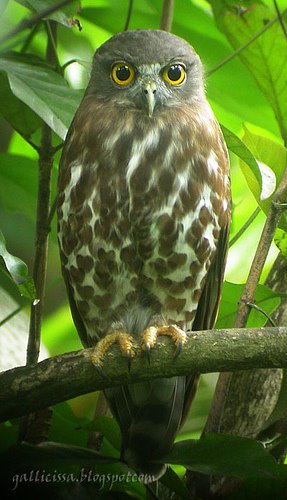
I nearly forgot, Peter became the first birder to see my garden's roosting Brown Hawk Owls.

Brown Hawk OwlA related post: Finding lifers for Peter Kaestner
Related Posts with Thumbnails