Showing posts with label Macro Monday. Show all posts

Saturday, 15 January 2011

Announcing a Name Change of a Planthopper

When I last blogged about this planthopper, it was known as Centromeria viridistigma.


Not anymore.

According to a recent revision done by Dr. Zhi-Shun Song and Al-Ping Liang at the Chinese Academy of Sciences, it now goes as Truncatomeria viridistigma. The new genus is endemic to Sri Lanka and is a monotypic one, which means there is only a single species that belong to it, which is T. viridistigma.

This revision appeared in Zootaxa 2740 in 2011 (in pages 24-34), under the title, "Two new genera and two new species of Oriental dictyopharid planthoppers (Hemiptera: Fulgoromorpha: Dictyopharidae) from Sri Lanka and southern India." Here's a preview of this paper.

The above photograph is published in it with due credit to yours truly.

According to this paper, the new genus name is a combination of latin “truncat” plus the suffix “meria”, which means the head is more or less truncate at apex.

I photographed this planthopper in December, 2008 at the Sinharaja rain forest while guiding Dr. Richard Bishop and his wife Anne Bishop from Kenya. Its identity was narrowed down with a question mark as Centromeria viridistigma with the help of Dr. Priyantha Wijesinghe and Jerome Constant of the Department of Entomology, Royal Belgian Institute of Natural Sciences, Brussels, an expert on Hemiptera: Fulgoromorpha. This helped Dr. Song to find my image in the web. He then sought my permission to use this image for his article announcing this revision.

It is my first photograph to be published in this top zoological journal.

(Edited on 5 January, 2012.)

Monday, 23 November 2009

Macro Monday

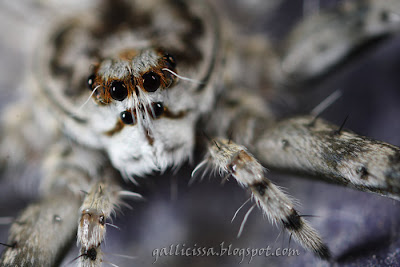
Plexippus petersi

Plexippus petersi ready to pounce. This is a common jumping spider at my house. It is widely distributed in Asia.

MM HQ is at Lisa's Chaos

Monday, 7 September 2009

ID challenge-1

ID challenge

This is a

A. fish

B. tadpole

C. gecko

D. snake

E: nymph of a dragonfly

The first person to comment the correct answer will receive a MP3 audio recording of the song of the Spot-winged Thrush, which can be used as a ring tone in your mobile phone.

Macro Monday HQ is at Lisa's Chaos

Monday, 27 July 2009

Macro Monday

There is a small patch of rain forest just an hour’s drive from my place, named Meethirigala reserve. This forest has been spared thanks to a forest buddhist hermitage situated in it. I did a half a day trip to this secondary rain forest yesterday with some bird and bug friends: Ayanthi (organiser), Cheryl, Rohantha and Sandaruwan. I was hoping to focus just on birds (determined not to take the camera gear out of the bag), but soon, had to abandon this idea as the majority favoured photography, and I found myself copying their behaviours. Insects were sluggish due to overcast and early morning conditions, which made their photography more profitable. I am sharing here some of them that cooperated.

First, I start with a critter that have no idea of; if you do, please let me know.

Spectacular bug, thanks Melli for the name This looks like a type of a builder wasp

builder wasp? I was crawling on the ground when I shot this fly and got a leech on my belly.

the fly
A solider beetle.
Soldier Beetle
And God knows what this is!

?A preying mantis species. Doug, please help

All of these were photographed at life size or above life size. Most of them were spotted by Cheryl who had a good eye for bugs. She also impressed me immensely with her ability to share fish sandwiches and chilled drinks at regular intervals.

Our top birding highlight of the trip included Common Hawk Cuckoo, which was picked by Ayanthi. This bird is not common here as the name suggests. A female Black-naped Monarch nest-building by the roadside was also nice. An endemic Green-billed Coucal was heard.

Our top butterfly highlight was the Southern Duffer, which was expertly spotted by Rohantha while being glued to a Elaeocarpus serratus tree (Veralu in Sinhala), drinking its sap that was oozing out of a wound in the bark. Later on, Ayanthi announced the second Southern Duffer and a third Southern Duffer joining in there while we were getting on with other things. It turned out to be an all-male drinking party. It was quite a good sighting of this rare butterfly found in forests with bamboo undergrowth. A Common Evening Brown was also seen there at the start. Ayanthi took good pictures of the Southern Duffer and Common Evening Brown together. A perched Banded Peacock spotted inside a bamboo thicket by me was too difficult to photograph but a good one for the trip.

The three males thought it was fit to copy the sap-seeking behaviours of the Southern Duffers, and we paused at the Hanwella Resthouse for some Arrack. The rice and curry that followed tasted good.

Macro Monday HQ is at Lisa's Chaos.

Monday, 13 July 2009

Macro Monday

Diya Na

Among the numerous meanings of the word flush there are two to do with botany. The fresh growth of young leaves in trees and such newly emerged leaves are referred as flush (as a verb and as a noun). These are not commonly known even by native English speakers and some of them flush at times hearing it from me for the first time. I think this word is quite appropriate to describe the young leaves of trees in the rain forest that appear in red or shades of red.

Nathaniel Dominy of the University of Chicago and his colleagues pooled existing information on the leaves of hundreds of tree and shrub species from Central America, Africa and South-East Asia and discovered that in as many as 62% of them, young leaves tend to be coloured anything from pale pink to deep red.

Red is a colour of warning in nature. The young leaves lack chlorophyll the green pigment found in mature leaves and are packed with toxins that are distasteful for leaf eaters. The bright red colours therefore work as a warning to repel folivorous (leaf eating) animals from making a meal of them. This gives a chance for the young leaf to grow into a mature stage to fulfill its duties of photosynthesis and transpiration. The reddish hues are also capable of reflecting harmful UV rays of the sunlight, than absorbing them, protecting young leaves with such colours further from the effects of sun.

As the leaves mature they turn less red and more greener – often taking yellowy-green and reddish-green hues. (It is those leaves of intermediate stages that folivorous animals such as Leaf-Monkeys pick for their diet).

A good example for such a tropical tree with reddish flush is Na (English: Iron Wood tree), which is botanically known as Mesua ferrea (formerly, M. nagassarium). This tree is native to Sri Lanka and is also named as the National Tree of Sri Lanka.

When we talk about plants and animals, we use the terms “native”, “resident” and “indigenous” generally to refer to ones that are found in country/territory as natural breeding populations but is also found in another country/territory the same way. The term “endemic” in contrast is used to refer when a plant or an animal is restricted to a particular geographic area – in our case, Sri Lanka.

Sri Lanka is blessed with over 3,600 flowering trees and plants that are termed as native/indigenous/resident out of which nearly 900 are endemic. I know it does not matter too much for world peace, but with such staggering endemism, I think we should have an endemic tree to represent as our National Tree. No?

In this respect, there is no better tree to be named a National Tree of Sri Lanka than Diya na – an endemic Ironwood beauty found in the lush valleys alongside streams in the rain forests in Sri Lanka, botanically known as Mesua thwaitesii (formerly, M. ferrea).

I have planted two Diya Na trees in my garden – one older and one younger (now aged 8 & 6 years respectively). The older one, which was about 3 feet tall when I bought it, was planted in a spot exposed to direct sunlight. The younger plant, which I got two years later, barely a foot tall, was planted in a shady spot. Most rain forest trees need shade at their early stages of growth. Proving this point, the younger plant has now grown very much taller & broader than the older one and looks in really good shape.

The picture at the top is an extreme close up (shot at 3 times the life size, if I remember right) of a young leaf of Diya Na, matured slighly to lose the deep purplish red hue seen in flush at early stages, as in the picture below.

Diya Na

The surrounding green represents the colour of the leaves when matured.

Note for native readers: The prefix “Diya” in Diya Na as you know refers to water – as this tree grows in riverine habitats. When you isolate the word “Na” I am sure you will agree that it gives a meaning approaching “bathed”. Combining these two meanings, I like the how the name Diya Na sounds in literal sense as “bathed in water”.

When I glance at a Diya Na tree in late stages of flush for long, the dense, droopy clusters of its elongate leaves with their slightly scalloped margins and beautiful highlights created by the flush make the poet in me see them as long dangling hair of a brunette who has bathed at the nearby stream and has just wiped her curly hair clean.

These are the kind of things I think when I am marooned in rain forests with too many male bird watchers.

Macro Monday HQ is at Lisa's Chaos.

Monday, 22 June 2009

Macro Monday

Lantana camera

This is a close up of a flower bud of the alien-invasive, Lantana camara in my garden. The flowers of this plant attract a lot of butterflies.

Macro Monday HQ is at Lisa's Chaos.

Monday, 1 June 2009

Insex

Insex

Macro Monday HQ is at Lisa's Chaos.

Monday, 18 May 2009

Macro Monday

Robber

This Robber fly was captured by me at 3 times the life size in my garden. No tripod was used. I got a person to hold a sheet of A4 paper at the background to prevent it from being dark as in these pictures.

Macro Monday HQ is at Lisa's Chaos.

Monday, 11 May 2009

Macro Monday

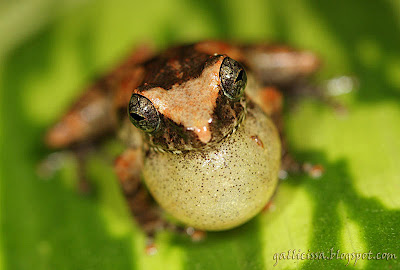
Common Shrub Frog

I shot this one to be used one day,

in a themed post named ‘Macro Monday’.

One of the good-looking Rhacophorid members,

Common Shrub-frog is found in big numbers.

Frogs cannot get sweeter than this, can they?

Macro Monday HQ is at Lisa's Chaos.

Monday, 20 April 2009

Macro Monday

I am watching you

This is a head-on shot of the one shown in my previous post. I photographed it yesterday at 5 times the life size. I am still awaiting a verdict on its ID, so don't ask me what it is. We do not have a guide to these types in this country still. So, I have sought ID help from an 'informed source'.

I did two tours in April. The images of the first of these were downloaded to my desktop computer and it has gone in for repairs. It should take about a week for it to be back in working condition. Due to this, my April trip reports will take a while to appear here. In the meantime, I promise to do a post on my dragonfly pond and brief you of its progress.

Monday, 17 November 2008

.42

My garden about which you have heard a lot is just .42 acres. In case you are new to this blog, it is quite well wooded as well. Most of the trees in it have been planted by me since I was 13 -- from the time I got hooked on nature as a schoolboy. Now that I am 30-something some of those trees stand to remind me how much I have aged as a naturalist. My garden borders to 9 other neighbouring home gardens, some of which are also quite well-wooded. So, by no means it is an island surrounded by lifeless sea of development. The natural riches that I get in my yard are also thanks to my neighbours who keep their gardens greener. This has helped to maintain a large enough area to harbour a decent enough diversity of natural history in what is actually a sprawling residential area.

Some of my neighbours are related to me and I have unfettered access to their gardens 24/7. I have even planted a few trees in them from time to time for habitat enrichment. Some of them are economically important trees. And I happen to derive indirect benifits from having them in the vicinity. So, it is a win-win partnership, as I see it. I have to observe here that none of my dear neighbours are as keen on natural history as I am. In fact they remain wilfully ignorant of the nature around them and lead lives of aloof ordinary citizens.

With that being the state of affairs, my cousin bro, next door decided to a clear what he termed as a 'grassy jungle' in his backyard, which in my world of reality translated into a good dragonfly and butterfly patch. Perhaps, he didn't know that it was a happy hunting ground of mine. Perhaps, I didn't dwell the importance of his backyard patch has to many critters that call it a home. All of a sudden he seemed to have got this preposterous notion of a 'cleaner environment' and turned a NIMBY!. He is not alone in this erratic thinking and quite a few neighbours seem to have their gardens with minimal low vegetation.

Careful diplomacy with my cousin to spare those patches fell on deaf ears. In our close-knit Asian social relationships, we depend on each other -- especially the neighbours for various kindnesses that are not valued in monetary terms. Having had no positive response to save this patch, I had to resort to more persuasive means of negotiations such as by threatening them of 'islolation' and categorising them into 'axis of evil'!Finally, this worked somewhat and I managed to save a few squares of 'grassy jungles' just as Tom Lovejoy saved those rectilineal squares of 1, 10, 100, 1000 sq.km of Amazonian rain forests from being clear-felled in the late 70s when they were being cleared by the Brazilian government to create among other things, cattle ranches to meet the demands of meat-eaters 'Up North'. Tom, I learnt had used less threatening negotiation tactics.

Due to thick overhead vegetation, my garden until recently had very few patches getting direct sunlight at the ground level, which is an important requirement for a good butterfly and dragonfly patch. This is why I decided to create a permanent patch for dragonflies and butterflies in my yard - one that I'd have full control of. After all, I cannot go on to use my bargaining tactics with my neighbours all the time!

For this end, I opened up a sun-lit patch in my backyard by selectively logging a few trees recently. More information of this new patch and a dragonfly pond that I am creating in it as we speak will be dealt in post later on. Until then, here's my .02 of the stuff I found in my .42 in the last few days. Enjoy!

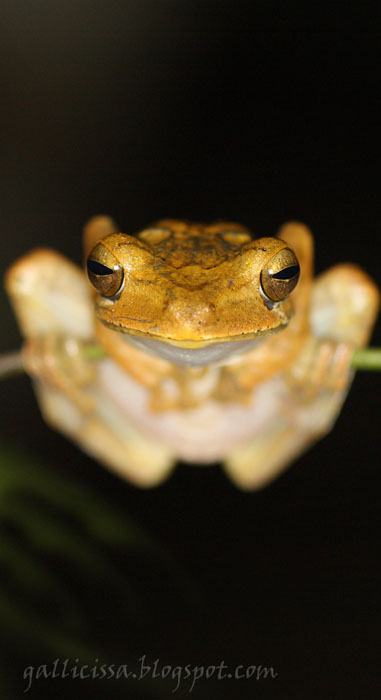
Common Hourglass Tree-frog Polypedates cruciger -- adult female. Endemic species.

Common Hourglass Tree-frog

Common Pierrot Castalius rosimon

Common Pierrot

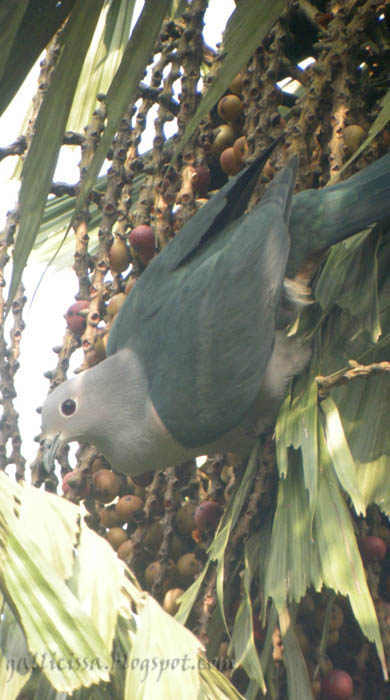
Green Imperiel Pigeon Ducula aenea - feeding on fruits of Fish-tailed Palm Caryota urens. This is a record shot. I have far better shots of this, which is the largest wild pigeon in Sri Lanka. I have 6 Fish-tail Palms in my yard.

Green Imperial Pigeon

Hump-nosed Viper Hypnale hypnale -- found inside a pile of coconut husks while clearing the land for the pond. Venomous but not deadly to humans.

Hump-nosed Viper

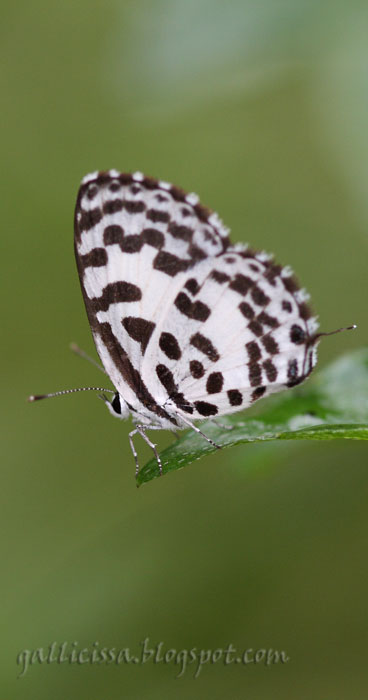
Tiny Grass Blue Zizula hylax -- wing span of the adult is about 1.5 cm -- the first butterfly photographed in the new patch.

Tiny Grass Blue

Pied Parasol Neurothemis tullia tuillia -- female

Pied Parasol - female Oh! I had yet another new bird in my yard in the form of a Bar-winged Flycatcher-shrike Hemipus picatus, which is also a new one to my local area. As in other recent new records, I heard it first. An Indian Pygmy Woodpecker and a Large Cuckooshrike were also seen well.

Monday, 10 November 2008

Macro Monday

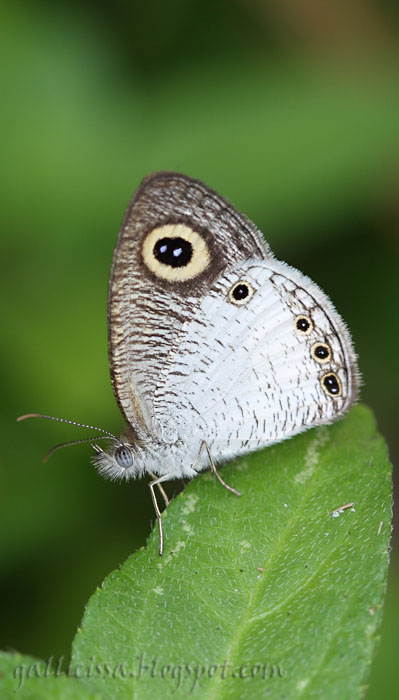
White Four-ring Ypthima ceylonica

White Four-ring

Apefly Spalgis epeus

White Four-ring

Monday, 13 October 2008

Macro Monday


Asian Pintail Acisoma panorpoides panorpoides—adult female.

This was photographed in my local patch a few days ago. It is often found quite low down among the vegetation. So it is not the easiest dragon to photograph.

By the way, one of my dragon shots emerged the winner as the Best Dragonfly Moments Macro Capture of 2008—in a contest in Flickr. Click here to see all the entries and the voting process and here to see the winning shot of mine announced.

A momentous day for mankind!

Monday, 29 September 2008

Macro Monday

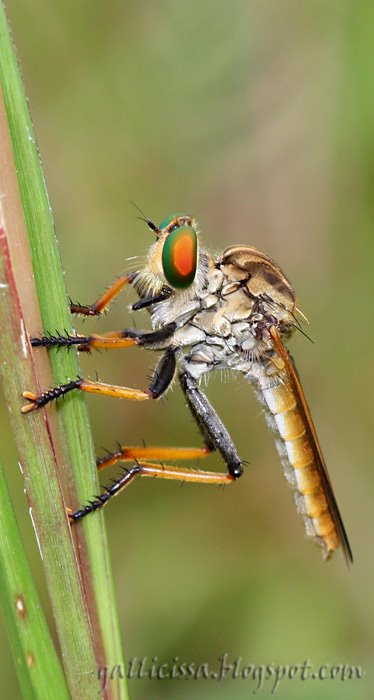
This beautiful Robber fly was shot in my local wetland patch.
Robber flies are extremely skilful hunters and their menu includes among other things, dragonflies.

Robber fly

Monday, 22 September 2008

Macro Monday

Lathrecista asiatica asiatica female

Pruinosed Bloodtail Lathrecista asiatica asiatica young female (a lass) in my home garden.

Related Posts with Thumbnails