Showing posts with label Binoculars. Show all posts

Friday, 22 May 2009

Ripleys, believe it or not

Barnes' Cat Snake
had a very good time in their 4-day natural history trip with me last month. We are talking about Dave and Rose Ripley from Wales and their girls, Celyn and Ceinwen, aged 13 and 12. Before the tour, Dave wrote to me “My wife and I enjoy birdwatching, the children not so much...”. And he added “...they would certainly enjoy elephants, snakes, lizards, insects, and birds in moderation.”
We agreed to combine the best of dry and wet lowlands by visiting the Udawalawe National Park and the Sinharaja "World Heritage" rain forest, with more emphasis on the latter.
Our dry zone leg gave plenty of the hoped for Asian Elephants. With Elephants found year-round, in their 100s at times, Udawalawe was a sure bet for seeing them. Additionally we saw Wild Boar, Wild Buffalo, Spotted Deer, Hanuman Langur, Jackal and Ruddy Mongoose. Land monitor, Flap-shelled Terrapin and Mugger Crocodile were some of the reptiles seen at the first leg.
With my 'oozing coolness' , I got the gals in my side and soon witnessed them actively getting involved in spotting birds, with enthusiastic support given by their parents. This resulted in us raking in nearly 100 species of birds on our day 01. These included Malabar Pied Hornbill, Lesser Adjutant, Grey-headed Fish Eagle, Blue-faced Malkoha, Sirkeer Malkoha, Pied Cuckoo, Plum-headed Parakeet, Crested Treeswift, Orange-breasted Green Pigeon, Sri Lanka Green Pigeon, Green Bee-eater, Barred Buttonquail (many), Indian Pitta and Indian Jungle Nightjar.
We also saw a large dragonfly named Elephant Emperor Anax indicus, which was my top highlight for day 01!
Our rain forest leg called for a different approach to get the girls involved – as it entailed exploring the forest on foot. I gave my Swarovski Binocs to Celyn, which she liked a lot.
Celyn with a Swarovski EL 8.5 x 42 binoculars
And I taught young Ceinwen how to do macro-photography using a point and shoot digital camera, which kept her constantly lagging behind. Both girls were sharp-eyed and got involved actively spotting things, which made my job a lot easier. They proved very good companions to have on a rain forest walk. Ceinwen spotted this critter, which was barely 12 mm in length.
rain forest insect sp.
I was conveyed a joint communication by the girls that they’d love to see rain forest snakes. This request was met with enthusiastic support and we ended up seeing 9 snakes with 7 of them being found by yours truly. They belonged to 5 species out of which 3 were endemic. They were:
Green Pit Viper Trimeresurus trigonocephalus One lazing individual was found by me in the undergrowth by the roadside. Heard the girls going "awesome".
Green Pit Viper
Green Whip Snake Ahaetulla nasuta – 2 individuals gave amazing views.
Green Whip Snake - library picBoiga barnesii– A couple of this scarce endemic was found by me in a courtship behaviour. They are called 'cat snakes' due to their vertically elliptical pupils similar to those found in cats. This is a smaller relative of the infamous Brown Tree Snake Boiga irregularis, which caused avian carnage almost wiping out all the native birds of Guam, where RD is known to be working these days.
Barnes’ Cat Snake
Barnes' Cat Snake
Common Bronzeback Tree Snake Dendrelaphis tristis - The individual that Ceinwen spotted first of this snake eluded me but this one that I found posed well for everybody.
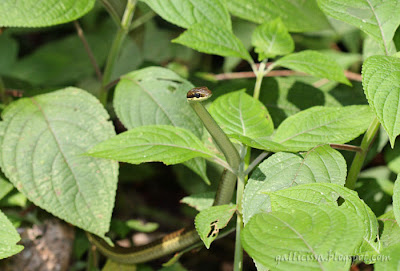
Common Bronzeback Tree Snake
Sri Lanka Keelbacked Water Snake Xenochropis asperrimus – 2 individuals at the usual spot. Endemic.
Our birding specials included 2 animated Chestnut-backed Owlets – the first of which was spotted by Dave at dawn. Chestnut-backed Owlet - library pic
With several decent mixed-species bird flocks, we saw almost all the specials expected to be seen at Sinharaja such as Sri Lanka Blue Magpie, Red-faced Malkoha, Sri Lanka Scaly Thrush, Malabar Trogon, and Crimson-backed Flameback
We also saw a brooding male Sri Lanka Frogmouth in a nest built on a tree branch above a trail. Observing it in the scope we noticed a ready-to-fledge chick. The angle of light did not allow good photography. But you can click here, here and here to see my previous photographs of this species.
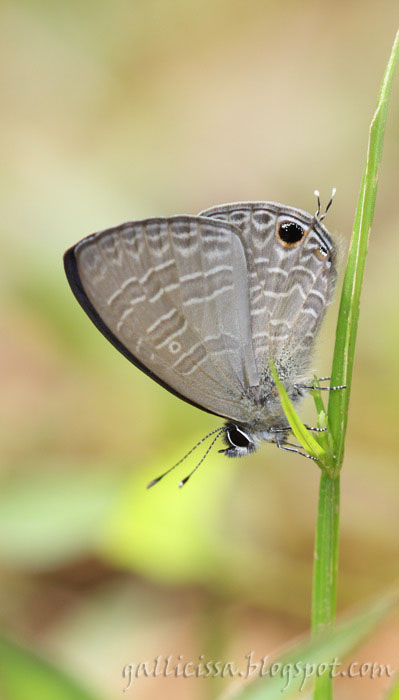
We saw plenty of beautiful butterflies, which included this Rounded 6-Lineblue Necaduba berenice ormistoni. Rounded Six-Lineblue
Dragonflies too were out in good numbers. My top highlight was this pair of Sri Lanka Sabretails Megalogomphus ceylonicus in wheel position. This was a dragonfly-lifer for me.
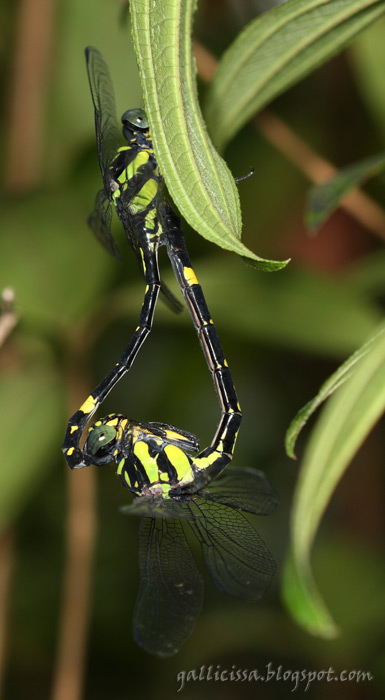
Sri Lanka Sabretail
Additionally we saw Amber-winged Glider, Rapacious Flangetail, Dawn Dropwing, Spine-tailed Skimmer, Asian Pintail and Marsh Skimmer.
We saw three species of Robber flies and the best-looking one of them is shown below. The body length of this excluding limbs was about 6 cm as you can judge from scale of the Clidemia hirta leaf on which it is resting. It looked formidable enough to tackle even a Sabretail!
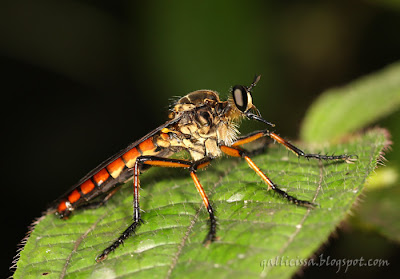
Robber fly sp. We also saw plenty of amphibians. They'll have to wait for another post as this has already swollen a bit.

Thursday, 23 April 2009

What is your binocular?

Mine used to be Leica Trinovid 10 x 42. Its current price in Adorama is $1,395, but if you shop around you can find cheaper offers.

I paid Rs. 65,000 for mine in April, 2002. It was a slightly used one, but I didn't mind that as a brand new Leica Trinovid was beyond my reach. Before this, I had two binoculars—Bresser "Shark" 7 x 24, and Bresser 7 x 50 "Action"—both received as birthday gifts when I was younger. Sadly, both of these didn't stand my abuse under field conditions for long.

So, I found myself in the market for a pair of binocs again.

For much of my early years as a budding bird watcher—I used no optical aids—for reasons beyond my control. A proof for this is this picture taken on 11 May, 1990 on my first trip to Horton Plains National Park. (I am the sweetest one of the lot.)

My first trip to Horton Plains National Park

This highland trip was led by the bloke in shorts—one Kelum Manamendra-Arachchi—who as this picture testifies shows, was at the prime of his youth.

Kelum (ayya) is a celebrated biologist in Sri Lanka now. He has discovered and described countless number of vetebrates new to science from Sri Lanka, and have gone on to author, and co-author papers such as this, this, this, this and this.

By the way, today marks 19 years since my first trip to the Sinharaja rain forest. It was with the school's nature club from 23-25 April, 1990. I will be making a private trip to Sinharaja to celebrate this special anniversary, later this month.

Coming back to binocs, in late February, 2009, I treated myself for a Swarovski EL 8.5 x 42.
Being a top of the range binocs, it came at a big price tag of $1,660.(It was actually $1,825, but I got this special deal thanks to Ben Allen). However, its superior light gathering power—helpful in low-light conditions, increased depth of field and jaw-dropping overall optical quality amply justified the premium price that I paid for this toy.

As a naturalist guide, I often find myself birding in dense and dimly-lit rain forests conditions. I have experienced that the visual clarity of this binoculars is markedly better in dimly-lit conditions compared to my previous model. This was really evident when I trained my new toy on the cryptically-coloured Sri Lanka Scaly Thrush at the Sinharaja rain forest during a recent tour. The light garthering power was just amazing.

In early this month, having arrived early at Haputale to pick up a few bird watchers to start a tour, I found myself birding in their hotel gardens. There, I picked a pair of Tickell's Blue Flycatchers down a ravine. When I focused on one of them, I was simply blown away by the vivid colours that I was seeing. I have seen this bird for many years; however, it has never occured to me before that this bird has such a gorgeous blue patch in the forehead. Perhaps, I may have overlooked this feature before.

According to the specifications, the Swarovski EL binoculars allows a minimum close focusing distance of 8ft, which is ideal for odonatoholics like me. This excellent review says that you can achieve a minimum focus of 7 feet, which I think is probably right although I have never measured it precisely.

If you are an avid bird watcher who is in the market for a pair of binoculars, prefer nothing but the best, and don't mind paying a little more in exchange of quality optical experiences, go for these.

I like this comment mentioned by a reviewer in Amazon:
"Looking through these things is like ingesting some kind of powerful drug. One is transported into a new reality, one in which even mundane objects become endlessly interesting..."

So, what is your binocular?
Related Posts with Thumbnails