Showing posts with label Peterite Rugby. Show all posts

Friday, 16 July 2010

A Tribute to the Champion Rugby Team of St. Peter's


The YouTube link is here.
The points table stood like this at the end of the league championship in 2010:


Edit: Accolades galore for the unbeaten Peterite rugby team of 2010.

Friday, 21 May 2010

Triskaidekaphobia x 2

Triskaidekaphobia is a morbid fear of the number following 12 and preceding 14. A variant of this is when that day happens to be a Friday. It the goes by the rather cool sounding name, friggatriskaidekaphobia! The first element of it derives from ancient Scandinavian goddess Frigga, after whom Friday is named. In any case, it is a hopeless word to know if you are a scrabble aficionado as it is too frigging long to play!

Now, I must be honest that I do not have any of the aforementioned phobias. However, I am awed by the destructive, unlucky and overwhelming nature of the number after 12 and before 14, multiplied by two. Just in case you don’t have a calculator handy, I am talking about 26

When I sat to write this post, I at once remembered an article by the veteran Sri Lankan journalist, DBS Jeyaraj on the deceased Leader of the Liberation Tigers of Tamil Eelam (LTTE), Velupillai Prabhakaran, who was born on 26 November, 1954. In this, DBS sheds light on the circumstances leading to his death in May 2009. Here's an excerpt from that.

“……LTTE launched a massive attack on the armed forces shortly after midnight on Sunday. This was because of numerology as Sunday was the 17. Once midnight passed it was Monday 18th. There was a time when the LTTE would not engage in major operations on the 8th, 17th or 26th. Because No 8 was considered unlucky. Subsequently these superstitions became irrelevant but at this critical juncture the “Eight” phobia was on.”

I think the irrelevance of this fear, as observed by DBS, is proved by the fact the LTTE chose to close the sluice-gates of Mavil Aru on July 26, 2006. A military operation by Armed Forces to wrest the control of the sluice gates to provide relief to thousands of people left without water due to this wanton act, marked the starting point of the Elam War IV. This ended badly for LTTE on 19 May, 2009 with a crushing defeat in the battlefield after 26 years of conflict.

Before it all ended, the first daring attack launched by 'Air Tigers' took place on 26 March, 2007, when two Czech-built Zlin Z 143 four-seater light aircraft, modified to carry four bombs mounted on the undercarriage, dropped their payload on the Katunayake Air force base, north of Colombo. This attack failed to destroy the Kafir and Mig aircraft targeted, but it killed three airmen and injured several. After several more fearless attacks of this nature, this treat was finally neutralised by the defence establishments.

In one of the worst terrorist attacks in the history of the conflict in Sri Lanka, country’s main Airport situated near the aforementioned Air force base was stormed by 14 Black Tiger Commandos, destroying 26 aircraft in July 2001. One Mil Mi-17 helicopter, one Mil Mi-24 helicopter, two IAI Kfir fighter jets, a MiG-27 and three Chinese K-8 trainer aircraft were part of the military aircraft destroyed. The attackers could not reach the hangers, probably didn't need to as all those the military aircraft destroyed happened to be on the tarmac—sitting targets for shoulder–mounted RPGs. A crack team of Special Forces finally brought the situation under control, after several hours; preventing the situation from dragging on for days, as it may have so easily have happened.

With losses of civilian aircraft alone estimated over US$ 350m, this attack dealt a crippling blow to the Sri Lankan economy, slowing it down by -1.4%. It particularly affected those of us in tourism with aftershocks coming in the form of tour cancellations and negative travel advisories, denting an already bruised industry. And two months later, came the 9/11 making things really bad for the world at large.

As we were slowly building our lives after all these happenings, came the Tsunami on 26 December, 2004—killing over 35,000 and displacing over 500,000 people in Sri Lanka alone, all within a matter of a few minutes. When this tragedy struck, I was guiding a Naturetrek Christmas birding tour at 2,100m above sea level, in the cloud forests of Horton Plains National Park. Later on, I came to find out that a lot of my friends at the Yala Safari Game Lodge were sadly no more. This included the manager, accountant, chef and the front office manager. The hotel’s in-house naturalist and a fellow bird tour guide, who happened to be there, ran for their lives, scaled up trees and survived, as did most of the junior staff. Did the senior staff think it was too chicken to run for their lives? I don't know. In any case, with a total estimated global death toll of 230,000, destroyed property running to billions of dollars and 1.69 million people displaced, the Boxing day Tsunami would go down as a major natural disaster in the modern history.

Seven months after this serious natural calamity, which also hit India, came the Maharashtra floods of 2005, bringing our big neighbour’s commercial capital, Mumbai to a standstill. This was caused by unusually heavy rainfall that lashed on 26 July 2005. It turned out to be the eighth heaviest ever recorded 24-hour rainfall figure: 994 mm. To put this into context, the floods we are now experiencing at Katunayake area was caused by a rainfall figure of 200mm reported over several days.

While we are at India, I should note that the horrendous 2008 Mumbai attack began on 26 November 2008. Dubbed by some as India’s 9/11, this killed 173 people and wounded at least 308.

I nearly missed, what about the 2001 Gujarat earthquake that tragedy killed 20,000 people and left 600,000 homeless? It happened on 26th January.

I find it amazing that scientists dated the big Cascadia earthquake near Canada to January 26, 1700. And to 9.00 p.m. on that day! They used old tsunami records in Japan and studies of tree rings, which showed that red cedar trees killed by lowering of coastal forests into the tidal zone by the earthquake have outermost growth rings that formed in 1699—the last growing season before this cataclysmic event. There’s also a great oral tradition about the quake and resultant tsunamis, and this interesting study sheds light on that.

To tell you the truth, my morbid fascination on 26th actually began when I watched a documentary about the famous volcano, Krakatau. Our 2004 Tsunami had already happened by then. When I heard the narrator explaining that this volcano began to explode with devastating fury on 26 April, 1883, it dawned on me that the biggest natural disaster in my memory, the Tsunami was also on a 26th. And it was from that point that I started to pay attention to 26. Coming back to Krakatau, this explosion was known to have been 13,000 times the nuclear yield of the "Little Boy" bomb that devastated Hiroshima. The actual explosion and resultant tsunamis killed over 36,000 people.

And finally, isn’t it really interesting that St. Peter’s crushed Price of Wales by planting 26 ties in their record breaking 164-0 victory a few weeks ago? St. Peter’s will meet Royal on 22 May at the Royal Sports Complex in a crucial schools rugby fixture. Two unbeaten teams playing vintage rugby, cool monsoonal weather, sludgy ground, and passionate supporters—what more do you want for a perfect Saturday late afternoon? I can safely say the match would get underway shortly after 4.26 p.m. I will be at the winning section. Say halo if you spot me. If you can't make it, catch live action via thepapare.com

Disclaimer: Far too many terrorist attacks and natural disasters have taken place on days other than 26th and events listed here are a set arranged for narrative convenience in this random monsoonal rant.

Edit: The South Korean Naval Tragedy that killed 46 of their sailors happened on 26 March, 2010.

Sunday, 9 May 2010

Birding and Rugby Roundup

I guided a 3-day birding trip from 3-5 January. It was with Paul Ode, an Entomologist who works as an Assistant Professor at the Colorado State University and his wife, Meena Balgopal who also works as an Assistant Professor in the School of Education at CSU. To combine the best of lowland dry zone and wet zone in real quick time, we visited the Udawalawe National Park and the endemic hotspot, Sinharaja ‘world heritage’ rainforest. These two coordinated birding raids yielded a whopping 142 species of birds! Our tally included twenty-one out of thirty-three endemics currently recognised. The star bird was the Serendib Scops Owl, seen at a daytime roost. This owl, discovered in Jan 2001, is one of the two “endangered” endemics in Sri Lanka with an estimated population of 200-250 in wild. A record shot of this owl in a daytime roost can be seen in a post below.

A male Purple-rumped Sunbird.

We observed a pair of immature Ashy Prinias in a plumage not depicted in colour plates of any of the field guides relevant to Sri Lanka. A picture of one of them is shared below. The sub-species brevicauda of Ashy Prinia found here is endemic.

Immature Ashy Prinia at Udawalawe National Park, 3 Jan 2010.

I learnt that Paul specialises in behaviour and ecology of parasitoid wasps among other things. I wasted no time in showing off my pics of the ant parasitoid wasp, Chalcura deprivata (Walker, 1860) - photographed sometime ago in my home garden.


Chalcura deprivata (Hymenoptera, Chalcidoidea, Eucharitidae) at my home garden in Bomiriya, Kaduwela
Click here for an earlier image of the same.

On other news, I am following the rugby of my school, St Peter's College with utmost interest. In the last match we played, Peterites mauled Price of Wales 164-0! This 'cricket score', crafted with 17 goals and 9 tries saw us tumbling several schools' rugby records. The final scoreline of this match was the highest in an 'division-1' (group A) schools rugby match. Several star players were rested in the second half to give the reserves the taste of the feast, which slowed the 'run-rate' somewhat. Eight of these tries were scored by the crack Outside centre, Danushka Ranjan, a rugby prodigy. He who also scored a hatrick in the match against Trinty—taming the Lions in their own den, 31-10. The number of tries scored by Danushka in the match against Cambrians also beat a previous schools rugby record of 7 tries by a single player. With also a convincing win over the traditional rugby power-house, Isipathana under the belt, our boys clearly look poised to emerge as the 'leage champs' this year, and no team would be able to halt that.

Not even Rrroyaal...

Monday, 15 December 2008

Birding with a Royalist

Another trip to Sinharaja 'World Heritage' rain forest. My visitors this time were Chandanie Wanigatunge and her son Lahiru. Chandanie is a specialist physician and a senior lecturer in pharmacology at a top university in Sri Lanka. Lahiru, a Royalist, was the birder of the two, having got hooked on birds at the age of 6, following a school project. He had just turned 13—the age at which I myself got hooked on birds following a school project at St Peter’s.

Blue-tailed Bee-eater
I wasted no time in reminding Lahiru the 41-0 thrashing we gave to Royal at the School’s under-20 Rugby in 2007. This was very special for me as it was the first victory that I witnessed over Royal, having tasted many bitter and painful defeats—even in 1995, the year that I passed out, the year in which we were a formidable force in schools' rugby. We lost to Royal that year too! That was also the year Lahiru was born, I learnt.

Moving on to matters that are birding, we made our first wayside birding stop on the way to Sinharaja scoring a Crested Serpent Eagle sentinelled on a wayside lamp post. Several migrant Blue-tailed Bee-eaters and a Brown Shrike brought about more stops, thereafter.

Reaching Sinharaja, we bagged several False Lanternflies glued to a wayside tree near the ticket office. After obtaining our permits, and meeting our local guide, we reached our overnight base, Martin’s Simple Lodge, in time for a power lunch—a Sri Lankan rice and curry. It was a bit gloomy when we got there.

False Lanternfly
This pawpaw tree with splayed leaves smack in front of Martin’s restaurant/lounging/birding balcony was obstructing all decent angles for scoping birds that visit the trees in front. And it was blocking the spectacular view of the primary forest, yet nobody had done anything to get rid of it.

Pawpaw tree the pain
And the frigging tree produced no pawpaws! After careful diplomacy, I got the nod of approval for "selectively logging" this alien angiosperm. And soon, it was delegated to a person in martin's ‘inner circle,’ as it's usually done.

We went for our first walk to the forest, anticipating some soggy play. And as expected we made use of our brollies several times as it rained in an ‘on-off’ fashion. No mixed-species bird flocks. However, by the time we finished, we had a moderate haul of birds, with Sri Lanka Junglefowl, Legge’s Flowerpecker, Sri Lanka Crested Drongo, Crimson-backed Flameback, Bright Green Warbler, Dark-fronted Babbler, Black-capped Bulbul, Indian Swiftlet and Brown-breasted Flycatcher all in our list.

Birding was tough work today due to the rainy weather. We returned to Martin’s a bit early as the skies were looking really ominous. And the Pawpaw tree was still standing to cause more misery. Checklist and dinner and we retired early, as we had a 6 o’clock appointment with a flock of Sri Lanka Blue Magpies the following morning.
Asian Brown Flycatcher
We gathered at the restaurant/lounging area for a cuppa just before six the following morning. Distant raucous calls of the Sri Lanka Blue Magpies announced that they were on schedule. When the calls were closing in, I alerted everybody to get ready. Soon, about three Blue Magpies came to land on the railings, chairs and tables to find easy moth-prey under lights. It was amazing how confiding they were, at times even landing within three feet from us! After five minutes or so they vanished into the jungle but soon returned for a second serving.

Reaching a sun-lit edge after breakfast, we had good birding with Orange Minivets, Sri Lanka Hanging Parrots, Sri Lanka Green Pigeons and more Legge's Flowerpeckers keeping us regularly busy. When Chandanie was busy photographing a wood spider, I took Lahiru to see a nest of a Sri Lanka Scimitar Babbler found by our local guide earlier. As we were seeing this nest built on an embankment, I heard faint calls of a few Ashy-headed Laughingthrushes moving in the undergrowth, and soon went for them.

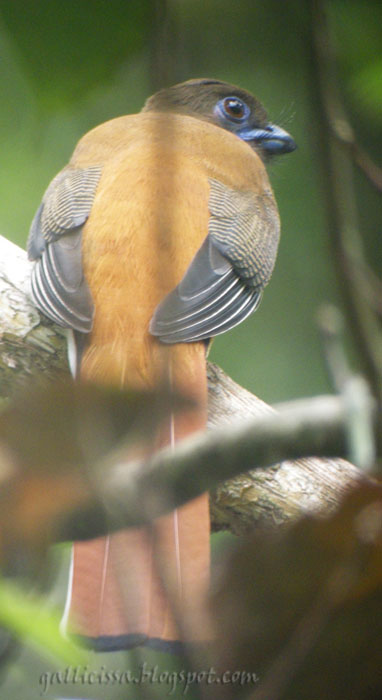
It was then that we realised that we had caught what was actually a tail-end of a mixed species bird flock. The laughingthrush calls that I picked were heard from an otherwise muted mixed species bird flock. Which also looked to be in fast forward mode! Quick footwork to keep up with them gave Lahiru an overdose of lifers. These included Ashy-headed Laughingthrush—which betrayed the presence of the flock, Sri Lanka Crested Drongo—the playmaker of the flock, Red-faced Malkoha—enough said, and Sri Lanka Scimitar Babbler. A Malabar Trogon eluded Lahiru, but I made amends by drawing a female after a pitched vocal dual lasting fifteen minutes! Brilliant scope views amply rewarded our perseverance.

Malabar Trogon
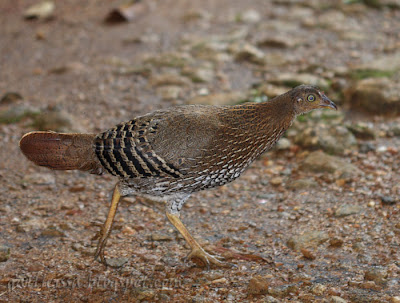
Some of the Sri Lanka Junglefowls are also getting quite tame around the main trail, and we had a male and a female posing nicely for us.

Sri Lanka Junglefowl
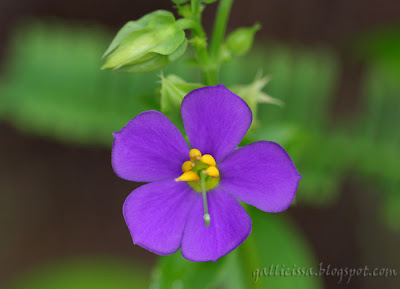
Few trees were in bloom, and a top highlight among them was this showy endemic Exacum trinervium (Binara in Sinhala).
Binara
When we returned to Martin’s before heading back home, the Pawpaw tree was still there, assaulting my senses. A man’s go to do what a man’s got to do and I had to execute this task myself before the "permit" expired. All for the benefit of the birding community!

Thursday, 4 December 2008

Masala

A masala post, bluuurp. Excuse me!

These days, there are regular sightings of Yellow Bitterns, and Black Bitterns at my local wetland patch . Their resident populations seem to have got boosted by migrant populations as it usually happens.
A new bird got added to my bathroom birding list. And it is is this lovely Black-rumped Flameback.

Black-rumped Flameback
The bathroom birding list comprise of birds seen from the bathroom windows (and occasionally doors), when occupied variously in it. My bathroom takes the form of a decent bird watching hide because of its strategic position. Other birds to have made to this pretty exclusive list include Brown Hawk Owl (aka. Brown Boobook) and Orange-headed Thrush! (One bird photographer even called over to photograph the latter using my bathroom as a hide!).

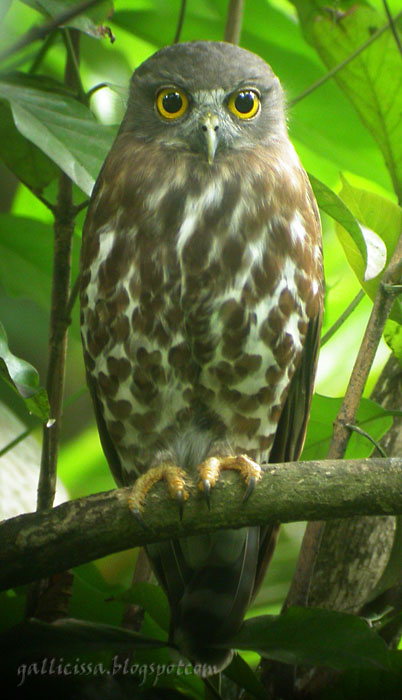
Brown Hawk Owl
Brown Hawk Owl vocalisations are a regular feature at the dusk soundsape these days. I observed a pair calling and chasing each other in what appeared to be a courtship ritual yesterday. I did not use a flash light, as it would disturb them. It’s the beginning of the breeding season for a lot of birds including this one.

BTW, the above picture of Brown Hawk Owl, shot at my yard, will appear in the Thayer Birding Software’s Gold Edition DVD – Birds of North America to be released on 12 December, 2008.

For your information, a Brown Hawk Owl was recorded by a tour guide named Jake Mohlmann at the rarity Mecca, St Paul’s Island off the coast of Alaska in North America in August, 2007. It stayed on untill September.

So, it’s officially now made its way to the ABA checklist.

Click here to see the pictures of the errant bird and to read the very interesting account written by Jake on this mega sighting. Also read this post by N8’s account at The Drinking Bird on the same.

The aforementioned DVD lists 2,850 photos, 708 songs, 551 videos ( including 493 new action videos), 837 abundance maps, thousands of variations of over 700 quizzes, 957 range maps ( including 695 new detailed maps), 957 birds seen in the U.S. or Canada (including accidental and extinct species), November 2008 additions to the ABA checklist; plus all features found in version 3.9.6. Click here to order this DVD.

Sorry to if I had given you more Christmas shopping!

I am expecting the construction work of my dragonfly pond to be completed before the end of this weekend. It’s taken longer than I expected. A female Asian Skimmer that dropped by for ovipositing at an inch-deep puddle of rain water in it as it was being built became the first dragonfly to officially lay claim to it first!

This was interesting as it was also a ‘first’ to my yard’s burgeoning dragonfly list. She appeared to be at a desperate breeding rush and had no decency whatsoever to wait until I declare the pond open.

I will be leading 15-day Christmas Birding tour in the last two weeks of this month. I’d like to break the radio-silence from time to time. Can anybody tell me how to do a ‘scheduled-post’ in blogger please? I searched blogger help but couldn’t find it.

My 32nd birthday is coming up on the 1 Jan, people. I accept greeting cards and gifts at 146 A, Pahala Bomiriya, Kaduwela, Sri Lanka from now onwards. As for gift items, birding and natural history related books, CDs and DVDs are appreciated, thank you.

I received a couple blogging awards recently. First of these were this beautiful award from the flowergirl at Madras Ramblings from India.
Arte-y-pico award And the second was this award from the fishing guy from OH, US.

Hot Blog Award
I'd like to thank both of you for these wonderful awards! It’s been a while since I received a blog award. So it is a good feeling to be recognized this way. I hope I will be forgiven for not complying with your full set of rules!

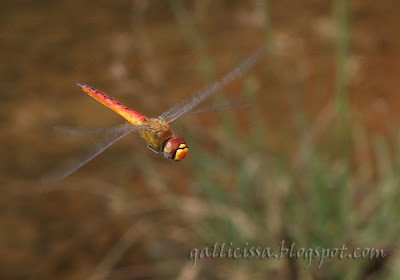
I got my first decent shot of a dragonfly in flight at the rain water pool that I blogged about in my last post.

Wandering Glider
It was this world famous Wandering Glider aka. Globe Skimmer Pantala flavascens, which is a globe trotting species considered as the most widely distributed dragonfly in the world. It is a known temporary pool breeder and is almost always found flying—which was what pressed me to attempt the above shot.

My Canon 40 D and Canon 100 mm f2.8 Macro Lens stopped auto-focussing last week when I was shooting dragons at the aforementioned puddle. I took them to the repair centre of the local Canon dealer. It turned out that it wasn’t the lens. So they kept the camera body for further checking. After a week or so they called me to say that it is working okay. Apparently the auto-focussing problem has happened due to humidity. All what they had done was to clean to contacts of the camera body with a soft cloth. The bloke there told me to repeat it if it happens again, but before doing that, to make sure that I remove the battery to prevent short-circuiting.

I guided and facilitated a photo shoot of leaves in my garden, to be used for a desktop calendar for a local corporate. They were after leaves of 14 species of native/endemic flora to select from them, 12 to go with each month. I found them about 16 with various hues and textures to surpass their requirements. The two ladies who came got a few leeches too. Which was more than what they bargained for!

Now, I know I have admitted that I do not have leeches in my yard in a comment somewhere in this blog. Things have changed, folks. A small leech population has established probably after an accidental introduction caused by yours truly, when leech socks and boots were brought home straight from the rain forests without de-leeching them at the forest!

And let me tell you that some people that I know of are not too amused by this. So it is official that my home garden is a safe heaven for home-grown-terror. The first person to get a bleeding bite was my mom.

My friend Java Jones has tagged me for a blogging game called "I never".

Okay here goes my reply Mr. Jones. I’ve never.

1. thought that I would switch from Lion to Carlsberg in this lifetime. Seriously.

2. eaten a better tasting Chinese chop suay rice (mixed meat/sea food) than at the ‘late’ Garden restaurant that used to be near the Liberty Roundabout at Colpetty. Does anybody know whether it’s been relocated, please?

3. ad better arm-chair birding in Sri Lanka than from the balcony at Martin’s Simple Lodge, Sinharaja.

4. expected that a full body massage at La Passion, Battaramulla 90210., would be so awesome after a good day’s manual labour (at the pond).

5. think that anybody in this country could give a better earth-shattering head and shoulder massage as Ananda at Vajira Salon, Bamba.

6. thought that St Peter’s would thrash Royal 41-nil at Rugby as it happened magically in 2007 in our own den.

I end this masala post with this beauty that I photograged at my local wetland patch.

It is an Oriental Scarlet aka Scarlet Skimmer Crocothemis servilia servilia. Apparently this is also found in outside the Orient despite the local common name; "Oriental Scarlet" suggested in the Sri Lankan dragonfly guide, which in my opinion ought to be revised. According to the “Dragonflies through Binoculars – A Field Guide to Dragonflies of North America”, it was “discovered in Miami in 1975, I has spread to Orlando by 1986….It now occurs in the FL Keys, Cuba, and Hawaii and in the Old World ranges from the Middle East to Japan and Australia.”
Related Posts with Thumbnails