Showing posts with label FOGSL trips. Show all posts

Wednesday, 15 September 2010

Sinharaja with FOGSL–2010

I am back from a trip to Sinharaja rain forest with the Field Ornithology Group of Sri Lanka (FOGSL) from 9-12 September, 2010. Prof. Kotagama, who usually leads this annual birding pilgrimage couldn't join us on the first two days because of some commitments. So, the main responsibilities of guiding on "birds and related matters" fell on me—as in 2007 and 2008. This year's trip had twenty-eight participants—mostly newbies.

Prof. Kotagama joined us from the late afternoon's bird walk on 11 Sep. onwards. And in that evening, we listened to his traditional lecture: "History of Sinharaja, and Mixed-species Bird Flocks"—the research of which is being spearheaded by him since the 80s.

We saw a total of 42 44 species of birds. This was fewer than what you'd normally see on a similar length tour to the dry zone. But, the important thing was, nearly 50% of our Sinharaja tally comprised of endemics—and new birds to most participants. So what we lacked in quantity, we certainly made up with quality.

We had a good mixture of rainy and sunny weather, as it is usual for this time of the year. I had absolutely no complains about the rain; I like my rain forests wetter and lusher.

We had the services of Dee as our local guide. As always, he delivered what the group and I wanted, with a smile. After making a clean sweep of almost all the flock-associated specials such as Orange-billed Babbler, Crested Drongo, Red-faced Malkoha, Ashy-headed Laughingthrush, Malabar Trogon, and the likes, I sent Dee to find several "high-value targets."

High on my "hit-list" was Serendib Scops Owl—an endemic bird discovered in 2001.
After several hours, Dee met me, looking as happy as a dog with two tails. Soon, I was taken to a spot, and shown this adorable Serendib Scops Owl, sitting on a Cyathia fern, doing its best to disguise its real birdie profile.

Returning to our base after this, I paused to search a patch, after hearing alarm/mobbing-type calls of Yellow-browed Bulbuls, and Black-naped Monarchs. Su Bambaradeniya who was with me, mentioned of seeing a perched bird taking wing; disappearing into the forested valley below. So, I searched that general area, also aided by the angry mob still at it. Moments later, I spotted the target of the mobsters's wrath—a Chestnut-backed Owlet—a lifer for all. Scope views followed through my Swarovski ATM-80 HD.

And with that, we cleaned up all the endemic owls.

A notable absentee among birds was "Square-tailed" Black Bulbul—not even heard. A Besra juvenile (a bird-hunting raptor) obliged to provide scope views in front of our accommodation; two more separate sightings of this species followed.

Close to the research camp, a Sri Lanka Scaly Thrush was expertly spotted by Dee.

My top behavioural observation—in the birds category—was seeing the mainly insectivorous Sri Lanka Scimitar Babbler feeding on the fruits of the pioneer Macaranga indica [family:  Euphorbiaceae; boo-kenda in Sinhala (pronounced, boo can-the)]. 

Aug.–Sep. mark the fruiting season of this pioneer, and I have previously observed other such mainly insectivorous birds, that make up Sinharaja's bird flocks, opportunistically "turn to bit of fruit" when Boo-kenda was in fruit: in Aug., 2007, I observed Orange-billed Babbler and Ashy-headed Laughingthrush feeding on Boo-kenda; in Sep., 2007, I observed Ashy-headed Laughingthrush of a mixed-species bird flock feeding on Boo-kenda—a behaviour, which was copied by a Crested Drongo that was nearby.

This Red-faced Malkoha was seen early during our last birding walk, was photographed when it perched on a tree across the field close to the entrance. I showed this enigmatic endemic to all newbies through my scope.


Change of topics, I was absolutely shocked to see the recent "improvements" done to the track by the Forest Department (FD) have turned it all muddy. And I have one word to explain the mud all over the track and those "planners" who caused it—thick.

May be this needs more explanation than just one word. But, I'll be brief.

FD has dredged a canal along the left side of the track, in sections between the barrier gate, and the turn off to Mullawella trail; and splayed the dredged soil on the track, forgetting that it rains here. And the result is this—a (previously) usable track for walking, turned into a quagmire.


Pressed to find drier paths, walkers have used the higher ground on the right, destroying low flanking vegetation on the roadside, not to mention the habitats of myriad critters. Here are FOGSL members negotiating the "facelifted" track.


I suppose the Forest Department may have perfectly logical explanations for this. Like trying to attract water birds bound to Bundala.

All you "planners" in your comfy air-conditioned rooms who are responsible for this, I have a simple message for you:

Sinharaja is like a rain forest. So it rains here a lot. Which is why rainfall figures of rain forests, such as Sinharaja, are expressed in metres rather than millimetres. So when you put loose soil on the track, like you've done, things really get messy after a while. Right now, your actions have made walking on this track, a nightmare. Please clear the mess you have created. The track you should repair, as a matter of urgency, is the old 3km stretch that connects the ticket office at Kudawa with the barrier gate. Which is like a dried river bed. Please make this "world heritage" rain forest visitor friendly; it's a national disgrace right now.

On the positive side, the conditions underfoot, made me the coolest dude of the lot because I was the only person sporting welly boots. I was as confident as this male Sri Lanka Junglefowl.


But, I wasn't really dressed to impress like this Sri Lanka Blue Magpie though.


The Spot-winged Thrush was heard and seen in song; it looked to be in a breeding rush again. A few members had observed one of them mobbing a Sri Lanka Blue Magpie—a notorious nest predator. 

Natural History Specials (part).

Cruiser Vindula erota.
Kusum Fernando (KF) spotted this female, when we were waiting for a "flock" near the research station. KF's now metamorphosed into a butterfly-chaser, with birds coming third; second is photography.
With species names like this one's—meaning "erotic"—who can blame him!


Striped Bronzeback Dendrelaphis caudolineatus
I spotted this uncommon tree snake in the primary forest patch close to the research camp—my top natural history highlight. I was seeing this snake, quite familiar to me, after a long time.


Kangaroo Lizard Otocrytis wiegmanni
Close to the main track, I spotted this male, sporting breeding colours.


Common Bronzeback Dendrelaphis tristis
We had three sightings of this tree snake, resting in ambush on ferns flanking the track—where "improvements" have not swept through.


One-spot Grass Yellow Eurema andersoni
A stupid name for an otherwise pretty, endemic butterfly. I spotted this seasonal delight, fluttering low over a shady section of the track, and shared it with KF to whom it proved a butterfly-lifer. I am quite familiar with this species, having photographed it earlier. Grass Yellows are tricky little ba butterflies. And photographing them definitely helps to put names to them.


Luckily, it was found in an unmolested section of the track, so that KF and I could lie low to shoot it.

Here are the newbies, old bees, spelling bees, and NIMBYs. The one with the Santa Clause-like beard is our good ol' Prof. Kotagama.


KF shot this using my camera; he had to take 3 shots to capture the whole group as my lens was not a wide angle one. And I stitched 'em all using PhotoStitch.

Popularising bird watching—traditionally limited to upper-class types—is one of the fundamental objectives of FOGSL. It was great feeling to share my joy of birds with loads of like-minded people. And to see their faces light up, after getting their first glimpses of these avian jewels through my scope. If the tour comments and feedback I heard in the end were anything to go by, Prof. Kotagama and I made most of those participants, joining on their first field trip with FOGSL, firmly hooked on birds.

That, to me, tops all the highlights mentioned above.

Sunday, 5 September 2010

Rush Hour—1

According to ancient Indian mythology, the cosmos is divided into seven concentric islands, which are separated by the seven encircling oceans, each double the size of the preceding one. And situated in the centre of this concentric scheme is Jambudvipa—where ordinary human beings live.

Although there are different interpretations as to what land area exactly constitutes Jambudvipa, it is generally understood that it refers to the Indian peninsular. [According to the Great Chronical, Emperor Ashoka's emisary to Sri Lanka, who introduced Buddhism to Thambrapanni (ancient Sri Lanka) in the 3rd century B.C., mentioned to the Sri Lankan King, Devanampiyatissa, that he is from Jambudvipa—referring to the Indian mainland.]

Jambudvipa literally means, "the island of Jambul fruits."

Jambul is scientifically known as Syzygium cumini, and belongs to the botanical family, Myrtaceae. It is an evergreen tree that grows to a height of around 25 metres. This tree is native to Indian subcontinent, including Sri Lanka; and South East Asia. One of its common English names Java plum is derived from its presence in South East Asia; it probably reached there through colonial channels.

In Sri Lanka, Syzygium cumini goes by the name, Maadan (මාදන්/මාදං) in Sinhala.
According to my observations, June-July marks the peak flowering season for Maadan in Sri Lanka, with August-September being the peak fruiting season. I was able to experience both these seasonal specials during my visits to the dry zone this year.

In early July, while guiding some guests in the dry zone, I had a lot of time "to kill," especially in the mornings. This was because they preferred to take the mornings easy. Luckily for me, the Maadang were bursting in flower. So I chose to hang around these amazing dry zone trees, hoping to photograph the "rush hour" traffic in the morning. One slight hitch, however, was the flowers were about 15-25m high up from the ground—a bit too high up for my liking.

I ideally wanted to reach upto a level so that I have the flowers more or less at eye level. As some of you may unhesitatingly concede, I am not quite the arboreal type.

I have long progressed on my evolutionary path.

What I needed was a tall building next to few of the these flowering trees. After a bit of searching, I found the perfect spot in the hotel we stayed—Heritance Kandalama—at level 5! The photographic essay that follows is a testament to my strategy, planning and execution. And silliness, not enjoying the lie-ins.

Butterflies were the biggest shareholders profitting from the blooming business. This Common Rose Pachliopta aristolochiae was slow and graceful in its movements.


There was definitely an air of confidence to the way it carried itself. And there are reasons for this.
The caterpillar of this butterfly feeds on the poisonous vines in the genus Aristolochia. So the winged adult too is packed with poison as result. This is distasteful for predators, and they escape predation because of this. Common to such "nasty" butterflies is the slow and confident demeanour. Which is a way of advertising their potent nature—giving predators enough time to observe clearly to avoid them.

Sri Lanka Birdwing Troides darsius—Sri Lanka's national butterfly, and the largest, with a wing span of around 7 inches—looked to own the air. It rarely stopped on one flower cluster for long. Instead, it preferred to patrol its wider territory, keeping its options open. The caterpillars of Sri Lanka Birdwings too feed on the same vines as above, and the body of the winged adult is similarly packed with poisons. Their wing-shiver behaviour while feeding was a mesmerizing sight, but posed a mild challenge for photography.


Common (Indian) Crow Euploea core asela were the most numerous in the scene.
It was bullied by the supersized Sri Lanka Birdwing—which bulldozed its way like a Jonah Lomu.


Coming in small but steady numbers to this drinking party were Blue Tiger Tirumala limniace. Slow and confident, this species too have poisonous body juices, and is left alone by birds, and predators that usually feed on flying insects.


Several birds came to feed on the insects drawn to the flowers. This Asian Paradise Flycatcher female was one of them that vied for my attention. It was successful it hunting a few "yellows"—butterflies that were less dangerous.


A well-endowed mate of its, sporting a tail plus tailstreamers measuring easily over a foot, showed up  briefly. It didn't appear as bold as the female, and disappeared quickly. Or else, I wasn't fast enough.

This Pale-billed Flowerpecker was not too elusive, and obliged, presenting all 7cms of it.


A couple of mammalian visitors too crashed the party. One of them was this Grizzled Giant Squirrel Ratufa macroura dandolena. It chose to ignore me, and fed the flower buds at close quarters. With a head and body length of 33–40cm and a tail length of 35–41cm, this is squirrel features high on the menu of several birds of prey in the forest, most notably that of the Black Eagle.

When heard at close range, the alarm calls of Grizzled Giant Squirrel (explained by Dr. Eben Goodale as a "blood-curdling scream"), uttered typically after sighting larger eagles that soar above the forest canopy, features third on my list of jungle noises that send a chill down my spine. The second in this is the breeding call of Spot-bellied Eagle Owl (උලමා)—especially when heard close, with this call piercing through the jungle soundscape at pitch darkness. The first in this list is the trumpetting of Asian Elephant, when it takes you by surprise at close quarters. This also features in another more personal list, but I digress too much now.

Continuing on with mammals, a troop of the endemic Toque Macaque Macaca sinica passed through without taking much interest of the bustling activity around it.


Maadan fruit season brings about great scope for social bonding in some quarters in Sri Lanka.
Here are some participants of the last FOGSL trip raiding a tree at Ritigala, with gay abandon, during our last trip.


I think Syzygium cumini fully deserves the recognition as a keystone species.

Thursday, 26 August 2010

Of Courting Cuckoos, Butterflies That Make Me Go Weak in the Knees & Stuff

I joined a bird watching trip of the Field Ornithology Group of Sri Lanka from 21–24 Aug., 2010.

It was led by Prof. Sarath Kotagama, whose book Kurullan Narambamu [කුරුල්ලන් නරඹමු (Let's Watch Birds)] was my first field guide in 1989, after getting hooked on birds in the same year. The good professor turned 60 during this trip; few members organised a surprise cake in celebration—which turned out to be his first b'day cake! And for that reason or another, only a single candle was lit on the cake.


Black-hooded Oriole at the Rajarata University premises where we stayed overnight.

On the birding front, we did well, seeing 110 species of birds. The most interesting bird sighting (for me) was two early Barn Swallows that I spotted on 24 Aug. They were flying over a roadside wetland birding stop between Mihintale and Ritigala. This is the earliest date for this migratory bird for me; my previous best was 25 Aug., 2007 at the Udawalawe National Park.

I also picked a Wood Sandpiper (one on 23 Aug., and several on 25 Aug.).  A Common Sandpiper spotted by "Sir" was our third migratory bird for the trip.

On popular request, I did a 10-minute night walk with several keener participants, and pulled out a Jerdon's Nightjar—a lifer for all. I wasn't comfortable in going on for longer; all participants, including I, had no "proper footwear" needed for serious night explorations. (I packed for this trip with an economy that would have put Mr. Bean to shame.)

The 7cm Pale-billed Flowerpecker—the epitome of avian downsizing in Sri Lanka. 

We had mixed weather with cloudy and sunny conditions. The rain experienced in patches did not get in the way of birding. Instead, it cooled the weather and made the unrelenting August sun—relenting.

The endemic Sri Lanka Grey Hornbill (male). This was rather abundant in the Rajarata uni. gardens.

My top behavioural observation was to do with a pair of Jacobin Cuckoos in courtship.
Spotting a perched individual of this cuckoo, we noticed it going all jittery—a display that consisted of wing-shivering accompanied by jerky head movements. In no time, it was joined by another Jacobin Cuckoo with a caterpillar in its beak. The latter then mounted on the jittery one, offering the morsel of food it held in its beak. This was followed with mating—when the female appeared to be distracted by food.

Here are the paparazzi captures.

Jacobin Cuckoos displaying courtship feeding, which led to mating.

These captures didn't come off the way I liked. The camera being at a wrong setting (with a higher ISO and lower shutter speed), and the scene being a twiggy one were the reasons for that.

Anyway, here's a better take, postcoital.

Jacobin Cuckoos after correcting camera settings.

Studying the photographs post-retuning-home, I saw through a cunning plan of the male.

That was during mating, the male had not let go of the caterpillar completely; instead, it had held on to a part of it in its beak—seemingly to keep the female waiting until it finished mating! I think the male was holding on to the caterpillar like a bargaining tool to seal the deal.

The cunning deal.

Moving on to matters non-birding and non-voyeuristic, I stumbled this cryptic Spotted Tree Frog Polypedates maculatus during a forest walk close to Kebithigollewa.

This particular individual was not all that spotted as the vernacular goes, but then, it is not unusual for it to be not spotty. This is one of the Gembas that turn up in toilets in the dry zone.

I also found a Sri Lanka Painted Frog hiding inside a tiny slit of a tree at the Rajarata University, where we stayed overnight.

This Oriental Scarlet Crocothemis servillia servillia was one of the dragonflies that cooperated. This is a female.


Our top reptilian highlight was an Agamid lizard described in 2005, Otocryptis nigristigma—the dry zone cousin of the Kangaroo Lizard Otocryptis wiegmanni found in the wet zone. It was spotted by a keen naturalist at the Rajarata University.

Butterflies dominated my non-birding highlights. Here are eleven of them—all photographed on this tour.

Family: Papilionidae.

Banded Peacock Papilio crino.
This is one of those butterflies that make me go weak in the knees.

We had this individual at Mihintale on day 2. It was nectaring on the flowers of Carissa spinarum (Heen Karamba in Sinhala), before perching within a few feet from me.


During a marathon lounging session in my garden, sometime ago, I saw a flash of peacock green luminescence. It at once registered in my head: "Banded Peacok." The fact that I was in my garden, in my laze, came to me little a bit late. And the delayed realisation that followed: "Banded Peacock in My Garden!" was truly an ethereal moment.

Bluebottle Graphium sarpedon teredon.
Uraji Karunaratne, an ardent Royal supporter, spotted this and shared it with me. This year's rugby captain of Royal, Duminda Attygalle, is her nephew, I learnt. (St. Peter's won the two matches played this year with Royal, after two amazing games of rugby: 22-20 in the first, and 29-27 in the second—the latter which was dubbed as the "Injuction Cup Finals," for reasons that I cannot go into detail here.)


Lime Butterfly Papilio demoleus demoleus.
Photographed close to Kebithigollewa.


Family: Danaidae.

Blue Tiger Tirumala limniace leopardus.
I got a decent sequence of this.


Family: Pieridae.

Blue Wanderer Pareronia ceylanica ceylanica.
Another butterfly that makes me go weak in the knees. I have had a few close encounters in the past, but when it happed, never have I had a camera. So when this male arrived at the Carissa tree that the first one was nectaring on—I was near collapse!


Family: Satyridae.

Tamil Bushbrown Mycalesis visala subdita.
Spotted at the same spot as above.


Family: Lycaenidae.

Monkey-puzzle Rahinda amor.
I photographed this on day 3, just before I stumbled the cryptic frog. This uncommon beauty is a sought-after species by butterfly enthusiasts, so I am very pleased about it.


Lime Blue Chilades lajus lajus.
I shot this near the vehicle park at Ritigala. This is a common species also found in my home garden.


Family: Pieridae.

Lesser Albatross Appias paulina galene.
Seen soon after the Bluebotte.


Small Salmon Arab Colotis amata modesta.
A common species in dry zone.


Family: Nymphalidae.

Chocolate Soldier Junonia iphita pluviatalis.
A common species also found in my garden. This was photographed at Ritigala.


Moving on to more other stuff, the best meal of the trip was an artery-clogging Sri Lankan breakfast—free!—thanks to the member and participant Asitha Samarawickrama, 17, whose Uncle, Malik Samarawickrama, had a bridal wear factory at Madawachchiya. (I thought Sir played his cards really close to his chests, stopping there on our way to Kebithigollewa on day 3.) Everybody who joined this excursion barring a fasting Muslim girl from the Rajarata University partook this tasty breakfast, which consisted of string hoppers, chicken curry, fish white curry, coconut sambol, bread, spicy dhal curry, milk rice, lunu miris; plus tea and juice to wash 'em down. Asitha's Farther, Lalin Samarawickrama (brother of Malik Samarawickrama), is the Managing Director of Amaya Resorts & Spas. So the Samarawickrama's knew their hospitality too well.

And finally, here is the cast—the heros, villains, jokers, lovers, sinners, and midnight toker talkers—that made this production possible. One actress is missing though. Any guesses who that is, FOGSL people?

Click on images to view them sharper.

Monday, 14 July 2008

Three gems in my garden

Adam's Gem Libellago adami
Adam's Gem in my home garden - 28th June, 2008
Three females of this endemic Gem were recorded on 28th June in my home garden. This damselfly species proved to be a lifer, a garden tick and endemic no. 2 in my garden. I stumbled upon them when they were sitting pretty at midday on three leaves of a lone Pine Apple plant Ananas comosus. They were seen there for the next two days, and disappeared from radar afterwards.

This beautiful damselfly belongs to the family: Chlorocyphidae of which the members are commonly known as Jewels. They are unusual in having the body clearly shorter than the wings. There are four species of Jewels in Sri Lanka all of which are named as Gems!

Three of these are endemic. The only other Gem that I had photographed previously was the endemic Green's Gem Libellago greeni, which was photographed three years ago in a riverine forest at Nilagala on 20th June, 2005, during a FOGSL field trip. Here it is.

Green's Gem - male at Nilgala -20th June, 2005

Monday, 30 June 2008

Confessions of a peak dodger*

The sunrise from the summit of Adam's Peak showing the conical shadow of the Adam's Peak cast on the veil of mist on the western side for a brief moment

I joined FOGSL’s annual birding pilgrimage to the Peak Wilderness Sanctuary from 20-22 June. This is the only wilderness area in Sri Lanka with attitudinally-graded rain forests ranging from lowland rain forests-up to 1,000m, sub-montane forests from 1,000-1,500m & montane aka cloud forests above 1,500m. These pristine rainforests covering an area of 224 sq.km envelop the Adam’s Peak (2,243m), which is the 4th tallest mountain in Sri Lanka. According to the local Buddhist tradition, a footprint atop this lofty peak is believed to be the foot print of the Buddha. Hindus on the other hand believe it to be their god; Shiva. Other traditions assert that it is the footprint of Adam, left by his first entrance into the world. Net result of all these is this is a pretty important site of pilgrimage in Sri Lanka. It brings together peoples from various faiths in their thousands during the peak pilgrimage season from Dec-April.

FOGSL’s visit to this important bird area (IBA) is done in the off-season to avoid the crowds & chaos. On the previous trip that I took part, we stayed overnight at the ambalama (free lodging shelter) at the Seetha Gangula (colder creek – translation mine) about half way up. This was quite exciting as it made us climb at least half way up towards the Adam’s Peak to earn a warm meal. It is rather cold at night at this camp site. So, we had to lug our sleeping bags & 'stuff'. These ground realities made this annual trip earn a reputation as a tough one out of the calendar of birding trips put together by the FOGSL. And unsurprsingly, the arm-chair birders in us happily eschewed this trip.

Things were different this time. The lodging was arranged at the ambalama at the Palabaddala village, which is a base-camp situated at one of the three main gateways to the summit. We could drive our coach right up to the point where we stayed overnight. This was viewed by many to be a ‘very convenient’ option. We had tasty home cooked meals at a village house nearby with village vegetarian food such as Crape ginger Costus speciosus shoots aka Thebu kola mallung, which we rarely get at home. So there was absolutely no worry of missing out on a warm meal and/or having to do a compulsory survival challenge on day-1. Two new sets of common toilets have been put up for men and women at the site. So, there was absolutely no problem in that department either. There was an ‘almost attached facility’ for ablutions for the lazy types and a dragonfly-infested fast flowing rain forest stream for those prepared to walk for 5 minutes. So, that department was also very much under control. Our mobiles had signals. So, we could stay in touch with the loved ones. There was electricity at the house we ate at. So, we could charge our mobile phones, camera batteries & laptops after sweet-talking the girl in da house. And if we had really pushed, we could have even downloaded our e-mails and checked the feeds of our favourite blogs using their fixed-line telephone. There was also a TV at the house. So, some of us could watch our favourite soaps & have our daily dosage of news. At the end all these spoils coalesced to give this year’s Peak wilderness trip the essence of a full board holiday in a fine nature resort! And it positively exposed the peak dodgers of the group.

The weather during the daytime was a mix of sunny, overcast & rainy - often heavy, with no particular order. Spoiled by the luxuries of our nature resort, swayed by the fickle nature of rain forest weather & tempted by the riches within easy reach, I decided to stick to the verdant lowland forest patches instead of scaling too far up along the well-trodden steps leading to the Adam’s Peak.

Birding highlights:

White-faced Starling Sturnia albofrontata -- After a few 'heard only' records, I was able to scope two individuals of this scarce endemic to give all the participants with excellent views, which proved to be a lifer for some. I observed one individual peeking into cobwebs high up in a tree. The same behaviour was observed by me in Sinharaja in December, 2007. I couldn't see clearly whether it was to drink dew drops off them or to prey on the any occupants. I will keep an eye on this to ascertain this in the future.

A White-faced Starling probing into some cobwebs in Sinharaja 'World Heritage' Rain forest in Dec, 2007Sri Lanka Myna Gracula ptilogenys -- A vocal pair was observed well in an alien-invasive; Deviltree Alstonia macrophylla . This tree is known in Sri Lanka as Havari-nuga meaning 'wig banyan', because of its distinct pendulous casings of its dry fruits, which look like a woman's long wig. I observed one of the individuals flying away with these long 'wigs'. Since it is a tree-hole nester as shown in this picture taken on a previous tour, this may be nesting material to cushion their nest holes; indicating breeding activity.

Sri Lanka Myna in rain - resting on an endemic Bheasa ceylanica in fruit in Sinharaja 'World Heritage' rain forest Sri Lanka Green Pigeon Treron pompadora – Regular sightings especially in a fruiting fig tree.

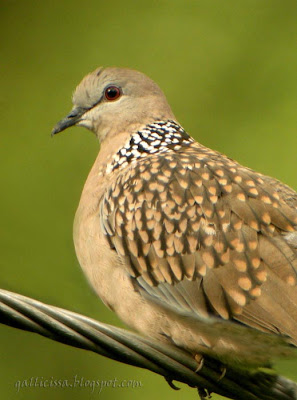
Sri Lanka Green Pigeon at teh Peak Wilderness Sanctuary Spotted Dove Streptopelia chinensis -- A common bird found in open & dry patches.

Spotted DoveOther birding highlight included Green Imperiel Pigeon, Yellow-fronted Barbet,Sri Lanka Small Barbet, Orange-billed Babbler, Square-tailed Black Bulbul, Black-capped Bulbul, Yellow-browed Bulbul, Orange Minivet, Sri Lanka Crested Drongo, Black Eagle, Southern Hill-Myna, Crested Serpent Eagle, Oriental Honey Buzzard, Black-headed Cuckoo-shrike, Tawny-bellied Babbler & Indian Swiftlet.


Dragonflies & damselflies:

When I labelled the following and sent them to my Slovenian Odonata mentor; Matjaž Bedjanič, he got back to me with a moral boosting line reading “…Your determination skills are very good so I didn't have much to add”.

Asian Skimmer Orthetrum glaucum -- The common name sounds like a racist euphemism that Geoge Carlin would have taken the mickey out of. We encountered this Libelluid a few times along the open trails close to water. The picture below is of a male.

Asian SkimmerIndigo Dropwing Trithemis festiva --This was found actively flying around the fast flowing stream at midday. It often settled on the exposed rocks in the stream to oblige for me.

Indigo Dropwing

Wall's Grappletail Heliogomphus walli --This endemic Clubtail was a lifer for me. It was found in the edge of the forest close to shallow steam that was bordering a tea field.

Wall's Grappletail

Shining Gossamerwing Euphaea splendens -- A truly gorgeous damsel that frequents streams & lures passerbys with flashes of iridescence.

The Shining Gossamerwing doing its thing

Dark-glittering Threadtail Elattoneura centralis -- Found sharing the same riverine habitat with the Black-tipped Flashwings & the above.

Dark-glittering Threadtail

Black-tipped Flashwing Vestalis apicalis nigrescens --This fine looking adult male was associating a few old ladies in a shallow stream.

Black-tipped Flashwing male

Black-tipped Flashwing Vestalis apicalis nigrescens -- Adult females of this pretty damsel is just like the male shown above but without the black tips to the wings. Like many other females, they get obsessed with gold when they grow older and wears gold - going for that rich look.

Black-tipped Flashwing - an old lady wearing gold

More fetching ladies this time of Butterflies:

Cruiser Vindula erota --This is simply an elegant lady. Sightings of her is quite rare. No wonder Bernard D'Abrera wrote this about it in his Sri Lankan butterfly book "Whilst the males are shy and thus not so visible, the sighting of the female in flight always causes my mouth to go dry and my reflexes to become confused". No wonder its species name is erota! This individual frequented a patch of shrubs in the middle of a tea field when we found it. This picture shows it while resting on an alien-invasive; Clidemia hirta plant. The male was photographed by me previously and you can see it here.
Cruiser female

Sri Lanka Birdwing Troides darsius -- The female form captured in the picure below is the largest butterfly in Sri Lanka although some dry season forms of the female Blue Mormons in the dry zone in Sri Lanka can rival its size in the wing area. This enigmatic forest lady descended like an angle to a shrub of Mussanda frondosa in search of nectar, when I was alone in a spot. It was an orgasmic sighting! It didn't linger on for too long in one spot and soon melted away into the greenery making my day.

Sri Lanka Birding - female

So here's a yet another euphemism explained:

Peak dodger 1. A lazy person who doesn't like uphill walks. e.g. My husband is a typical peak dodger and went golfing. So, I went hiking up to the cloud forest with the resort guide. 2*. A smart naturalist who eschews climbing up to forested peaks during awful weather and explores the forested lowlands in search of familiar pleasures. e.g. It was cloudy when were about to start our climb. Luckily our guide was a peak dodger and we did a great alternate walk just before the rains and saw loads of birds in real quick time!! 3. slang An extremely selfish person who suppresses knowledge of birding/ natural history to other people - especially to tour guides/naturalists, paranoid that they will overshadow him/her one day/earn a living out of it. e.g. That lepidopterist in Sri Lanka is a dead-set peak dodger! He thinks the whole world revolves around him!

The above post is my contribution to IATB #80 hosted at The Hawk Owl's Nest

To visit the IATB HQ click on the logo below

IATB HQ
Related Posts with Thumbnails