Showing posts with label Culture. Show all posts

Tuesday, 2 August 2011

The Yatala Stupa Fouteen Minutes Apart

This is Yatala Stupa at Tissamaharama as seen at 6.07 p.m. on 25 January, 2011. I photographed it while birding at the vicinity of this stupa with Jan and Britt last January. 


This is the same fourteen minutes later at 6.21 p.m.


A stupa is a funerary monument built to enshrine bodily relics of the Buddha and such important Buddhist persons. According to the book, "The Stupa of Ceylon" by the eminent archeologist Senarath Paranavitana, all stupas, including those built in modern times, are supposed to enshrine a particle, in most cases a minute one, of the corporeal remains of the Buddha, or a saint, from which they derive their sacred character.

The modern day Tissamaharama lies superimposed on the ancient capital city Magama of the Ruhuna Kingdom (of southern Sri Lanka), which was one of the three principal territorial divisions from 3rd century B.C. to 12th century A.D.  This stupa was believed to be built 2300 years ago by King Yatala Tissa of the Ruhuna Kingdom in the place where his wife gave birth to their son.

In the classification of stupas according to their shapes, Yatala Stupa is believed to be a "bubble-shaped" one. The restoration work was undertaken in 1883, and during that, four relic caskets made of chrysoberyl, amethyst, clear crystal, and rock crystal were found in the debris around the stupa. They were all enshrined in the new relic chamber that was built during the restoration.

This year's provincial T20 tournament in Sri Lanka was won by Ruhuna who defeated reining champions Wayamba in a close game. By the virtue of this win, Ruhuna booked their place in the qualifier stage of the Champions League T20 Tournament to be played in India this year.

Tuesday, 3 August 2010

Sri Lanka Painted Frog


Meet the Sri Lanka Painted Frog aka. Sri Lanka Bull Frog Kaloula taprobanica (Parker, 1934), an amphibian endemic to Sri Lanka and South India. This frog is peculiar in that during drier times, it leads a subterranean life—at times being found 10–12 feet under! It comes out during wet weather for breeding, and I found the above individual on my lawn on 14 July, 2010. This day turned out to be rainy towards the evening, resulted by a monsoonal high.

On 17 July, another rainy day, I found another Sri Lanka Painted Frog—this time, would you believe, inside my house! Compared to the previous one, it was less-colourful, fatter, and full of attitude; it was probably a female (based on at least two of those attributes).


The species name: taprobanica refers to taprobane—how Sri Lanka was known to Greeks and Romans since pre-Christian times. Taprobane had derived from the local name that was in use in the past: Thambapanni (aka. Thambrapanni), which means "copper-coloured palms". The legend has it that the palms of the hands of the ancient settlers, who arrived in Lanka from northern India in the 6th century B.C., became copper coloured when they sat on the shore following landfall. (No doubt their backsides too would have turned the same colour, but historians make no such referrence.) Thereon, the newfound land of those ancient settlers came to be known as Thambapanni. As mentioned above, it later became known as Taprobane for people in the West, who came here in search of gems, spices, and elephants—the latter were famously used for wars of Alexander the Great. (Onesicritus, a historical writer who accompanied the latter, claimed that elephants from Taprobane were larger and more pugnacious than those of India.)

Guiding some visitors from USA, I first visited the general area of the aforementioned legendary site of landfall in 2004. One such site: Kudremalai, situated bordering the Indian ocean inside the massive Wilpattu National Park, to my surprise, had rusty coloured soil all over, evidently following volcanic geological events in the past. Here's how the soil looked—with a Fan-throated Lizard Sitana ponticeriana as eye candy.

Friday, 29 August 2008

Tuktuk

A Tuktuk in Sri Lanka
Click on the logo below to visit the Sky Watch Friday HQ
SWF HQ

Monday, 25 August 2008

Pure Gold!

I bagged three golds during the Olympics.
I mean during the time when Olympics was on. They were

1. Dancing Dropwing Trithemis pallidinervis

Dancing Dropwing 2. Leopard Panthera pardus kotiya

Leopard 3. Serendib Scops Owl Otus thilohoffmanni

Serendib Scops Owl
They were seen on an 18-day photography tour from 2-19 Aug, 2008. That was with Thierry and Maree-Andree Becret and Michelle Gerner from France.

The first gold was bagged at the dragonfly-rich wetlands at Tissamaharama.

The second gold was won in a photo-finish during our very first game drive at Yala National Park—one of the top locations to see this big cat in the world.

We had this male Leopard for nearly 15 minutes with only a partial view of the head visible through the dead brush. It then rewarded our perseverance by coming out of its lounging spot to sit in a more open patch, affording us a brief moment of magic. After a brief show up, it retreated to same spot as earlier. About 10-minutes after, it again stood up, came out to the open, glanced at us and disappeared into the thick cover to the sound of camera clicks.

Being the only big cat, Leopard is the apex predator in Sri Lanka. And thanks to the protection afforded to Sri Lanka’s Yala National Park, especially to its prey species, Leopards are bolder in Yala. Therefore, daytime sightings are quite regular at Yala compared to other parts of Sri Lanka, and outside it, where human-related pressures have pushed them to be nocturnal and ultra-secretive.

Finally, our the third gold was bagged outside Sinharaja ‘world heritage’ rain forest. This one, of course, was very special because it allowed my first proper photograph of this avian jewel taken at nighttime—when it is at its element. Click here to see a picture of it taken by Peter Kaestner in Sep., 2007, which inspired me to buy my Panasonic Lumix FZ-18.

The Serendib Scops Owl was discovered only in Jan, 2001, and formally described in June, 2004.

It was first seen after its discoverer, Deepal Warakagoda, had been looking for it for 6 years since first hearing its call in 1995. The last endemic bird discovered before this was the Sri Lanka Whistling Thrush - 132 years ago in the colonial era of natural history explorations, which made this discovery all the more special.

One of the reasons why it eluded bird watchers for so long is due to its unobtrusive and ventriloquial call, which is so simple in form and so infrequently delivered with a note length of 0.3 seconds repeated after 15-29 seconds. This makes it difficult to determine that it is originating from a bird, especially when it is mixed with the cacophony of calls that dominate the rainforest soundsape at night. Before its discovery, even some of the senior Sri Lankan naturalists had suspected its call to be of an amphibian of an unknown origin.

Big misktake!

This initial confusion over its call is not surprising considering that the island is rich in amphibians with over 100 new species discovered since the mid 90s. In fact a tree hole-dwelling frog species described in May, 2001, just four months after the discovery of the owl, named Nagao’s Ramanella Ramenella nagaoi, has almost identical call note to the Serendib Scops Owl that it has fooled me several times when I have been all ears trying to pick up the monosyllabic call of the Serendib Scops Owl from the other rain forest noises.
Serendib Scops Owl is recorded only in 5 lowland rain forest sites in Sri Lanka and due to its narrow range small numbers—estimated at 200-250 individuals, it is categorized as “endangered” in the IUCN of Red List of Threatened species.

Its vernacular name’s "Serendib" part is derived from a 14th century name of Sri Lanka used by the Arabs named "Serendip" (the "dip" part, is appropriate considering some birders dip out on this!) in place of the local name that existed at that time: Sihaladeepa – the island of the Sinhala people (note: some say that it derived from Swarnadeepa, which means the island of gold/gems).

The word Serendipity was coined by English novelist Horace Walpole (1717-1797) in a letter written in 1754 based on a Persian fairy-tale: The Three Princes of Serendip, the heroes of which "were always making discoveries, by accidents and sagacity, of things they were not in quest of."

The serendipity of its discovery, being endemic to ‘Serendib’ are why the new Owl was appropriately christened Serendib Scops Owl. The species etymology thilohoffmanni is to honour Thilo Hoffman a top conservationist who spearheaded a campaign to stop a government endorsed mechanised logging project carried out with the help from a Canadian logging company from 1971–1977 at Sinharaja rain forest, where the discoverer first laid eyes on this owl. By the way the logging activity was carried out under the euphemism “selective logging."

Serendib Scops Owl is so new that it is not even featured in the first comprehensive modern field guide of the birds of Sri Lanka “A Field Guide to the Birds of Sri Lanka” by John Harrison (1999) - ISBN 0-19-854961-X. 240 pages, 48 colour plates, 2 maps, 200x140 mm. £39.95.

After 9 years of publication, Oxford University Press, UK is now planning to do a second edition of this highly popular field guide to the birds of Sri Lanka. I was approached by OUP, UK for a review for the second edition, which I did to earn my reward of £50 worth of books of OUP in addition to a free copy of the second edition of the Sri Lankan Bird Guide when it is published!. For the immediate reward I picked
“A Field Guide to the Birds of Borneo, Sumatra, Java, and Bali” by John Mackinnon and Karen Phillipps (1993). ISBN 978-0-19-854034-2. 510 pages, numerous colour plates, maps, line drawings, 200x140 mm. £39.95. Click here for link.

and

“Dragonflies through Binoculars A Field Guide to Dragonflies of North America” by Sidney W. Dunkle (2000. ISBN 978-0-19-511268-9. 368 pages, 381 color illus., 216x138 mm. £17.99. Click here for link.
the books
Yes, this was slighly over their budget but the nice people at Oxford University Press made no fuss over it. Both books arrived in fine condition, and I am eagerly consuming them. The bird guide is quite timely as I am planning a private trip to Borneo. The dragonfly book is great—I think every American dragonfly enthusiast ought to have it.

Friday, 7 December 2007

A visitor in my garden

Indian Pitta

I forgot to blog this earlier; I had my first Indian Pitta for this migratory season on the 30th October in my garden. I usually keep a corner of my garden with thick undergrowth to invite it and it accepts my invitation every year! This pretty terrestrial bird calls at dawn and dusk around 6.00 O’clock. Consequently, one of its popular local Tamil names is 'Aarumani Kuruvi', which translates to ‘The 6.00 O’clock bird’. According to local folklore, the beautiful feathers of the Indian Peafowl aka Peacock were originally belonging to the Indian Pitta. The Peacock had ‘borrowed’ it for a wedding and had Indian Pittanever returned. Hence the reason the Pitta calls everyday to remind the peacock to return its feathers!

It must be noted that there are various versions to this story; one saying that the peacock stole it, while the Pitta had put it aside for bathing! However, the version mentioned in the ‘Aspects of Sinhala Folklore’ by Prof. J.B. Disnayaka is that the peacock borrowed it and I am happy to borrow that version

Anyway, what a beauty it would have been its original plumes!

Wednesday, 5 December 2007

A Sri Lanka Bullfrog in my garden

Sri Lanka Bullfrog
I found a Sri Lanka Bullfrog aka. Sri Lanka Painted Frog Kaloula taprobanica, while I clearing a garbage bin, outside my Kitchen on 23 November, 2007. It was hiding underneath the bin. And with its distinctive colour pattern, it caught my attention straightaway. This was my first encounter with this little frog. But I knew what it was the very moment I saw it. This frog has an interesting life-cycle, and is known to live a life of underground existence during the dry times, at times being found in 10-12 feet below, at times! It surfaces out during the wetter times for breeding.

The species etymology of this frog alludes to Taprobane, a pre-Christian era name for the island of Sri Lanka. It was coined by Onesicritus, companion of Alexander the Great's campaigns in northwestern India after the name that existed for Sri Lanka: Tambapanni. It means "copper-hued palms". That was how the ancient settlers from Northern India. These settlers colonised Lanka in the 6th century B.C., and according to the Mahavamsa, the Great Chronical. This was named like because the soil in the place of their landfall turned the palms of the settlers copper coloured after they rested on it following landfall.

The island of Sri Lanka is referred as Tamrapanni in the 3rd century B.C rock edicts of Emperor Ashoka in North India. Therefore, Tamrapanni is another variant of the name, Tambapanni. While leading a SLWCS trip with some US visitors in 2004, I have been to this general area—a site called Kudremalai—inside the Wilpattu National Park (131,693 ha). The sand was strikingly reddish-hued. Here' a photo of that soil with a nice Fan-throated Lizard (Sitana ponticeriana) to complement it.

Fan-throated Lizard in Kudiramale, Wilpattu National Park

Friday, 16 November 2007

Water birds & Sea food trip

Common Greenshank and Black-winged Stilt
Kusum, a birding pal, and I organised a 2-day "water birds and sea food trip"  from 11 to 12 Aug., 2007. It served two puposes: to catch the early arrivals of winter migrants and to increase our blood cholesterol levels measurably. We were joined by several of our birding buddies: Mihiri, Umesh, Ayanthi, Rohantha, Madhu, Kishan and Devi—latter an MD—our doctor on call, just in case.

Our overnight base was a private Bungalow close to Kalpitiya, named the Turtle Point, which was recommended by Sandali Wijayatilake, who had been there in April and alledgely seen the highly sought-after Crab Plover nearby. All my previous sightings of this Deccan avi-faunal zone rarity had been in the Talaimannar area in Mannar, so one of the ulterior motives of this trip was to find it in a site more accessible.

We left Colombo very early and reached our first birding spot, Chilaw Sandspits—a wader patch in the western coast, north of the airport. It was too early in the season for the Sanderlings, which are usually found wintering here. But, we found a few early arrivals in the form of Common Sandpiper, Common Greenshank, and several Eurasian Whimbrel in the shoreline. A pair of Great Thick-knees and several Great Crested Terns also were noted. I was the only person with a scope, so as usual, there was a neat queue to take turns for better views.

Chilaw Sandspits is situated close to a fishing hamlet. Several of our participants had to experience ‘too much of reality’ too early in the morning. But what can I say? I had warned them precisely of such "ground realities."
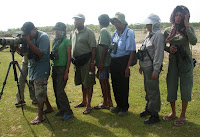
 The queue
Breakfast at the Chilaw Resthouse was good and Kusum fell 10 short of his alltime string-hopper-eating record—gobbling 70!

This was with fish, potato, and dhal curries; plus pol sambol. The fish curry was a bit on the hot, and this was made an excuse to eat two slices of bread on top of it—in a bid put off the fire in his mouth!
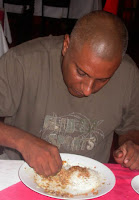

Kusum:'no strings attached'
With our bellies full, we drove to the Annaiwilundawa RAMSAR wetland, which not surprisingly for this time of the year, was very dry—with its network of tanks reduced to small ponds here and there. A noteworthy birding highlight was  Large Cuckoo-shrike, which is somewhat of a regular at this site.

Cotton Pygmy-goose, Oriental Darter, Pied Kingfisher, Green Bee-eater, Indian Roller, Black-headed Ibis, Purple Heron and the four species of white Egrets, came in quick order. Thereafter, we drove up to the Puttlam Saltpans, which appeared devoid of birds at the first glance. It was so desolate that we almost turned back before we spotted a couple of small flocks of waders comprising of Little Stint, Curlew Sandpiper, Kentish Plover, and Lesser Sand Plover—all retaining variable degrees of summer plumage. Some of those Curlew Sandpipers were almost in full summer with their beautiful brick-red plumages.

Several Gull-billed Terns were also spotted settled down close by. Returning to our vehicle baked in the blazing Puttlam sun, the organisers of the trip bedazzled the lot with some chilled soft drinks pulled out from a a coolbox tucked inside a seat. A few brownie points.

We broke for lunch at the good old Puttlam Resthouse, and since this is not a FOGSL trip, some of us had the luxury to replenish the lost liquids properly with chilled Lion beer with devilled cuttle fish as "bites" (Sri Lankans almost never drink without bites—which are often spicy/fired dishes with liberal amounts of chillie and high fat eating thingies).

Next, we enjoyed an artery-clogging rice and curry lunch—with more cuttle fish, prawns curry, and some fish curry for those who didn't like prawns and cuttlefish.

Western Reef Egret
Post lunch, we explored the vast expanse of Palavi mudflats.

As soon as getting off the vehicle, I picked up the call of a Grey Francolin—yet another deccan avi-faunal zone specialty. It was my first at this site. We looked for it but had no luck. It was extremely dry here, as expected, resulting in the wader patches being too far from the roadside. I saw not much point in trying to scope things from the roadside so Rohantha, Mihiri and Umesh agreed to walk up to the wader flocks following my ASS (advance-stop-scan) technique.

We had to report to our accommodation at around 5ish with the dry rations that we had brought along, in order for the caretaker family to cook our dinner. So this meant we could ASS only 750m. However, this was enough to find several high profile early migrants in the form of a grey morph Western Reef Egret, at least five Broad-billed Sandpipers, and Grey Plover. Those who stayed back in the dry land had also picked up blobs of the Grey Plover and the Western Reef Egret, but had missed the Broad-billed Sandpipers.

Returning to our vehicle, we accidentally flushed a Grey Francolin, a lifer for the rest. A BVD, of course.

After getting some ice from an ice factory to cool our food and beverages, we drove to the fish market in Kalpitiya to buy some seafood. It was here that another one of my techniques came in real handy. When we turned up at the fish market, all the fish vendors, who happened to wholesale fish dealers, didn’t care about us townies wanting small quantities of fish. And they gave us ‘Colombo prices!’.

One of the interesting things about our culture (shared also with certain other eastern cultures) is addresing complete strangers in kinship terms. So I addressed the vendor that I was speaking to ‘Ayye’ (elder brother), for he clearly looked older than me. This not only conveyed respect, but also put me in equal level with him socially. To be effective, I used it more often in my sentences than I would do it normally.

And Lo and behold!

It really worked as that bloke who seemed rude, and unfriendly at first really loosened up. We were quoted Rs. 1,200 per 1 kg of ‘jumbo’ Prawns initially but thanks to my heart-melting Ayyefying, we walked away with the same quantity paying just Rs. 500, which was a great bagain!

Similarly, I Ayyefyed another vendor to get a 2.8 kg Paraw Fish (Black-Tip Trevally,) at fraction of the Colombo prices! And I did this wearing my shorts and looking more like one of them.
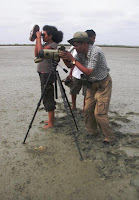
following my ass(advance stop and scan)technique
We reached our accommodation around 5.30p.m., to be greeted by our friendly caretaker, Lional, who looked after us extremely well during our stay. The Turtle Point has three rooms (one with two beds, and two with three beds) each coming with private facilities. Note it has no electricity. Also, there are also extra beds that can be used if you want to sleep out in the veranda, which is what Kishan, and I did as it was a bit stuffy inside the room. More liquids, checklist and a fine seafood dinner marked the end of a great day.

A pre-breakfast birding walk on the following day along the shoreline was productive with steady flows of Brown-winged (Bridled) Terns, a passage migrant flying south, close to the shoreline. This proved a lifer for some. Also seen here were Little, Common, Large Crested, and Lesser Crested Terns, in addition to Black-winged Stilt and more Eurasian Whimbrels. Other highlights were early arrivals of Ruddy Turnstone, Little Stint, Common Greenshank, Wood Sandpiper, and Curlew Sandpiper—all showing of summer and summer to winter transitional plumages in varying degrees.

No luck with Crab Plover. Our breakfast was rice with dhal curry, pol sambol and more Paraw fish curry.

Our exportations until lunch didn’t produce anything spectacular, and after another superb lunch, we bid farewell to Lionel and his family and drove to the Nawadankulama Tank. Here we had 19 Common Coots, a locally uncommon bird, and many Little Grebes feeding in formation. I also heard a yet another deccan avi-faunal zone specialty in the form of Eurasian Collard Dove, which would have been a lifer for the rest.

We returned home with copious quantities of Jumbo Prawns –the bloke charged only Rs. 450 per kg!

The above was my submission for I and The Bird #63 hosted by The Greenbelt
Related Posts with Thumbnails