Showing posts with label Water birds. Show all posts

Monday, 26 October 2009

Sanderling Watching

Last Saturday I got a detailed reading of my horoscope through a local astrologer. For the record, it was done on my own initiative. One of the interesting things I learnt from that was that I have two lucky months: September and October, the latter being the luckiest! I was told that these months, therefore, are auspicious ones for me to begin new things. Liking buying new cameras and lenses. OK, this latter fact was revealed after I posed a specific question. Now, I must be honest here, that I had absolutely no knowledge of this when I got my first dSLR in Sep., last year, or when I got my Canon 100-400mm lens last month, or when I started this blog 2 years ago on a day like this. Wish me luck, ladies and gentlemen, today is my second blogoversary.

To mark this momentous day, I wish to share some pictures of a bird that I like very much, the Sanderling, a High Arctic breeding, long-distant migrant that winters in sandy beaches, pretty much around the world.
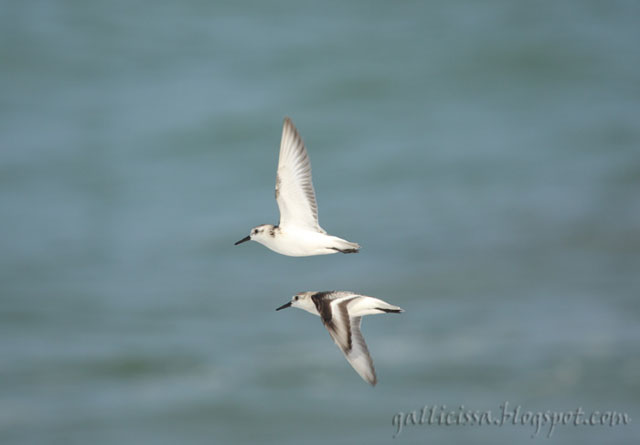
Sanderlings
It is an uncommon visitor to Sri Lanka and the sandspit near the fishing village at Chilaw is arguably one of the best places in Sri Lanka to see it.
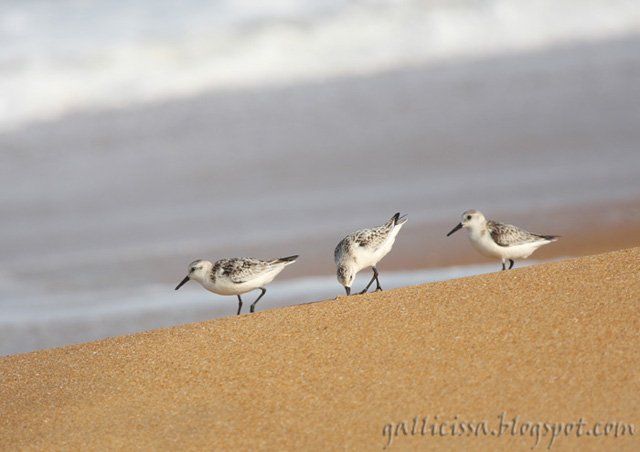
Sanderling
Sanderling is a gregarious bird in winter. However, when there are not enough numbers at a wintering site, they can join flocks of other shorebirds, probably to seek safety in numbers. When they do that, they can be often seen in locations, well away from their typical sandy-shore habitats. Here's a case in point.


In the above, two Sanderlings (largely white & grey birds, in the left and middle) can be seen mixed with the migrant Lesser Sand Plovers, at the Bundala National Park. When found in habitats like this, Sanderlings are not at their usual bubbly selves.

See this wader flock in flight photographed at Bundala.
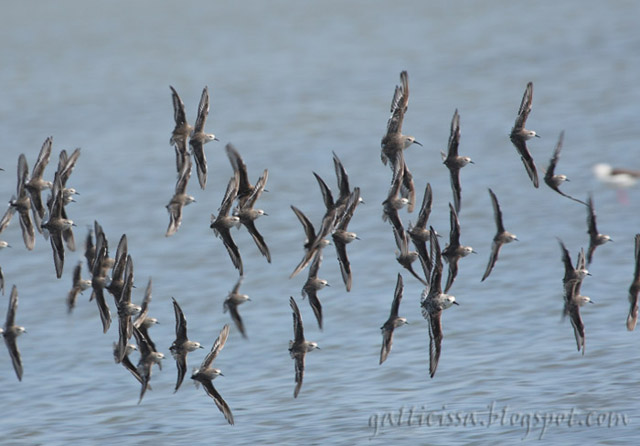
Calidrids
And here' a close crop of the area that I want you to see. You should be able to identify two strangers in it.

Strangers
The one that I want to point out is a Sanderling—the larger bird in lower middle. The other obvious stranger in this flock of Little Stints, is a Curlew Sandpiper, which is the one with a decurved beak, at the top left.

In Chilaw sandspits, there are enough Sanderlings to form flocks of their own during the migratory period. I saw my first Sanderlings for this season while birding alone at this site, on 1 Sep. In that, I saw four birds; they appeared to me as if they had just touched down in the balmy Sri Lankan shores.

Sanderlings, when they are found in their typical shoreline habitats, are absolutely pleasing birds to observe. This is mainly to do with their peculiar feeding actions. It is characterised by dashing runs towards the shoreline with each ebb, to frantically feed on any organisms exposed. Like this.


And soon turning back to run ahead of the breaking waves. Like mad.

Sanderling
Sometimes, those waves are too brisk for their comfort, and they are forced to take wing to take evasive action.


You really don't have to be a bird watcher to enjoy these avian tourists in their element. If you happen to pass Chilaw between now and late April, just pay a visit to the Chilaw sandspits to see what I mean.

Note: locals may not readily understand if you ask directions for "Chilaw sandspits" from them, for it is very much a term used by the small coterie of bird watchers to refer to this particular site.

This is how to get there: When you drive along the road that leads to the beach, turning right near the Chilaw Resthouse (which you should be able to find easily, with its directions clearly marked), turn left when you come across a colourful Catholic church, and then turn right again when you meet a small Catholic shrine—both within sight of each other. At this point the sea will come into view. The road gets narrower from this point onwards with houses of the fisher folk hugging it from either sides. From here, you will have to drive very slowly, as there are a lot of people around. I usually advise my drivers not to toot the horn while passing this stretch, as the locals may find it disturbing.

Generally speaking, the proletariat folk there are peaceful types. I have taken a fair number of western bird watchers to this site. No drama so far.

Anyways, once you pass the narrow stretch, you come to an open area, with a graveyard on the right (the dead centre of Chilaw sandspits). Having arrived there, drive another 100m or so and stop when you meet another Catholic shrine and walk towards the beach at that point. Scattered flocks of Sanderlings are usually found along this stretch. 6.00–9.00 a.m. is my preferred time belt to visit this site. Afternoons at times attract local visitors, who may not share the same level of passion in birds as you.

Once you are there, also look out for such goodies as Terek Sandpiper, Eurasian Oystercatcher, Western Reed Egret, and if you arrive on stormy weather, scarce seabird visitors such as Brown Noddy. This site is also great to observe a good array of tern species. These may include Whiskered, White-winged, Little, Caspian, Gull-billed, Large Crested, Lesser Crested, Common, and Bridled Terns. If you visit this site after reading this post, please drop a comment here to let me know how you fared.

Saturday, 21 February 2009

Birding with Keith and Julie Ellis

Sri Lanka Frogmouth male
I led an 18-day 'birds, wildlife and culture tour' with Keith and Julie Ellis from Kent, UK from 23 Jan – 9 February. Keith was a serious birder with over 3,000 world birds in his life list. He knew most of the species that he wanted to see by their scientific names and was a sharp birder. Julie had broader interests, which included culture. She was supportive and tolerant—two traits that I admire in non-birding spouses accompanying serious birders! A cultural extension added to the tour to please her took us to several Unesco world heritage sites that included Anuradhapura—the first capital of Sri Lanka from 4th century B.C to early 11th century AD, Polonnaruwa—the medieval capital from 11-13th century A.D, Sigiriya—popularly, a pleasure capital of a single king named Kashyapa in the 5th century A.D, and Kandy—the last Sinhalese capital from 16th to 19th century A.D, which is home to the Temple of The Sacred Tooth Relic, where a Sacred Tooth of the Buddha is encased in jeweled caskets that sit on a throne. In Anuradhapura, we also visited Mihintale—the cradle of Sinhalese Buddhist civilization and birded in the world’s first declared wildlife sanctuary, announced as early as in the 3rd century B.C.!

The 'World Heritage' Sigiriya Rock Fortress
We were quite lucky with the weather, and experienced nice dry conditions throughout the tour, which was perfect for birding. In total, we bagged 253 species of birds including all thirty-three endemic birds currently recognized. Nineteen of these endemics were bagged during our first two days at Kithulgala—in the "power play" stage of the tour. And this reduced the ‘asking rate’ during the rest of the tour considerably!

Some of the high-profile endemic targets bagged at Kithulgala included Serendib Scops Owl, Sri Lanka Spurfowl, Crimson-backed Flameback, Red-faced Malkoha, and Sri Lanka Blue Magpie.
The latter two species are usually considered as Sinharaja specials, but we made good ground by bagging them in advance to free up time to look for bonus birds. Our last endemic to be seen on the trip, Sri Lanka Bush Warbler was the one that gave us the hardest time. As it was proving elusive at my regular sites at Nuwara Eliya, a pre-dawn visit was undertaken to the cloud forests of Horton Plains National Park just to see it. The temperature at at the site we settled to look for this LBJ at the Horton Plains was just about 3 degrees centigrades! Not my cuppa tea! It was so cold that there was ground frost. Jesus Christ!

After 45 minutes of searching, I managed to spot one Sri Lanka Bush Warbler skulking in low bamboo thicket, thus making a clean sweep of the endemics. I suspect the reason for its inactivity at elevations low-down probably may be due to the very dry weather experienced at those sites.

Painted Stork
Painted Stork
A special highlight of the tour was seeing ten out of the fifteen resident night birds—with most offering multiple orgasmic views! This figure comprised of seven owls, two nightjars and the only frogmouth species found in Sri Lanka. This night bird number beat a previous high recorded on my tours of nine—seen on a 15- day birding tour in February, 2008 with four crack team of British birders.

Touching in the specifics of the haul of night birds and other things, our first owl of the trip was Chestnut-backed Owlet (shown below), and it was spotted by Keith while it was actively foraging at daytime close to our accommodation. The same species was seen moments later in another patch close by, with its characteristic call betraying its hide-out in the dense vegetation.

Chestnut-backed Owlet
Our second species of owl for the trip, a roosting Indian Scops Owl was picked by me quite by chance moments later, when I was looking for the skulking endemic, Green-billed Coucal in a thicket. We got decent views of the hoped for coucal and as dusk approached the scops owl cooperated at a more open branch to present us full view of its profile. Indian Scops Owl was recorded again at a nest hole towards the tail end of the holiday (that's like, work, for me) at Anuradhapura during the cultural leg.

Our day 2 at Kithulgala saw us getting cracking views of the highly-sought-after endemic, Serendib Scops Owl. This rain forest owl was discovered in 2001 and is one of the 2 ‘endangered’ endemics (which I believe should go up to 3 with Sri Lanka Bush Warbler added to it!). The other endemic bestowed with this conservation status, Sri Lanka Whistling Thrush gave an untickable view on our first dusk vigil, but did not disappoint us on our second attempt when a female showed up over 10 minutes. A change of strategy adopted by me did the trick for us: Keith and I occupying two different spots, at several metres apart, covering two vital angles. Both of us got it almost at once when the bird emerged secretly.

Our fourth Owl species for the trip and second for day two came in the form of a vocal Brown Fish Owl in flight. The same species gave cracking views at Nuwara Eliya, Sigiriya and Anuradhapura, the last at daytime courtesy of a mob of smaller birds harassing it.

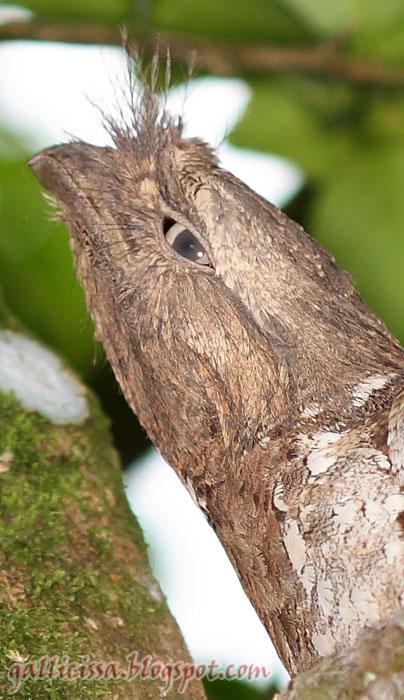
Our fifth resident night bird for the trip came in the form of a brooding male Sri Lanka Frogmouth (shown below and again, at the very top) at Sinharaja on day three. Rather sadly, we learnt the on the following day from our local guide, Ranjaka, that this nest had been ‘predated’ under mysterious circumstances. A Human involvement was suspected, which if true, was very very sad.

Sri Lanka Frogmouth - a brooding male
The day three also brought us the ultra-elusive Brown Wood Owl, which was our fifth owl and sixth night bird for the trip. We manage to see the same species on the following day too courtesy a mob of short-tempered Sri Lanka Crested Drongos. They dive-bombed it with no mercy at dusk pin-pointing us of the exact location!

Several Indian Jungle Nightjars seen at Udawalawe on day six proved to be our seventh night bird for the trip. This species offered very good views at close range at Yala too. Our eighth night bird and sixth Owl for the trip seen at Sigiriya saw us cleaning up all three Scops Owls of Sri Lanka, when Keith expertly zeroed in on an Oriental Scops Owl on day thirteen. It was calling teasingly close for over fifteen minutes. Its location remained hidden in the dense foliage for most angles available. When we found it, we had to make do with unsatisfactory back views of it due to the location of its perch.

The following morning saw us making a return visit to this site for it. After a bit of hardwork, I spotted a pair of this cute little Owls at dawn to give absolutely stonking views within three metres. Sadly, we had no camera with either of us to record this moment of magic. (Isn't that typical!).

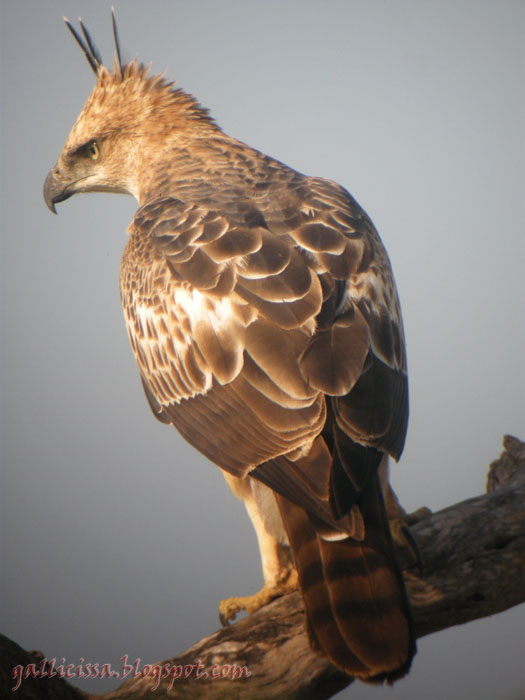
Crested Hawk Eagle Crested Hawk Eagle
Jerdon’s Nightjar spotted by Keith on a snag high up became our ninth night bird of the trip. That was again seen on day thirteen. A prolonged sighting of the same species in a low perch bettered this sighting three days later at Anuradhapura. Our last night bird for the trip was Common Barn Owl, a pair of which was recorded in a stake-out inside shrine in Polonnaruwa.

Concerted attempts at seeing Spot-bellied Eagle Owl, Brown Hawk Owl, Jungle Owlet and Sri Lanka Bay Owl failed on this tour. However, we came agonizingly close to seeing Sri Lanka Bay Owl, twice, but it just did not show up being vocal but staying uncooperatively hidden in dense foliage despite our best efforts to obtain an angle of view. This ultra secretive owl caused a mega twitch in Sri Lanka when it turned up in a daytime roost at Sinharaja in 2007. It is in public domain that at least one local bird watcher took a tuktuk tour all the way from Colombo to see it.

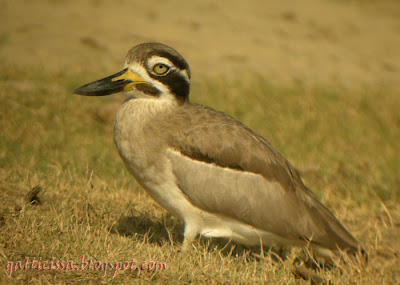
Great Thick-knee
Great Thick-knee on its knees
Our other birds of note recorded during the trip included Grey-headed Lapwing (vagrant & lifer for me seen at Yala thanks to US of Ceylon Bird Club who conveyed the news), Western Reef Egret (white morph one picked skilfully by Keith at Bundala, shown below), Legge’s Hawk Eagle (formely Mountain HE, great overhead views at Sinharaja), Chestnut-winged Crested Cuckoo (a lone individual outside a flock at Sinharaja), Fork-tailed Drongo Cuckoo (spotted expertly by Julie at Kithulgala), Black-backed Dwarf Kingfisher (seen & photographed at point black range at Kithulgala), Indian Reed Warbler (in song at Bundala), Slaty-breasted Rail (Scarce resident with possible migrant populations supplementing resident populations during migratory season, seen at Tissamaharama), White-naped Woodpecker (punctual!), Kashmir Flycatcher (at least 4 sightings with the first being of an adult male), Pied Thrush (great views at Nuwara Eliya) Common Ringed Plover (a scarce migrant, not too exciting to Keith), Dollarbird (seen thanks to G. de Silva Wijeyeratne at Kithulgala) and Eurasian Collard Dove (a scarce resident in Sri Lanka seen at Annaiwilundawa RAMSAR wetland, not too exciting to Keith). A Slaty-legged Crake at Sinharaja, seen only by yours truly, was the only bird species that eluded Keith.

Western Reef Egret - white morph
We had exceptional views of the ultra-elusive Sri Lanka Spurfowls when a female followed by a male were seen over five minutes, walking in the dimly-lit forest floor, totally unaware that we were observing them from a ridge higher up! Such heart-melting sightings of this game bird are rare, and this was one of the best views that I have had of it for quite a long time guiding an overseas birder. Before that we had brief view of it at Kithulgala. It was a case of BVD.

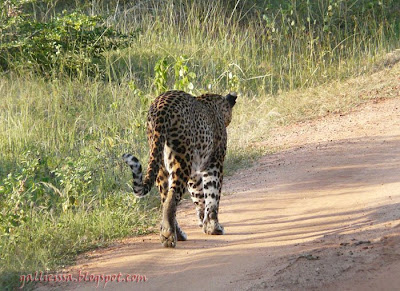
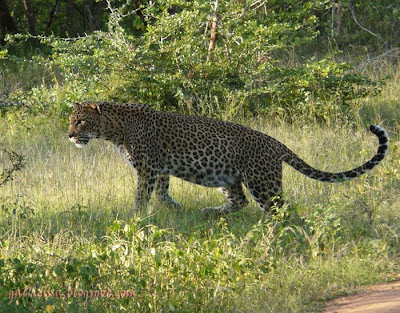
Moving on to non-birding matters, the Leopard shown below (same individual as in the previous post) was clearly our top non-birding highlight. We were the only jeep at the site when we found it. It was first sighted at 5.30 p.m., while resting in a shady spot near a water hole named rawung-wala (meaning circular water-hole) at Meda-para at the Yala National Park—the premier site for Leopards in Sri Lanka. The cat was about 25 m away when we found it first. Soon after we killed the engine of our jeep to observe it, the cat stood up and walked towards the track in front of us. It then continued to walk along it for a while like this, soon going out of view in the bend ahead.

Leopard at Meda-para, Yala National Park
We then approached it to find it again, this time within 5 meters or so from it, enabling us to photograph it at close range. Finally, after giving a good long glance at our jeep, it retreated into the jungle and disappeared out of radar.
Leopard at Meda-para, Yala National Park
More non-birding specials, we saw a pair of Barking Deers (Indian Muntjak) at Welimada. My previous sightings of this deer species has always been at the massive Wilpattu National Park. We exchanged glances with a pair of these before they retreated to the woodier interiors.

Sunday, 30 March 2008

One Fine Day

A pair of Eurasian Oystercatchers at the Chilaw Sandspits, 15 March, 2008
I did a half a day "water birds trip" with Joan and Martin Fine on 15 March, combining a couple of wetlands north of the Club Palm Bay Hotel, Marawila, where they were based.

Our first point of call was the shorebird patch Chilaw Sandspits, which proved quite productive with a flock of over 30 Sanderlings feeding frantically with their dashing runs ahead of the breaking waves. Always a pleasant start. A pair of hoped-for Eurasian Oystercatchers followed next, which had made Chilaw Sandspits their wintering grounds this migrant season. This as reported in previous reports by me is a good record as it is usually found wintering in the wetlands further north. A couple of Whimbrels surveying the coast weren't ignored. A Whimbrel at the Chilaw Sandspits, 15 March, 2008 Kentish Plovers and Lesser Sand Plovers were also represented in reasonable numbers and scanning them closely, I was able to zero in on a Greater Sand Plover, which Joan enjoyed especially with Lesser Sands nearby to compare.

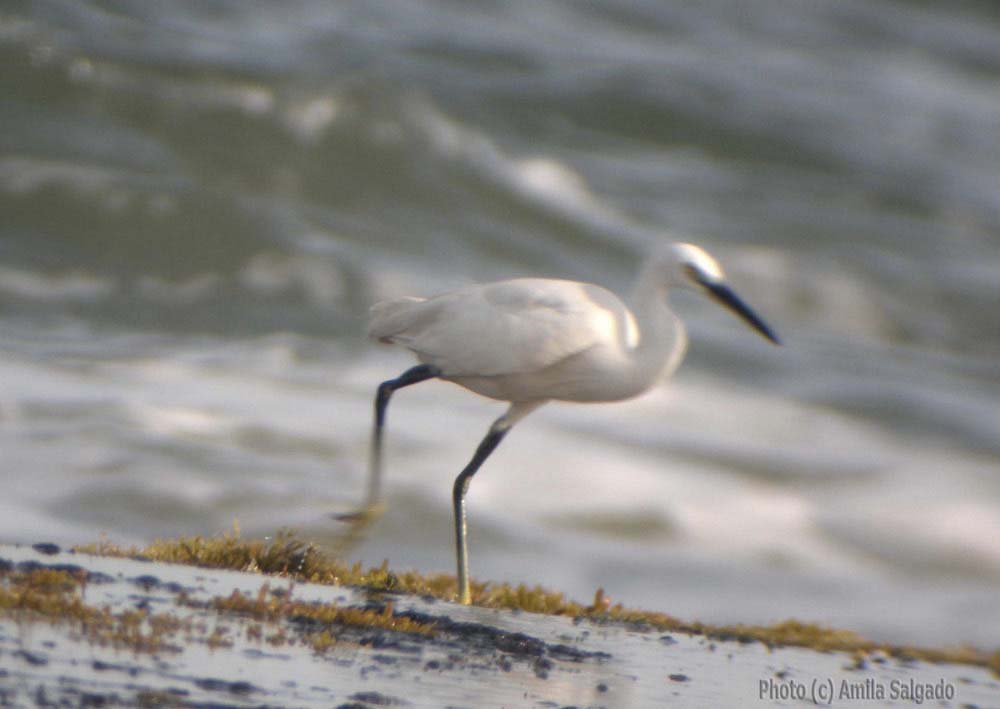
This was followed with the most exciting find of the morning when I spotted a distant white egret near the shoreline. It had its greenish yellow colour of toes extending up towards the hock joints of the leg and a heavier beak prompting me to claim exclaim 'Western Reef Egret!'

Joan had seen this species in Goa but this was the first white morph type for her. Closing in, we had several Little Egrets too in our view, which were useful for comparing the jizz, and this bird appeared quite different especially due to its heavier beak. Behaviour-wise and habitat association-wise too it strongly suggested of Western Reef being found running around the breaking waves at the edge of the shoreline. This is only my second white-morph individual ever, after seeing my first little over a month ago at Bundala National Park during my 15-day Absolute birding trip. This time, I got a fine photographer interested in it.

Here's a record shot.

In my opinion, if there is one bird that makes a mockery of the modern Bird Field Guides (books ) this would be it! Its supposedly ‘established characteristics’ listed in various Field Guide have made things a bit complicating when used to identify real birds observed in the field.

According to the most recent work on birds of our part of the world; ‘Birds of South Asia’ by Rasmussen, the bill of the white morph Western Reef Egret Egretta gularis compared with the Little Egret Egretta garzetta (with which it can be confused in the field) has a "a heavier, yellower bill (and longer in males)."

Coming back to the current observation, the individual observed had a clear black beak (as did the Bundala one for that matter) but the jizz (and leg colour too ) strongly suggested of Western Reef Egret. Grimmett’s ‘Birds of Indian Sub-continent’ suggests, "bill is usually yellowish or brownish-yellow, but may be black when breeding," which I feel is a more fair description given the variabilty of this feature.

The Collins Bird Guide to Britain and Europe by Killian Millarney, suggesting "Bill colour is variable, usually yellowish with darker culmen," acknowledging variability when there is variability is also good in my reckoning.

I invite you to see this analysis in the Stokes Birding Blog addressing such an Egret ID conundrum of a (possible) Western Reef Egret Egretta gularis in the USA using various Field Guides and sources. None of Field Guides compared in their analysis suggests the bill colour could be at times black!

I sent my WRE pictures to Krys Kazmierczak (surname pronounced as cash me a cheque) of Oriental Bird Club, who is also the author of the Field Guide to the Birds of the Indian Subcontinent. He too agreed that it is a Western Reef Egret, confirming my original claim.Coming back to other birds, we had a good diversity of terns. They were Great Crested, Lesser Crested, Little, Common, Whiskered and Gull-billed Terns.

Good views were also had of winter plumaged Brown-headed Gulls. Moving towards the lagoon side, I picked up a single Terek Sandpiper—at almost infinity. This was a good record (my second ever for this site) as it is an uncommon migrant wader usually found "Up North." At 60 times magnification, it showed a clearly up-curved beak, dumpy profile and clear orangey legs aiding the ID. Soon, Joan drew level, deftly picking up a pair of Great Thick-knees—her first lifer for this morning.

A Blue Tiger at Annaiwilundawa RAMSAR Wetland, 15 MarchTime seems to fly by and soon it was nearly 9.00 a.m. and time to go to the nearby Chilaw Resthouse for breakfast.The Annaiwilundawa RAMSAR WetlandThereafter, we drove to our second and the last patch of this trip: Annaiwilundawa RAMSAR wetland, which was teeming with life. Martin was overwhelmed with the sheer diversity of things in shooting range. Our highlights very quickly, dragonflies: Oriental Scarlet, Pied Parasol and Variable Flutterer; butterflies: Great Orange Tip, Plain, Common and Blue Tigers; reptiles: Green Forest Lizard and Common Garden Lizards keeping him rather busy.
A Common Tiger at Annaiwilundawa RAMSAR Wetland, 15 March, 2008Birding at this vast wetland complex was at its usual best, as expected for this time of the year.
Birds seen here were Pheasant-tailed Jacana in full breeding regalia, many wintering Garganey, Cotton Pygmy-goose, Lesser Whistling-duck, Little Grebe, Purple Swamphen, Oriental Darter, Little Cormorant, Indian Cormorant, Great Cormorant, Black-winged Stilt, Purple Heron, Intermediate Egret, Stork-billed Kingfisher, Pied Kingfisher, Common Kingfisher, White-throated Kingfishers, Purple Sunbird, Purple-rumped Sunbird, Brown-headed Barbet (nesting) and Blue-tailed Bee-Eater.

An Accipiter was scrutinised closely and it proved to be an immature Shikra while a pair of Large Cuckoo-shrikes that I found in the scope was the lifer no.3 for the day for Joan.

An Oriental Scarlet at the Annaiwilundawa RAMSAR Wetland, 15 March, 2008We returned to the hotel at midday to log our sightings before ending our short and sweet trip.
The above is my contribution to I and the Bird #75 hosted by me!

I and the Bird - Birding Blog Carnival

Wednesday, 5 December 2007

Birding with Liz and Keith Richie Part 1

Purple Heron

I did a Water birds trip with Liz and Keith Richie, England on 24 Sep, 2007. We combined a selection of sites namely Annaiwilundawa RAMSAR wetland, Palavi Saltpans, Nawadankulama Tank and finally the Chilaw Sandspits. Our driver was Sameera Arandara, who owns and drives a Nissan Bluebird Sylphy and this was the first time I used him for my tours. He did a good job in taking us to our sites promptly and safely, which was important in this type of tours involving multiple sites.

As expected our first stop; Annaiwilundawa RAMSAR wetland was dry as this was the tail end of the dry season. However, that didn’t stop us from seeing a good combination of scrub and wetlands birds including a few migrants. These included Blue-faced Malkoha, Crested Serpent Eagle, Pacific Golden Plover, Blue-tailed Bee-Eater, Purple, Long-billed & Purple-rumped Sunbirds, Brown-headed Barbet, Black-hooded Oriole, Wood and Common Sandpipers, Oriental Darter, Pied Kingfisher, Purple and Grey Herons & Black-headed Ibis.

Spotted Dove

Next, we visited the Palawi Saltpans, which was again drier than in August when I last visited this site. I had already told Liz and Keith to expect such conditions and to come ready to follow my ass (advance, stop and scan) technique. It didn’t take me too long to realize that waders were too over the head for Liz and Keith so I soon decided to change habitats to give them different birds, which they appreciated. Anyway, our brief Palawi-watch produced Grey Plover, Gull-billed Tern, Lesser Sand Plover, Curlew Sandpier, Little Stint & Kentish Plover.

Indian Green Frog

After enjoying a sumptuous lunch in the good-old Puttlam Resthouse; the Sri Lankan rice and curry lunch of which was described by Keith as one of the best meals he had on his Sri Lankan holiday, we leisurely explored the Nawadamkulama tank where we had White-naped Woodpecker, Black-Liz and Keith at Palawi Saltpansrumped Flameback, Common Coot (a locally scarce bird), Little Grebe, Purple Swamphen & Pheasant-tailed Jacana. Liz also picked up a Pied Cuckoo. We also enjoyed seeing several good-looking Indian Green Frogs aka Green Pond Frog (Euphlyctis hexadactylus) floating in good light.

Finally we explored the Chilaw Sandspits for Sanderlings and we were rewarded with good views of 17 of them in addition to Whimbrel and several Large Crested Terns. Thereafter, I dropped them off at their cosy retreat; Club Palm Bay Hotel, Marawila.

Friday, 16 November 2007

Water birds & Sea food trip

Common Greenshank and Black-winged Stilt
Kusum, a birding pal, and I organised a 2-day "water birds and sea food trip"  from 11 to 12 Aug., 2007. It served two puposes: to catch the early arrivals of winter migrants and to increase our blood cholesterol levels measurably. We were joined by several of our birding buddies: Mihiri, Umesh, Ayanthi, Rohantha, Madhu, Kishan and Devi—latter an MD—our doctor on call, just in case.

Our overnight base was a private Bungalow close to Kalpitiya, named the Turtle Point, which was recommended by Sandali Wijayatilake, who had been there in April and alledgely seen the highly sought-after Crab Plover nearby. All my previous sightings of this Deccan avi-faunal zone rarity had been in the Talaimannar area in Mannar, so one of the ulterior motives of this trip was to find it in a site more accessible.

We left Colombo very early and reached our first birding spot, Chilaw Sandspits—a wader patch in the western coast, north of the airport. It was too early in the season for the Sanderlings, which are usually found wintering here. But, we found a few early arrivals in the form of Common Sandpiper, Common Greenshank, and several Eurasian Whimbrel in the shoreline. A pair of Great Thick-knees and several Great Crested Terns also were noted. I was the only person with a scope, so as usual, there was a neat queue to take turns for better views.

Chilaw Sandspits is situated close to a fishing hamlet. Several of our participants had to experience ‘too much of reality’ too early in the morning. But what can I say? I had warned them precisely of such "ground realities."
 The queue
Breakfast at the Chilaw Resthouse was good and Kusum fell 10 short of his alltime string-hopper-eating record—gobbling 70!

This was with fish, potato, and dhal curries; plus pol sambol. The fish curry was a bit on the hot, and this was made an excuse to eat two slices of bread on top of it—in a bid put off the fire in his mouth!


Kusum:'no strings attached'
With our bellies full, we drove to the Annaiwilundawa RAMSAR wetland, which not surprisingly for this time of the year, was very dry—with its network of tanks reduced to small ponds here and there. A noteworthy birding highlight was  Large Cuckoo-shrike, which is somewhat of a regular at this site.

Cotton Pygmy-goose, Oriental Darter, Pied Kingfisher, Green Bee-eater, Indian Roller, Black-headed Ibis, Purple Heron and the four species of white Egrets, came in quick order. Thereafter, we drove up to the Puttlam Saltpans, which appeared devoid of birds at the first glance. It was so desolate that we almost turned back before we spotted a couple of small flocks of waders comprising of Little Stint, Curlew Sandpiper, Kentish Plover, and Lesser Sand Plover—all retaining variable degrees of summer plumage. Some of those Curlew Sandpipers were almost in full summer with their beautiful brick-red plumages.

Several Gull-billed Terns were also spotted settled down close by. Returning to our vehicle baked in the blazing Puttlam sun, the organisers of the trip bedazzled the lot with some chilled soft drinks pulled out from a a coolbox tucked inside a seat. A few brownie points.

We broke for lunch at the good old Puttlam Resthouse, and since this is not a FOGSL trip, some of us had the luxury to replenish the lost liquids properly with chilled Lion beer with devilled cuttle fish as "bites" (Sri Lankans almost never drink without bites—which are often spicy/fired dishes with liberal amounts of chillie and high fat eating thingies).

Next, we enjoyed an artery-clogging rice and curry lunch—with more cuttle fish, prawns curry, and some fish curry for those who didn't like prawns and cuttlefish.

Western Reef Egret
Post lunch, we explored the vast expanse of Palavi mudflats.

As soon as getting off the vehicle, I picked up the call of a Grey Francolin—yet another deccan avi-faunal zone specialty. It was my first at this site. We looked for it but had no luck. It was extremely dry here, as expected, resulting in the wader patches being too far from the roadside. I saw not much point in trying to scope things from the roadside so Rohantha, Mihiri and Umesh agreed to walk up to the wader flocks following my ASS (advance-stop-scan) technique.

We had to report to our accommodation at around 5ish with the dry rations that we had brought along, in order for the caretaker family to cook our dinner. So this meant we could ASS only 750m. However, this was enough to find several high profile early migrants in the form of a grey morph Western Reef Egret, at least five Broad-billed Sandpipers, and Grey Plover. Those who stayed back in the dry land had also picked up blobs of the Grey Plover and the Western Reef Egret, but had missed the Broad-billed Sandpipers.

Returning to our vehicle, we accidentally flushed a Grey Francolin, a lifer for the rest. A BVD, of course.

After getting some ice from an ice factory to cool our food and beverages, we drove to the fish market in Kalpitiya to buy some seafood. It was here that another one of my techniques came in real handy. When we turned up at the fish market, all the fish vendors, who happened to wholesale fish dealers, didn’t care about us townies wanting small quantities of fish. And they gave us ‘Colombo prices!’.

One of the interesting things about our culture (shared also with certain other eastern cultures) is addresing complete strangers in kinship terms. So I addressed the vendor that I was speaking to ‘Ayye’ (elder brother), for he clearly looked older than me. This not only conveyed respect, but also put me in equal level with him socially. To be effective, I used it more often in my sentences than I would do it normally.

And Lo and behold!

It really worked as that bloke who seemed rude, and unfriendly at first really loosened up. We were quoted Rs. 1,200 per 1 kg of ‘jumbo’ Prawns initially but thanks to my heart-melting Ayyefying, we walked away with the same quantity paying just Rs. 500, which was a great bagain!

Similarly, I Ayyefyed another vendor to get a 2.8 kg Paraw Fish (Black-Tip Trevally,) at fraction of the Colombo prices! And I did this wearing my shorts and looking more like one of them.

following my ass(advance stop and scan)technique
We reached our accommodation around 5.30p.m., to be greeted by our friendly caretaker, Lional, who looked after us extremely well during our stay. The Turtle Point has three rooms (one with two beds, and two with three beds) each coming with private facilities. Note it has no electricity. Also, there are also extra beds that can be used if you want to sleep out in the veranda, which is what Kishan, and I did as it was a bit stuffy inside the room. More liquids, checklist and a fine seafood dinner marked the end of a great day.

A pre-breakfast birding walk on the following day along the shoreline was productive with steady flows of Brown-winged (Bridled) Terns, a passage migrant flying south, close to the shoreline. This proved a lifer for some. Also seen here were Little, Common, Large Crested, and Lesser Crested Terns, in addition to Black-winged Stilt and more Eurasian Whimbrels. Other highlights were early arrivals of Ruddy Turnstone, Little Stint, Common Greenshank, Wood Sandpiper, and Curlew Sandpiper—all showing of summer and summer to winter transitional plumages in varying degrees.

No luck with Crab Plover. Our breakfast was rice with dhal curry, pol sambol and more Paraw fish curry.

Our exportations until lunch didn’t produce anything spectacular, and after another superb lunch, we bid farewell to Lionel and his family and drove to the Nawadankulama Tank. Here we had 19 Common Coots, a locally uncommon bird, and many Little Grebes feeding in formation. I also heard a yet another deccan avi-faunal zone specialty in the form of Eurasian Collard Dove, which would have been a lifer for the rest.

We returned home with copious quantities of Jumbo Prawns –the bloke charged only Rs. 450 per kg!

The above was my submission for I and The Bird #63 hosted by The Greenbelt
Related Posts with Thumbnails