Showing posts with label Butterflies. Show all posts

Thursday, 6 October 2011

Sinharaja in August

I am back after guiding several trips.

One of them was a two-day trip to Sinharaja rain forest from 28–29 August. It was with Dr. Jane Rosegrant, who is the outgoing country director of VSO (Voluntary Services Overseas) in Sri Lanka. An American married to a Scot, Jane holds a PhD in Human Ecology from the University of Edinburgh. The work of her organization here is mainly to do with assisting Sri Lankan people involved in the treatment of mentally ill. Jane was a keen birder and the main purpose of her trip with me was to see as many endemic birds as possible. While working towards that goal, she also did not mind seeing a representation of natural history that Sinharaja had in store.

I thought all the good karma that Jane had accrued from her altruistic line of work had a positive effect on our trip: we saw forty-nine species of birds, including twenty endemics, most of which obliged to provide scope views; we encountered four mixed-species bird flocks in full swing, first of which was found just two minutes into our very first walk; we were able to find one of these mixed-species bird flocks engaged in a midday bath, with several of the high-dwelling specials, some of which are found in the forest's canopy thirty-five to forty metres above ground level, obliging to give superb views low down; in between birding, we encountered a superb array of natural history, which included nine individual snakes belonging to four species, over a dozen butterflies species, and several mammal species including two species of monkey.

I am sharing below some of the highlights that cooperated.

Red-faced Malkoha

Red-faced Malkoha
This attractive cuckoo family bird proved to be one of the top endemic lifers for Jane. This particular individual was spotted on day two, while it was basking in beautiful early morning light, close enough to provide frame-filling views through in my Swarovski scope at twenty-five times zoom—orgasmic!

Mountain Hawk Eagle (Legge’s Hawk Eagle)

Mountain Hawk Eagle
This rare forest-dwelling raptor was found close to the Morapitiya rain forest, rather serendipitously, during a leg stretching stop that we did on the way to Sinharaja. It was perched atop a roadside 40-metre canopy giant. My lens didn't have enough reach to capture this well, so this is just a cropped and dirty record shot. This was only the third time in which I had been able to see this bird of prey while perched, so I was very pleased, as was Jane.

Red-spot Duke

Red-spot Duke
The nymphalids were in force, especially at midday and this rare gem was seen twice.

Grizzled Giant Squirrel
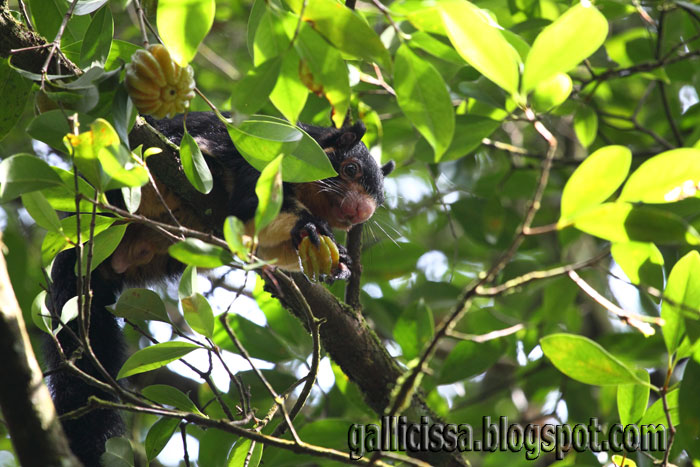
Grizzled Giant Squirrel
This chose to ignore us and nibble away at a fruit of the Malabar Tamarind Garcina gummi-gutta (Goraka in Sinhala), which is a resident tree species in Sri Lankan rain forests. Its fruit is a regular curry condiment in cuisine in our part of the world. Which I think makes this squirrel is a curry muncher! Or a real Gorakaya, if you like.

Anyway, this squirrel is one of the favourite prey species of the Mountain Hawk Eagle. Detecting one of these eagles soaring above the canopy, it would make “a blood-curdling” alarm call, which is not a strange to people who frequent rain forests. As a matter of fact, I use that call as a reliable indicator to spot airborne birds of prey.

I have planted a Goraka tree in my garden. It has reached nearly twelve metres, but is yet to bear fruit.

Striped Bronzeback 

Striped Bronzeback
This is one of the nine individual snakes we encountered, thanks largely to the superb snake-spotting skills of our local guide Dee. I have better shots of this snake taken on previous visits, just for the record. 

Sri Lanka Keelback

Sri Lanka Keelback
We found three individuals of this water snake at two sites.

Cruiser

Cruiser, male
Here’s another pretty Nymphalid butterfly that we saw at close quarters. It is christened Vindula erota scientifically, presumably because of its erotic nature.

Blue Glassy Tiger 

Blue Glassy Tiger
Although supposed to be "not found more than 20 miles from the coast" according to "The Butterflies of Ceylon" by Bernard d' Abrera, this butterfly is found at Sinharaja rain forest, which is more than 70 miles inland from coast.

Toque Macaque

Toque Macaque at Sinharaja
The Toque Macaques in Sinharaja are not forthright and confiding as those found in cultural sites, where they accost humans for handouts, and often commit snatch theft on anything that they see as food. The ones in Sinharaja are quite wary of humans, presumably because villagers have/are hunting them (in villages close to the forest) for bush-meat.

The Land Snail Arcavus superbus

The Land Snail Arcavus superbus
Here's a Gondwanaland relic land snail species in an endemic Nelu tree (Strobilanthes sp.) in bloom.

Apart from above specials, I also was able to photograph the Sinhalese Bushbrown—a butterfly lifer for me. And I got a decent sound recording of the Sri Lanka Scaly Thrush. Our birding highlights included Serendib Scops Owl and Sri Lanka Spurfowl, arguably two of the toughest endemic birds to see. And we saw a brooding male Sri Lanka Frogmouth in a nest.

Change of topics, who do you think will win the Rugby World Cup 2011? My money is on Ireland Australia! New Zealand!!

Saturday, 16 July 2011

The Monkey Puzzle, and I Am Like.


The Monkey Puzzle is, like, now in my garden's expanding butterfly list.
And I am, like, totally, happy.
First time I saw this rare beauty was like an year ago, close to Kebithigollawa.
It is named Monkey Puzzle because its "prickly" caterpillar looks like a leaf of the South American conifer Monkey-puzzle.

Today, I am heading to Kandy for the big rugby match between Kingswood and St. Peter's. At this moment, I am, like, in need of a pump up song ahead of this clash. So here it is.


The inspiration to use the word "like," except, where it was genuinely needed as a word, came from this post of London, Lanka and Drums.

Thursday, 9 June 2011

25 Endemics in 2 Days with Paul Brown

I guided Paul and Ros Brown on a 2-day trip to Sinharaja rain forest.  An entomologist by profession, Paul works at the British Natural History Museum in London. His main focus on the tour was birds, and more specifically, endemic birds, for which Sinharaja is famous for. Ros, on the other hand, was the supportive spouse of the birder, who preferred to read her book, leaving the boys to chase after the endemics. We did extremely well in the latter department, raking in a whopping 25 out of the 33 endemics in record time—of just 2 days! Fresh from leading several birding tours, I was in fine form, and that I think contributed to such high success.


A pair of Sri Lanka Frogmouths Batrachostomus moniliger at a day roost. 
 
My most rewarding find was the Sri Lanka Spurfowl—a male accompanied by two females which walked on a arc that I predicted they would take. Having our binoculars prefocussed on exactly that, it was all too easy to get splendid views of this ultra secretive endemic. All this and more are revealed in a report done by Paul.

Layard's Parakeet Psittacula calthorpe, formerly known as Emerald-collared Parakeet. The species name honours the maiden name of Layard's wife, Barbara Anne Calthrope.

I didn't do much photography as I was too busy finding birds.

Brown-capped Babbler Pellorneum fuscocapillus

Some entomological delights obliged too, and these included the commoner fair.

Common Rose Pachliopta aristolochiae

Glad-eye Bushbrown Nissanga patnia

Saturday, 30 April 2011

Owls, Leopards, Blue Whales, and Rapacious Flangetails

I am back after leading several exciting bird and wildlife tours.

My last tour for the season ended was a 15-day Natural History tour from 9 to 23 April, 2011 with Barry Barnacal, Gary Bellingham, Katrina Hay, and Andrew Vinson from the UK. The three gentlemen of this group were very keen photographers, and they carried serious photo gear, including Canon EOS 1D Mark 4s and lenses that ranged from 100mm macro to 500mm telephoto.

They came to me through a referral by Barry’s pal David Clugston—an avid birder and a worldlister with nearly half the world birds in his tally; he did an Absolute Birding tour with me in November, 2009. David was a pure birder, and did not do any photography while in Sri Lanka, opting just to watch birds and finding more of them. This explains why were able to rake in a massive 14-day tally of 252 species of birds, including all endemics.

The Brown Wood Owl Strix leptogrammica that I discovered thanks to a mobbing party of birds at Welimada.

Coming back to this tour, it was designed to focus on four aspects: birds, Leopards, Blue Whales, and other natural history.

After arriving in Sri Lanka, Barry, a former wildlife tour leader, wasted no time in briefing me that he and his group were not like their good friend back home! And that they certainly did not need to end up with a huge triplist. So, for them the success of the trip did not depend on making a clean sweep of special birds that most birders come here to see.

One of the main reasons why my visitors chose to visit Sri Lanka in April was to improve their chances of seeing the Blue Whale, as it is arguably the best month to see it, with almost a 100% success rate reported by whale watching operators. April also happens to be one of the best months for observing dragonflies and butterflies in Sri Lanka, as it sees most seasonal specials taking
wing. Being the tail end of the migratory season, April is not bad for birds either. And April is certainly not bad Leopards, which can be seen year round at Yala. So, the timing of the visit fitted perfectly with the broader requirements of the group.

So, with this rambling preamble, you may want to know how we fared.

Not too badly.

We ended up seeing 223 species of birds.
These included all 33 endemics and 10 out of the 15 resident night birds. And we bagged four Leopards at Yala, and four Blue Whales in the big pond 12 nautical miles off Mirissa.

Yes, it was real bagful!

As it is usual for April, we had good “viewing and photographic weather” in the first half of the day, with rains experienced during most afternoons. Which gave a lot of siesta time. This provided a nice balance because we found ourselves getting up early to take advantage of the conditions. And chill indoors during afternoon rains. Daylight was early, with the dawn chorus begining roundabout 5.30 a.m. At Sinharaja, the Blue Magpies coming to clean up the moths under lights at our lodge were punctual at 5.45 a.m. on both mornings we were there.

Gary wrote to me after the trip to say that he downloaded some 80GB of photos! I am sure others were not too far behind.
I too clicked a few here and there. Some of them are shared below.

Serendib Scops Owl Otus thilohoffmanni


I found a single bird in a day roost on day 1. Which, needless to say, got the tour to a terrific start. On day-2, there were two birds in the same roost, presumably male and female, and the picture above shows that.

The iris colour of the males of this owl is orangey, and yellowy in the females. After studying a picture taken by Andy, which he shot when the birds had briefly revealed a bit more of their eyes, I came to the conclusion that the top bird was probably a male, and the other, probably a female. The latter, as captured in this picture, was a bit more darker than the top one in real life too. Other than the eye colour, and differences in vocalisations of the two sexes, published literature on Serendib Scops Owl do not reveal of any diagnosable morphological features proving sexual dimorphism in this species.

Leopard ("Sri Lanka Leopard") Panthera pardus kotiya


Our first sighting was of two adults guarding over a Sambar Rusa unicolor carcass. By the time we visited the park, news of these two Leopards seem to have spread fast, judging by the traffic of safari jeeps. The Leopards were very much hidden in the vegetation and were not too photogenic. Shown above is one of the two Leopards taking us in amidst all the commotion created by the jeeps muscling for better viewing positions.

Soon, we wisely left the big traffic jam to look for other things.

With no local guide available because of new year holidays, I moved to the vacant front seat of our jeep. After finding Brown Fish Owl in a day roost, we arrived at a spot named Gonalabbe Kalapuwa, where Gary spotted a distant Black-necked Stork. After that we drove around for a while stopping frequently for various subjects.

And about an hour later, we found ourselves back at the site we saw the big stork.

Pausing there, we hit gold between 5.19 to 5.21 p.m. This was when Garry expertly spotted a Leopard ambling through the low vegetation towards the road where we were parked.


We backed off a little to get a clearer view of it. There was not a single jeep nearby, and we had this Leopard all to ourselves in the first minute or so.

It was our Leopard!

When it looked as if it was just about to cross the road behind our vehicle, a jeep came rushing behind us, apparently unaware of the big cat. The team wisely signaled to that jeep and brought it to halt just in the nick of time, before it could get too close to disturb the animal.

Everything seemed to work really, really well.
Seconds later, as expected, the Leopard nochanatly crossed the road between the two jeeps.


A moment of magic!


Had our four Mark 4s fired live GPMG rounds, this Leopard would have ended up in a pretty bad shape!


That’s why I like photography; it is such a bloodless sport.

Blue Whale Balaenoptera musculus


Travelling 12 nautical miles into the deep blue seas off Mirissa in beautiful weather, first signs of a Blue Whale were detected when we saw their diagnostic vertical blows. (On the whale watching trip done in April, 2009 with Peter Kaestner, as blogged by me before, we had first signs after travelling just 5.5 nautical miles.) After approaching this sighting, we detected two individuals moving together. Only one of them was noted by to lift tail fluke in its diving sequence. 


The above shows the two individuals seen closely. Two more were found farther away at the same time.

Compared to their massive body size, the Blue Whales are endowed with puny dorsal fins, which can be seen above. They are located roughly about three-quarters along the length of the body, and are visible when they are diving to reach deeper waters after breathing near the surface.

Indian Fritillary Argynnis hyperbius


We encountered this thirsty highland butterfly at Hakgala. It was very pretty in the underside.

Rapacious Flangetail Ictinigomphus rapax


I spotted this large dragonfly at the Bundala National Park in a patch quite far from freshwater. It was very much distracted by its large prey. Taking advantage of that, we photograpjed it from our safari jeep.

Sri Lanka Tree-climbing Crab Perbrinckia scansor


Katrina spotted this one and only tree-climbing freshwater crab at Sinharaja in a spot not too far from where we found the same species in the Absolute Birding tour that I guided in April, 2010 with Dr. Gil Ewing from the USA.

More posts of this tour will follow.

Thursday, 28 October 2010

Sinharaja in October—1

I guided a 2-day natural history trip to Sinharaja "world heritage" rain forest from 13 to 14 October, 2010. It was with Kevin and Annie Ford from Bath, England. Kevin was a keen bird watcher and Annie a nature enthusiast. This was their third visit to Sri Lanka, and they were staying in the Club Palm Bay Hotel in Marawila, which is a beach hotel situated north of the airport.

Our first point of call was my home garden, where a fig tree (Ficus tsjahela) was in fruit. A deciduous giant in a sea of evergreens, it had no leaves, having shed them all. And this made birding as easy as A.B.C.

Sri Lanka Small Barbet foraging in a Ficus tsjahela in my garden.

In a brief vigil near it, we saw close to fifteen Sri Lanka Small Barbets, which seemed to own the tree. Seen with them were a couple each of Brown-headed Barbet, Green Imperial Pigeon, and Black-hooded Oriole—all which waited long enough to provide scope views. A newly arrived migrant Forest Wagtail also showed up at a different spot, and it was photographed by Kevin.

In the days before the trip, I heard from my forest-based sources that it had been quite moist there. Wet weather during this time of the year is caused by inter-monsoonal rains. As we usually do on rain forest visits, we went prepared for wet weather. And what was the weather like during our trip? Not a drop of rain! Instead, we had bright and lush conditions to deal with! And with the 13th and 14th being weekdays, we had the forest virtually to ourselves. With all the rain leading up to our visit, and bright weather that we brought with us, the forest was absolutely teeming with life; we couldn't have timed our visit better!

On the birding front, we had a few mixed species bird flocks, starting with one found in front of our forest accommodation—at 2.30 p.m. on day 1. Of the flock-associated endemics, the Red-faced Malkoha was the toughest to get good views of. I eventually found one in the scope, in a full-blown mixed-species bird flock near the research camp. That was before it melted away into the canopy in the all-too-familiar manner. It was brief sighting, yet enough to note its diagnostic red-face to call it "tick."

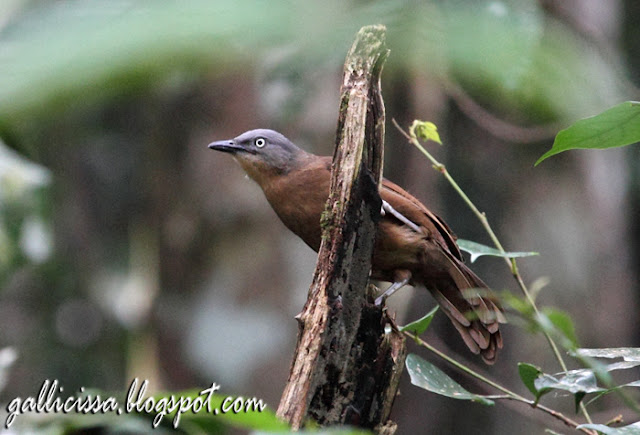
Hysterical laughter in the under-storey pointed our attention downwards to a flock of Ashy-headed Laughingthrushes—a threatened endemic and a regular member of the flock. I was able to take my first decent captures of this drab, forest-dweller, which is not too easy to photograph. Finally!

Ashy-headed Laughingthrush—a threatened Sri Lankan endemic.

The Indian sub-continent endemic, and a regular member of Sinharaja's bird flocks Yellow-browed Bulbuls were at their usual bubbly selves. One of them obliged to give Kevin and me photo opportunities.

Yellow-browed Bulbul, another regular in the Sinharaja's flocks, showed up well.

For some of us who preferred furry stuff, this Grizzled Giant Squirrel Ratufa macroura melanochra was a joy. It was found close to the track, unfazed by our close presence. The black and yellow bicoloured form of this squirrel found in the wet zone looks almost a different species to what is found in the dry zone, with which it is currently treated as conspecific.

A gentle giant

October being a top month for insects, most notably butterflies and dragonflies, we had an absolute blast in seeing and photographing them. I fail to pick a favourite, as all of them were special due to one or more attributes: rare, endemic, tough to photograph in field conditions, not seen by me before, not photographed by me before, and just too sexy.

Good enough reasons to make one go weak in the knees!

First, it was this Papilionoid butterfly Sri Lanka Rose Pachliopta jophon that landed on a "Weraniya" Hedyotis frutocosa plant in bloom. A quick disclosure why this was special: rare, endemic, and not photographed by me before.

The graceful female of the Sri Lanka Rose.

And then there was this common Papilionid, Tailed Jay Graphium agamemnon. Am I the only one who find photographing the Tailed Jay tough? It is like a butterfly on steroids: it has a rapid flight; it hardly stays long on a single feeding stop; each time it pauses for nectaring, it'd go into a fit of rapid wing quivering; and to make matters worse, rarely staying still, it'd constantly change the postures while nectaring; thereby, messing up compositions.

I think I will not bother with the Tailed Jay again. OK, may be I will, to get a plainer background.

Of the Danaid butterflies in Sri Lanka, four have been named Glassy Tiger, Blue Tiger, Blue Glassy Tiger, and Dark Blue Tiger!

Meet the Blue Glassy Tiger.


According to the Butterflies of Ceylon the Blue Glassy Tigger Ideopsis similis exprompta, "... does not occur inland more than 20 miles from the coast." I don't mean to sound pedantic, but it is a well known fact among butterfly enthusiasts in Lanka that a disjunct population of this occurs at Sinharaja rain forestmore than 3 times the maximum inland distributional range mentioned above.

The sun-loving Nymphalids were in force, relishing the bright conditions. We had two Red-spot Dukes Dophla evelina. One was on the track, and the other beside the track—both waited long enough for photographs; my first of this species. Here's the one we found on the track.

I declare the Red-spot Duke, bagged. I will not bother photographing this. Seriously.

Returning to our base, all sweaty and tired, after a marathon rain forest session lasting over seven hours on the second day, I spotted my first ever Gaudy Baron Euthalia lubentina at 1.00 p.m., sending me to fit of uncontrollable joy. About this, Bernard d'Abrera in his book The Butterflies of Ceylon wrote this: "... both sexes of this butterfly are so magnificent that they must surely rank as the most spectacular butterflies on the island."

One of the special Nymphalids seen by us—Gaudy Baron (male)—just too sexy. Other Nymphalids noted by us were Chestnut-streaked Sailor, Tawny Rajah, and Baron.

Not as Gaudy as the above, or its mate, this female Dawn Dropwing Trithemis aurora was one of the few dragonflies that obliged.

A female Dawn Dropwing. Of other dragons seen by us, the endemic Furhstorfer's Jungle Watcher Hylaeothemis fruhstorferi was special.

Our top reptilian highlight was this Green Wine Snake Ahaetulla nasuta . The genus of this attractive snake is of Sinhala origin, being the local vernacular for it, which means—"the eye-picker"—owing to its alleged reputation to pick eyes of unwary people. Rrrubbish!

Clicking on the images, you can view all images sharper in Flickr.
On other news, this blog celebrated its third birthday a couple of days ago.

Sunday, 17 October 2010

Absolute Birding–April, 2010

My last tour for the 2009/2010 birding season was a 14-day Absolute Birding tour from 17 to 30 April, 2010 with Dr. Gilmer (Gil) Ewing from Calif., U.S.A. Gil works as a specialist Paediatrician at Kaiser Permanente.

He had grown up in a lush, beautiful neighbourhood in Atlanta, where all families fed the birds in their backyards. Seeing such delights as Cardinals, Pileated Woodpeckers, Ruby-throated Hummingbirds, Blue Jays, and Purple Finches, Gil had got hooked on birds by the age four; he had reached a life list of 100 even before getting his first binoculars.

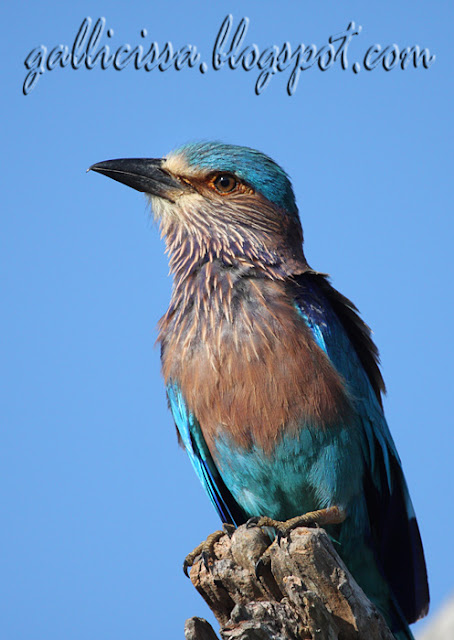
All pictures shared in this post were shot during this tour. They are spread randomly, so they are not always directly linked to what is revealed in bigger text near them. Now, about this picture, as the blue skies reveal, we had great weather during this trip. This Indian Roller we found at Bundala National Park gave frame-filling captures at the 300mm range of my 100–400mm lens. Gil too used a similar lens.

A prolific birder, Gil had seen “way over 4,000 species of birds,” but since his birding comrades had become jealously competitive and secretive, he had rejected the numbers game altogether and stopped counting. And he never reports his numbers to the official lists now. I was told that his ABA list to be somewhere in the region of 800, and a CA list to be over 500, but he wouldn't tell these things, if you don't ask.

Looking all handsome in its cute little bow tie dress, the Common Tailorbird's mountain subspecies fernandornis was found singing its heart out at the Victoria Park, Nuwara Eliya.

Gil frequently joins group birding tours of the “big three” bird tour companies in the U.S.: Bird Guides, VENT, and Wings; and have travelled with them to such birding hotspots as Panama, Venezuela, Galapagos, Peru, Namibia, Bhutan, Brazil, Indonesia, Madagascar, Kazakhstan, New Guinea, Ethiopia, and. Chile. He'd also been to Alaska 13 times. Six of these trips have taken him to the North American rarity hotspot Attu.

Gil and I photographed this Jerdon's Leafbird at Sigiriya where the morning light was great for photography.

During the journeys between birding sites, I probed his birding anecdotes. And weren’t they fantastic! My favourite was his Peruvian birding adventure, when he’d sighted a Jaguar during a daytime vigil in anticipation of a game bird, deep inside a Peruvian rain forest. This doesn’t make to the top because of this extremely rare big cat sighting. Instead, it was made special by of a web of stories to do with the people on that tour: serious birders, and the bird tour leaders. All I can say is it was definitely more intriguing than The Moment of Truth.

We found the best photo opportunities of birds at the Bundala National Park where the light was fabulous. This Painted Stork was perfectly lit and it gave Gil and me some decent exposures.

He had me gasping in shock and awe at some of the incidents that had happened on that trip. I think it would make a spellbinding documentary, in say, Discovery Channel. I asked Gil to write it up one day. Being the busy professional and the modest person he is, I doubt he will ever do it though.

This Grey-headed Fish Eagle too gave us frame-filling captures at the 300mm range at the Bundala National Park. Its got a horrible call that complements its severe appearance deficits.

Touching on the tour period, April was the only month Gil could travel to Sri Lanka.

April, incidentally, is a very special month for nature enthusiasts in Sri Lanka. First, it is the last of the “high-yielding” birding months in the birding season of Sri Lanka that starts in October with the arrival of migrants. Second, it is the best month for spotting Blue Whales off the southern coast of Sri Lanka—with almost 100% success rate of seeing them. (Gil was not keen on this, as off CA, he’s seen Blue Whales a plenty.) Third, it is one of the best months for observing rare and seasonal insects, most notably, butterflies and dragonflies.

Asian Elephants were in force at Yala National Park were we photographed this on the track ahead of us.

On the bird watching front, we did well for late April, seeing 216 species of birds, with all 33 endemic birds currently recognised. I showed 12 out of the 15 resident night birds—equalling my record, set a month earlier. Interestingly, the tally of night birds was identical to that of March. 101–108 species of birds (depending on taxonomy) were life birds for Gil. He wrote to me that “… night birding experience was amazing, especially when compared to the past trip lists …”

Gil’s favourite Sri Lanka bird was the Sri Lanka Blue Magpie, followed by the Serendib Scops Owl that I showed at the endemic hotspot Kithulgala.

The orderly Eurasian Spoonbills at the Bundala National Park.

My top birding highlight was the Oriental Scops Owl that I found at Sigiriya. On the night that I found it, we also heard an Indian Jungle Nightjar, but it was stubbornly uncooperative once again. (I need to work hard to break its "code.") As in March, we saw the Spot-bellied Eagle Owl well. (I could have photographed it well had I got a decent flash.) We also heard it again at Sigiriya. A howling of a terrified dog each time this massive owl gave out its blood-curdling scream was a creepy yet stimulating auditory experience.


Yellow Bittern’s status in Sri Lanka is “Breeding resident and regular migrant.” We had good sightings of it at the Bundala National Park. While birding with Pete Isleib in Attu, Gil had been able to locate an errant Yellow Bittern—a first for North America. This was after Pete had seen an unidentified heron-like bird flying off. After this, Gil and Pete have gone in separate ways to locate this mystery bird. And during that, Gil had managed to find it, and had identified it positively.

Gil had found me through this blog, after trying to identify some dragonflies and insects that he had photographed in a birding trip to Indonesia during last year with VENT. Although he was a serious birder, he certainly didn’t ignore such "other forms of life," and several seasonal delights seen during birding walks were appreciated well.

His top non-birding highlight was a Green Pit Viper that we found at a stake out at Sinharaja. For me it was the rare lycaenid butterfly Aberrant Bushblue. Not many serious butterfly chasers in Sri Lanka have photographed this one, let alone seen it, so it was a big catch.

We cleaned up all the lowland endemics by the third day at Sinharaja, and this gave time to explore Sinharaja's natural history treasures. One of these finds was this lycaenid butterfly Aberrant Bushblue Arhopala abseus. I photographed this with my 100mm f 2.8 lens with Canon MT-24EX Macro Twin Lite Flash.

Gil is also a grammar stickler expert, and I learnt a lot about grammar and usage matters that I either didn’t know or had taken for granted. And with all those selfish benifits extracted also factored in, this trip would rank high in my mind's list of best birding trips that I have guided.


We had two sightings of the one and only tree-climbing fresh water crab in Sri Lanka, Perbrinckia scansor.

Wednesday, 13 October 2010

Related Posts with Thumbnails