Showing posts with label From the past. Show all posts

Friday, 8 May 2009

Bagging the Blue Whale


Sri Lanka is one of the best places to see the Blue Whale Balaenoptera musculus—according to Marine Biologist Dr. Charles Anderson. He is based in Maldives since 1983 and his research on whales in the Indian Ocean led him to believe that Blue Whales should be present off the south coast of Sri Lanka in April—a hypothesis he confirmed with pelagic trips done in April 2007 and 2008. In the last of these trips, he has had Blue Whales on all 14-days he spent looking for them, with an average of 4.5 sightings per day!


Sri Lanka, as you may be aware, is a continental island, which had been connected to India for much of the geological past through epocs of lowered sea levels. The continental shelf that it sits on begins to slope after 3 nautical miles off Dondra in the southernmost tip of Sri Lanka, which is also the southernmost point of the whole of Indian subcontinent. Because of this oceanographical reality, ships plying between east and west have to circumnavigate Sri Lanka, passing by Dondra instead of cutting across the northern Sri Lanka, where seas are shallower.

According Dr. Anderson, the cetaceans migrating between feeding areas in the east and west of the Indian Ocean also take the same route as the ships. This, according to him, happens between December to April—with clear peaks in December and April.


With this beging the state of affairs Peter Kaestner, who at present is the world’s 7th ranked birder, came to Sri Lanka on a 9-day holiday with his family in early April—with wathcing the Blue Whales being central element of the tour. According to the latest numbers listed in Surbirds.com, Peter has got a whopping 8,180 species of birds, out of 10,000 or species found in the world.

In 1989, he was fortunate to discover a bird species entirely new to science, from Columbia, which came to be known as Cundimarca Antpitta Grallaria kaestneri.


This was Peter’s second trip with me. The first was in Sep, 2007 when he came on 3-day weekend birding trip wanting to clean up 8 Sri Lankan endemic birds missing in his world bird list. Before this, he had been on a solo birding visit to Sri Lanka in 1981—round about the time when I was getting ready to go to the kindergarten!

In the 2007 trip, we managed to see 7 of those 8 targets: Serendib Scops Owl, Ashy-headed Laughingthrush, Red-faced Malkoha, Sri Lanka Spurfowl, Green-billed Coucal, Sri Lanka Bush Warbler and Sri Lanka Whistling Thrush—the toughest endemics, with two being in the “endangered” club.

The one we missed out was the not-so-elusive Brown-capped Babbler. This miss was because some of those rare species we sought were found in two ecological zones – the lowland wet zone and highland wet zone respectively, and because some of them being rare birds didn't show up easily, demanding more time.

Oh! And because, we encountered foul weather throughout in this particular tour due to the period of travel coinciding with a monsoonal high.


We commenced our 2009 trip in the southeastern Sri Lanka with two game drives to the spectacular Yala National Park hoping to go 1-nil with the Leopard. Unfortunately, we drew a blank with this big cat this time.

But, to make amends, I managed to find the Brown-capped Babbler!

Next came the pelagic leg—the most important one—of the trip to see our main quarry, the Blue Whale.

Having started from Mirissa at 7.15 a.m., on 5 April, we had the first evidence of our first Blue Whale after travelling 4 nautical miles, towards—well—Antarctica. It was a distant but unmistakable view of a characteristic high vertical blow.

Tickable views were obtained around 5.5 nautical miles off. We had at least 4 good sightings of just an individual after we reached the hotspot and started looking intently. We knew it was the same one as it had a characteristic white marking in the tail, which showed up clearing with each surfacing. Here's a crude video of our Blue Whale. I should stress the word: crude.


At one point it was seen as close as 20-30m from our boat as it surfaced to breathe, almost taking our breath away. It performed well for us as well as for people aboard 3 other boats that converged at this hotspot for the same purpose. One of those was full of familiar faces with members of a local nature club. They, at one point, were pretty close. By the way, the terra firma you see in the picture below is Sri Lanka, just in case if you are wondering whether it is Antarctica.


I did not take my dSLR for this trip. That's because all my lenses are macro types. And the Blue Whale was not really a macro subject.

So, all these pictures shared here were taken by my trusty Panasonic Lumix FZ-18, which is also the model that Peter currently uses as his carry on camera. I bought mine after seeing this amazing shot he got by photographing the Serendib Scops Owl at night (using an older Lumix version).

A day trip we did following this to Sinharaja rain forest to see Sri Lanka Scaly Thrush and Crimson-backed Flameback was successful. The former responded aggressively to my rendition of its contact call by flying straight towards my head, indicating it may be busy nesting. These two birds together with Sri Lanka Woodshrike and Common Hawk Cuckoo seen on this tour by Peter went as ‘bank birds’—ones which do not get added to his bird list immediately as the ‘Clements' checklist’ that he uses to keep track of birds species seen, has not yet accepted these recent taxonomical splits/potential spits as valid species yet; and now that he has seen them, they would increase his tally once they are accepted as valid species in the future.

I nearly forgot, Peter became the first birder to see my garden's roosting Brown Hawk Owls.
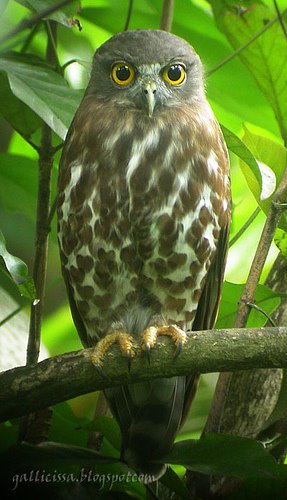
Brown Hawk OwlA related post: Finding lifers for Peter Kaestner

Thursday, 23 April 2009

What is your binocular?

Mine used to be Leica Trinovid 10 x 42. Its current price in Adorama is $1,395, but if you shop around you can find cheaper offers.

I paid Rs. 65,000 for mine in April, 2002. It was a slightly used one, but I didn't mind that as a brand new Leica Trinovid was beyond my reach. Before this, I had two binoculars—Bresser "Shark" 7 x 24, and Bresser 7 x 50 "Action"—both received as birthday gifts when I was younger. Sadly, both of these didn't stand my abuse under field conditions for long.

So, I found myself in the market for a pair of binocs again.

For much of my early years as a budding bird watcher—I used no optical aids—for reasons beyond my control. A proof for this is this picture taken on 11 May, 1990 on my first trip to Horton Plains National Park. (I am the sweetest one of the lot.)

My first trip to Horton Plains National Park

This highland trip was led by the bloke in shorts—one Kelum Manamendra-Arachchi—who as this picture testifies shows, was at the prime of his youth.

Kelum (ayya) is a celebrated biologist in Sri Lanka now. He has discovered and described countless number of vetebrates new to science from Sri Lanka, and have gone on to author, and co-author papers such as this, this, this, this and this.

By the way, today marks 19 years since my first trip to the Sinharaja rain forest. It was with the school's nature club from 23-25 April, 1990. I will be making a private trip to Sinharaja to celebrate this special anniversary, later this month.

Coming back to binocs, in late February, 2009, I treated myself for a Swarovski EL 8.5 x 42.
Being a top of the range binocs, it came at a big price tag of $1,660.(It was actually $1,825, but I got this special deal thanks to Ben Allen). However, its superior light gathering power—helpful in low-light conditions, increased depth of field and jaw-dropping overall optical quality amply justified the premium price that I paid for this toy.

As a naturalist guide, I often find myself birding in dense and dimly-lit rain forests conditions. I have experienced that the visual clarity of this binoculars is markedly better in dimly-lit conditions compared to my previous model. This was really evident when I trained my new toy on the cryptically-coloured Sri Lanka Scaly Thrush at the Sinharaja rain forest during a recent tour. The light garthering power was just amazing.

In early this month, having arrived early at Haputale to pick up a few bird watchers to start a tour, I found myself birding in their hotel gardens. There, I picked a pair of Tickell's Blue Flycatchers down a ravine. When I focused on one of them, I was simply blown away by the vivid colours that I was seeing. I have seen this bird for many years; however, it has never occured to me before that this bird has such a gorgeous blue patch in the forehead. Perhaps, I may have overlooked this feature before.

According to the specifications, the Swarovski EL binoculars allows a minimum close focusing distance of 8ft, which is ideal for odonatoholics like me. This excellent review says that you can achieve a minimum focus of 7 feet, which I think is probably right although I have never measured it precisely.

If you are an avid bird watcher who is in the market for a pair of binoculars, prefer nothing but the best, and don't mind paying a little more in exchange of quality optical experiences, go for these.

I like this comment mentioned by a reviewer in Amazon:
"Looking through these things is like ingesting some kind of powerful drug. One is transported into a new reality, one in which even mundane objects become endlessly interesting..."

So, what is your binocular?

Monday, 20 October 2008

Sticky matters.


I led a 17-day "Christmas Bird watching Tour" in December, 2004, for a reputed British nature tour operator. Its ground handing was done by a local travel agency to which I freelanced at that time. This tour stays in my mind for a number reasons.

First, the unfortunate reasons:

1. Briefed and given in writing as a "mostly bird watching oriented tour," this tour had five English people that included:

i. A nature photographer with a keen interest in wild flowers.
ii. A walking enthusiast who just liked to keep on walking.
iii. A natural history enthusiast with a passion for photography and a passing interest in birds.
iv. A hardcore birder who was heavily into listing.
v. A person who didn’t fall into either of the above categories.

It was like a challenge that Donald Trump would have chosen for the final episode of the Apprentice. I did my best to juggle all the balls without dropping any. What can I say,  it was a good learning curve!

2. The Boxing Day Tsunami, which caused havoc killing over 40,000 people in Sri Lanka alone, happened during this tour. We were mopping up the montane endemics at the cloud forests of Horton Plains National Park—the tallest plateau in Sri Lanka some 2,100 m above sea level—when the killer tidal waves devastated the coastal lowlands. And we were to visit this area in two days’ time!

I had the tour rerouted thereafter to stay away from the affected lowlands. I also decided to spend more time in the unaffected endemic rich wet lowlands.

And now, the fortunate reasons:

1. More time in the wet lowlands didn’t harm our burgeoning bird list one bit. This was the first tour in which I showed the avian jewel Serendib Scops Owl Otus thilohoffmanni to an overseas bird watching audience, after its discovery in Jan, 2001. Needless to say, it was a momentous day for mankind!

2. I made a clean sweep all 33 endemic birds on this trip—for the first time having started my guiding career in January in the same year. As a budding bird guide, it was an important rite of passage.

3. An observation that I made at Sinharaja "world heritage" rain forest became the subject of my maiden paper to a peer-reviewed ornithological journal. It is—

Salgado, A. (2006). Some observations on the diet of Red-faced Malkoha Phaenicophaeus pyrrhocephalus in Sri Lanka. Sandy (UK): Forktail Journal of Oriental Bird Club. 22: 122-123.

Click here to download a PDF of it.

Anyway, what I am trying to get at like Sir. Humphrey Appleby is to correct an error that had slipped in the above article by me.

In it, I had a ‘giant stick insect’ preyed upon by a Red-faced Malkoha identified as Palophus sp (Order Phasmatodea) after comparing it with what I thought at that time to be a reliable source of reference.

On 14 October, 2008 its identity was corrected by a world authority on stick insects: Dr. Frank H. Hennemann from Germany, thanks to intervention by Dr. Priyantha Wijesinghe who is a Sri Lankan Entomologist/Systematic Biologist based in the USA.

Accordingly, it is an adult female of Phobaeticus hypharpax (Westwood, 1859).

The classification being:
Order: Phasmatodea. Suborder: Anareolatae. Family: Phasmatidae Subfamily: Phasmatinae Tribe: Pharnaciini.

A better view of the Giant stick insect. Note the rear left limb is a result of an optical illusion created by a limb like branch behind. The actual left rear limb was broken off by the time I took this shot as this was photographed after the above
Dr. Hennemann disclosed that the locality data for all but one of the specimens lodged in the world museums including the type specimen from which Westwood named this species bear nothing beyond "Ceylon."

Therefore, he, was quite happy to receive the locality data of my Phobaeticus hypharpax that eventually ended up in the gut of the above Red-faced Malkoha.

Very interestingly, on 15 October, a day after this e-mail communication, Dr. Hennemann had a revision of the very Tribe: Pharnaciini published in Zootaxa in the form of a 316 paged paper, which included, the above species.

The reference is:
Frank H. Hennemann & Oskar V. Conle (2008). Revision of Oriental Phasmatodea: The tribe Pharnaciini Günther, 1953, including the description of the world's longest insect, and a survey of the family Phasmatidae Gray, 1835 with keys to the subfamilies and tribes (Phasmatodea: "Anareolatae": Phasmatidae. Zootaxa 1906: 1-316 pp. Auckland, New Zealand: Magnolia Press.

According to the above, and as per a personal communication by Dr. Hennemann, in addition to the above species, Sri Lanka has one more species belonging to the tribe: Pharnaciini, which is Phobaeticus lobulatus (Carl, 1915). Its body length is 162.0 mm and is a very similar species to P. hypharpax, which has a body length of 185.0–236.0 mm. The former is only known from the female holotype with the locality data reading again as "Ceylon" only. So far, it has never been recorded since its original discovery in 1915 according to him.

By the way, the world’s longest insect, referred in the title of the aforementioned stick insect revision paper is (drumroll, please) Phobaeticus chani—Chan's megastick from Borneo—with a body length of 333.5–357.0 mm. Its overall length with the limbs stretched out is a whopping 567mm!

This is a completely new species described based on a specimen in the collection of a Malaysian naturalist and insect collector from Sabah Borneo, Chan Chew Lun, who had received it from a local collector. Dr. Philip Bragg named it in honour of Chan who had donated his world record holding megastick to the British Museum of Natural History.

If you are really into sizing up your megasticks, the former record holder for the world’s longest insect title based on body length was Phobaeticus kirbyi with 317.0mm., which is also found in Sabah, Borneo. So the newly described Chan's megastick is 40mm longer!

The former record holder for the overall length with the limbs stretched out was Phobaeticus serratipes distributed in Peninsula Malaysia, Singapore and Indonesia of which one has been measured at 555mm.

The new megastick on the block has beaten that record too by 12mm. However, this recorded would have been greater by 7–10 mm if the specimen of Phobaeticus chani donated by Chan Chew Lun had not been damaged according to Hennemann and Conle, 2008.

So no matter how you size up, the Malaysians get to retain the coveted world record title for the world’s longest insect by a long margin. I am sure Tabib, who is a regular visitor to my blog from Malaysia, will be proud about this.

I’d like to conclude this post by saying a big thank you to Dr. Hennemann for taking his valuable time to help with the identification of my megastick. Last but not least my profound gratitude is due to Dr. Priyantha Wijesinghe, for sending my images to Dr. Hennemann to seek his expert opinion and communicating to me the same and putting me in touch with such a world authority.

Saturday, 5 January 2008

A Mountain Hawk Eagle in a dump

Mountain Hawk Eagle - 16 Oct, 2006
How often do you get to see a Mountain Hawk Eagle in full view for over 15 minutes in mist-free perfect light conditions? I would say not very often. That is exactly how lucky two dozen or so FOGSL members including myself were during our annual highland birding trip between 6–8 October, 2006. It happened on the 6th October at 5.30 p.m., on our very first walk and the location was Bomuru-ella forest reserve—close to the official garbage dump of the Municipal Council of Nuwara Eliya. Needless to say it was the highlight of the trip for me and most other participants. It was arguably the best view that I have had of this enigmatic forest dweller. Most of my previous encounters have been of birds passing over head majestically, and disappearing into a veil of mist. It was feeding on a rat and seemingly was more occupied with its meal than in vigilance—the reason why got so lucky.
Related Posts with Thumbnails