Showing posts with label Owling. Show all posts

Wednesday, 25 May 2011

Brown Hawk Owls Sharing a McSunbird Meal


I spotlighted this pair of Brown Hawk Owls during the last tour close to the airport at Katunayake. We first saw the bird on the right arriving at  the above perch with a mouthful. It was soon obvious that the victim was a bird. And looking at zoomed up pictures, I could see that it was a Purple-rumped Sunbird.  

As it started to feed on its prey, it was joined by its mate, seen on the left.
After opening up its prey and biting it heavily—probably to tenderise the prey—the owl with a mouthful presented its meal to its mate next to it to the clatter of Canon Mark 4s.

Here's a close up of this interesting behaviour.


Sadly, I could not photograph it as I was acting as the torch bearer to illuminate the scene. (I don't use a camera flash, so I couldn't have photographed this anyway because this was at nighttime.) These photographs are thanks to Gary Bellingham.

Brown Hawk Owl is a regular in my home garden. It sometimes turns up in daytime roosts, looking smart like this.

My mother is quite fond of this owl. She's often asked me why smaller birds harass it so much when it seems to mind its own business. She's right in way— whenever this owl reveals itself those smaller birds really give it a tough time, mobbing it with no mercy. So much so, they often succeed in chasing it away from its roost and from their sight.

Thanks to Gary's pictures, I have now been able to convince her why smaller diurnal birds such as sunbirds direct so much anger towards the Brown Hawk Owl!

Saturday, 1 January 2011

Happy New Year!


I hope the New Year will bring you peace, happiness and good health!

The endemic Chestnut-backed Owlet above was photographed last November at Kithulgala while guiding Dr. Wilf Powell and his wife Mrs. Julia Powell on a 14-day Absolute Birding tour. I am always careful when typing the name of this bird to avoid the embarrassing misspelling: Chestnut-baked Owlet!

I first heard mobbing calls smaller birds, typically made when a predator has been spotted. Scanning the centre of this commotion, I found this owlet, clearly startled by the abuse. When this species of owl is sighted front on, you often do not get to see its beautiful chestnut back. With its chestnut back to us, it rotated the head to look back at us. A really neat view.

This was our second Chestnut-backed Owlet for the trip. I shot it at 1/250 at ISO 4000 using Canon EOS1D Mark iv and Canon 100-400mm lens. I removed camera noise using Noiseware Professional.

1 Jan., 2011 marks my 34th birthday.
And, as usual, gifts are accepted at 146A, Pahala Bomiriya, Kaduwela, Sri Lanka.

Wednesday, 15 September 2010

Sinharaja with FOGSL–2010

I am back from a trip to Sinharaja rain forest with the Field Ornithology Group of Sri Lanka (FOGSL) from 9-12 September, 2010. Prof. Kotagama, who usually leads this annual birding pilgrimage couldn't join us on the first two days because of some commitments. So, the main responsibilities of guiding on "birds and related matters" fell on me—as in 2007 and 2008. This year's trip had twenty-eight participants—mostly newbies.

Prof. Kotagama joined us from the late afternoon's bird walk on 11 Sep. onwards. And in that evening, we listened to his traditional lecture: "History of Sinharaja, and Mixed-species Bird Flocks"—the research of which is being spearheaded by him since the 80s.

We saw a total of 42 44 species of birds. This was fewer than what you'd normally see on a similar length tour to the dry zone. But, the important thing was, nearly 50% of our Sinharaja tally comprised of endemics—and new birds to most participants. So what we lacked in quantity, we certainly made up with quality.

We had a good mixture of rainy and sunny weather, as it is usual for this time of the year. I had absolutely no complains about the rain; I like my rain forests wetter and lusher.

We had the services of Dee as our local guide. As always, he delivered what the group and I wanted, with a smile. After making a clean sweep of almost all the flock-associated specials such as Orange-billed Babbler, Crested Drongo, Red-faced Malkoha, Ashy-headed Laughingthrush, Malabar Trogon, and the likes, I sent Dee to find several "high-value targets."

High on my "hit-list" was Serendib Scops Owl—an endemic bird discovered in 2001.
After several hours, Dee met me, looking as happy as a dog with two tails. Soon, I was taken to a spot, and shown this adorable Serendib Scops Owl, sitting on a Cyathia fern, doing its best to disguise its real birdie profile.

Returning to our base after this, I paused to search a patch, after hearing alarm/mobbing-type calls of Yellow-browed Bulbuls, and Black-naped Monarchs. Su Bambaradeniya who was with me, mentioned of seeing a perched bird taking wing; disappearing into the forested valley below. So, I searched that general area, also aided by the angry mob still at it. Moments later, I spotted the target of the mobsters's wrath—a Chestnut-backed Owlet—a lifer for all. Scope views followed through my Swarovski ATM-80 HD.

And with that, we cleaned up all the endemic owls.

A notable absentee among birds was "Square-tailed" Black Bulbul—not even heard. A Besra juvenile (a bird-hunting raptor) obliged to provide scope views in front of our accommodation; two more separate sightings of this species followed.

Close to the research camp, a Sri Lanka Scaly Thrush was expertly spotted by Dee.

My top behavioural observation—in the birds category—was seeing the mainly insectivorous Sri Lanka Scimitar Babbler feeding on the fruits of the pioneer Macaranga indica [family:  Euphorbiaceae; boo-kenda in Sinhala (pronounced, boo can-the)]. 

Aug.–Sep. mark the fruiting season of this pioneer, and I have previously observed other such mainly insectivorous birds, that make up Sinharaja's bird flocks, opportunistically "turn to bit of fruit" when Boo-kenda was in fruit: in Aug., 2007, I observed Orange-billed Babbler and Ashy-headed Laughingthrush feeding on Boo-kenda; in Sep., 2007, I observed Ashy-headed Laughingthrush of a mixed-species bird flock feeding on Boo-kenda—a behaviour, which was copied by a Crested Drongo that was nearby.

This Red-faced Malkoha was seen early during our last birding walk, was photographed when it perched on a tree across the field close to the entrance. I showed this enigmatic endemic to all newbies through my scope.


Change of topics, I was absolutely shocked to see the recent "improvements" done to the track by the Forest Department (FD) have turned it all muddy. And I have one word to explain the mud all over the track and those "planners" who caused it—thick.

May be this needs more explanation than just one word. But, I'll be brief.

FD has dredged a canal along the left side of the track, in sections between the barrier gate, and the turn off to Mullawella trail; and splayed the dredged soil on the track, forgetting that it rains here. And the result is this—a (previously) usable track for walking, turned into a quagmire.


Pressed to find drier paths, walkers have used the higher ground on the right, destroying low flanking vegetation on the roadside, not to mention the habitats of myriad critters. Here are FOGSL members negotiating the "facelifted" track.


I suppose the Forest Department may have perfectly logical explanations for this. Like trying to attract water birds bound to Bundala.

All you "planners" in your comfy air-conditioned rooms who are responsible for this, I have a simple message for you:

Sinharaja is like a rain forest. So it rains here a lot. Which is why rainfall figures of rain forests, such as Sinharaja, are expressed in metres rather than millimetres. So when you put loose soil on the track, like you've done, things really get messy after a while. Right now, your actions have made walking on this track, a nightmare. Please clear the mess you have created. The track you should repair, as a matter of urgency, is the old 3km stretch that connects the ticket office at Kudawa with the barrier gate. Which is like a dried river bed. Please make this "world heritage" rain forest visitor friendly; it's a national disgrace right now.

On the positive side, the conditions underfoot, made me the coolest dude of the lot because I was the only person sporting welly boots. I was as confident as this male Sri Lanka Junglefowl.


But, I wasn't really dressed to impress like this Sri Lanka Blue Magpie though.


The Spot-winged Thrush was heard and seen in song; it looked to be in a breeding rush again. A few members had observed one of them mobbing a Sri Lanka Blue Magpie—a notorious nest predator. 

Natural History Specials (part).

Cruiser Vindula erota.
Kusum Fernando (KF) spotted this female, when we were waiting for a "flock" near the research station. KF's now metamorphosed into a butterfly-chaser, with birds coming third; second is photography.
With species names like this one's—meaning "erotic"—who can blame him!


Striped Bronzeback Dendrelaphis caudolineatus
I spotted this uncommon tree snake in the primary forest patch close to the research camp—my top natural history highlight. I was seeing this snake, quite familiar to me, after a long time.


Kangaroo Lizard Otocrytis wiegmanni
Close to the main track, I spotted this male, sporting breeding colours.


Common Bronzeback Dendrelaphis tristis
We had three sightings of this tree snake, resting in ambush on ferns flanking the track—where "improvements" have not swept through.


One-spot Grass Yellow Eurema andersoni
A stupid name for an otherwise pretty, endemic butterfly. I spotted this seasonal delight, fluttering low over a shady section of the track, and shared it with KF to whom it proved a butterfly-lifer. I am quite familiar with this species, having photographed it earlier. Grass Yellows are tricky little ba butterflies. And photographing them definitely helps to put names to them.


Luckily, it was found in an unmolested section of the track, so that KF and I could lie low to shoot it.

Here are the newbies, old bees, spelling bees, and NIMBYs. The one with the Santa Clause-like beard is our good ol' Prof. Kotagama.


KF shot this using my camera; he had to take 3 shots to capture the whole group as my lens was not a wide angle one. And I stitched 'em all using PhotoStitch.

Popularising bird watching—traditionally limited to upper-class types—is one of the fundamental objectives of FOGSL. It was great feeling to share my joy of birds with loads of like-minded people. And to see their faces light up, after getting their first glimpses of these avian jewels through my scope. If the tour comments and feedback I heard in the end were anything to go by, Prof. Kotagama and I made most of those participants, joining on their first field trip with FOGSL, firmly hooked on birds.

That, to me, tops all the highlights mentioned above.

Monday, 26 July 2010

Sri Lanka Frogmouth


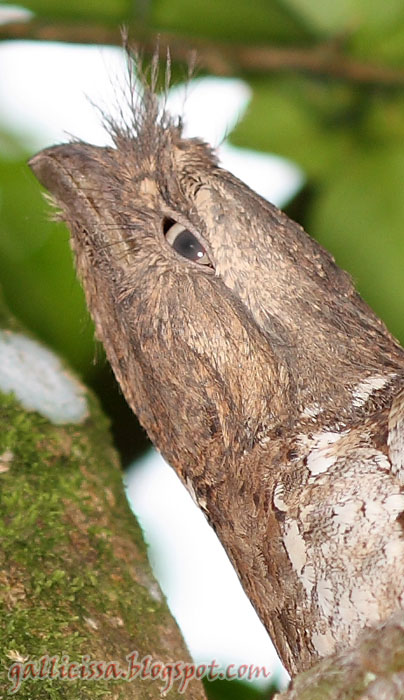
Here is a pair of Sri Lanka Frogmouths huddled together at a daytime roost. The male is looking at the camera, and the female is the more tawny coloured bird next to it. I photographed them at the Sinharaja 'world heritage' rain forest, when I guided Dave Thrussel and Chris Holtby from the UK, in March, 2010. I reached a personal milestone on this tour in showing twelve out of the fifteen resident night birds found in Sri Lanka—a record I equalled in April, 2010, guiding Gil Ewing from CA, USA. In the latter, I showed the identical mix of species as in March. Before these two tours, my previous best tally of night birds shown in a single tour was ten, and it was recorded in a serious birding tour done in February, 2009, with two British birders.

Tuesday, 11 August 2009

Corona

I was in the market looking for a decent headlamp to spot night birds and wildlife. After doing some research, I found the perfect one, the Corona LED Headlamp from Outersports.com. It is a product of Princeton Tec, the makers of high quaility light products.

Corona LED Headlamp

For spotting nocturnal birds and wildlife, it is important that the source of light that you use for it is held as closer to your head as possible in order to detect their eye-shines. Corona fills your entire field of vision with an even distribution of light simulating daylight conditions and achieves this task spectacularly well. The wide beam of light it produces prevents the need for your eyes to adjust quickly from very bright to dark areas and eliminates eye fatigue. The wider beam also eliminates the need to move your head too much – a real pain in the neck with previous headlamps, which offered narrower field of view.

Corona uses eight permanent high-power 5mm white LEDs (producing white light) and you can selectively light eight, five, three or one of them depending on the scene you want to illuminate. Once the number of LEDs have been turned on like this, you can further dim them or get them to flash continuously. I do not require using the latter feature much, but the dimming function helps a lot to observe animals that are wary of brighter lights.

Proving this point, a few days ago, I spotted a family of Asian Palm Civets in my yard with my Corona. I observed them with all 8 LEDs on in dim mode – just to be on the safer side. The Palm Civets just went on with their normal behaviour, in foraging at distances of 10-15m and they did not appear to be too bothered by my headlighting them. Eventually, I left the scene leaving them where I found them.

The angle of the light source of this headlamp can be altered to get the light coming at a downward angle from the forehead to illuminate the subject just perfectly for binoculars and/or cameras to focus upon simultaneously. With a hand-held torch it was always a difficult task to hold it in one hand and try to focus on the the subject with the binoculars from the other hand. (Yes ladies, we men are hopeless at multi-tasking). I found the eight LEDs in full brightness quite sufficient to identify subjects about 25m or so, which is really enough on most situations on jungle walks.

The Corona LED headlamp requires three AA Alkaline or Lithium batteries. The burn time varies between 70-30 hours depending on the intensity and mode. Corona uses current regulation so the light source chosen will remain at a constant brightness as long as the batteries have sufficient voltage to run them. It has very good power-saving options. The Dim mode is known to produce 40-50% of the maximum light of high mode with as little as 25 % of the battery power as on high mode.

For night birding, I prefer a light source that produces white light as opposed to yellow light. This is because the yellow light casts a tawnier hue on otherwise none-tawny night birds. Take a look at this male Sri Lanka Frogmouth that was digi-scoped at a daytime roost with the available low-light.

Sri Lanka Frogmouth - digiscoped in available daylight

Now look at the same bird photographed with a torch producing yellowy light.

Sri Lanka Frogmouth male digi-scoped with yellowy light

The photogaph below is the same bird photographed by a friend named Riza (not the drummer) using a dSLR camera and in a different angle.

Sri Lanka Frogmouth male - photographed by Riza

You can see that the real ground colour of the bird is grey. In the picture taken with a torch with yellow light, the male appears tawnier and therefore very much like a typical female of this species (well, there's also a colour morph of the male that is more rufous-brown and approaching the colour of the female). Corona LED Headlamp will avoid you falling in such visual pitfalls and you will be able to see the colours of the birds closer to what you will see in daytime. BTW, click here to read detailed article by me about the plumage of this interesting-looking bird.

I tried the Corona as the light source (for focusing and clicking) for night time macro photography too. However, it is not used as a headlamp but as a hand-held lamp. This is because you cannot wear it on your head and find the subject in the view finder as the big macro flash that I use (Canon MT-24EX) blocks the fore-head area where the light source of the headlamp would be placed. This Common Shrub Frog in my yard was photographed with Corona hand-held together with the camera. I used three LEDs on in dim mode for this.

Common Shrub Frog

The outersports package arrived in air-mail direct to my house and I did not have to waste time at the ‘big post office’ in Colombo and go through custom procedures as in previous such deliveries.

Disclaimer: Directing light sources at the eyes of the nocturnal animals can be harmful for their vision, so please dim the lights/use brightness-reduction methods when viewing them. And never overdo it.

Wednesday, 1 April 2009

Birding in style

I did an 18-day ‘birding in style’ tour from 24 February to 10 March. It was with four bird watchers from Australia and England. This was my first birding in style tour. And it was put together for Ben Allen from Perth. He was joined by his wife Fiona, her mother Shirley and their birding friend, Sybil Sassoon—the latter two Brits—both born in 1932! This was the first trip to Sri Lanka for the first three, but for Sybil it was the fourth— having led tour groups in 1973, 1982 and 1994! She remembered seeing Leopard and Sloth Bear very well at the Wilpattu National Park in her previous visits, and was very pleased when we found this massive Leopard— one of the two we encountered—at the spectacular Yala National Park. Sybil and the African specialists in all of them noted that this was the biggest individual they have seen. I was happy to hear that.

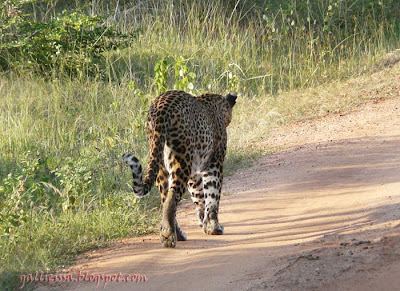
We found it when we were leaving the park and it just kept walking like this.

Leopard at Yala National Park
And pausing briefly...


...to checking us out, before disappearing.


My ‘birding in style’ tour uses swanky accommodations, which include 5-star nature resorts, and boutique hotels—with good garden birding, and top recreational facilities. It is operated at a much slower pace compared to serious birding tours, in which we aim to see as many birds as possible. This relaxed pace is mainly for one thing—to enjoy no-nonsense arm-chair birding! Very important, our slow approach also leaves us enough time to experience such guest facilities as spas, and infinity pools in the posh accommodations we use. Special dining experiences also mark another crucial element of this tour with international buffets, fine dining, and a good mix of Sri Lankan cuisine for those who are adventurous enough.

One of the trappings of being a tour guide, is that I too get to experience the same facilities and experiences as my guests, more often than not.

I'll explian a day at Heritance Kandalama:

A hour and half of morning birding—starting at 7.00 a.m., breakfast buffet, 40 minutes of post breakfast arm-chair birding near the hotel's rock pool, followed by an extended time at leisure to do our own thing.

For me the latter included, a bit of bird-sound recording, watching cricket in the TV, volunteering to sample a complimentary spa treatment that Ben didn't want to do, lounging by the pool with everybody—scoping birds that visit a fig tree near the pool with a chilled Carlsberg as an observational aid.

Buffet lunch.

A post-lunch power-nap, two and a half hours of absorbing late-afternoon birding in the hotel gardens, a shower, checklist over drinks.

A ‘Mongolian night’ buffet dinner.

More TV before finally retiring for the day.
Crickey mate! This job, guiding, can take a lot of ya!

Such pure pampering and holiday spirit notwithstanding, we managed to see 230 species of birds on this tour, which included thirty out of the thirty-three endemics. The endemics we didn’t see were the very endemics we didn’t bother to look for—the Serendib Scops Owl, the Sri Lanka Bush Warbler and the Sri Lanka Spurfowl—a troublesome trio—which my clients unanimously decided to let go.

Our final bird tally included six of the fifteen resident night birds. We also scored twenty-seven mammals on this tour including all four mongooses found in Sri Lanka. This included a species that is getting rarer, the Stripe-necked Mongoose, which was expertly spotted by Sybil close to the legendary Rawana Falls.
While there are many highlights on a tour such as this, spanning over 18-days, some stay in memory for very special reasons. They are as follows in no particular order.

(a) A White-throated Kingfisher beating the hell out of a 'Tawny-bellied Babbler prey', captured in a crude video by me below.


(b) A Chestnut-winged Crested Cuckoo that came to a frutting fig near the natural rock pool at Kandalama minutes after settling to do some arm-chair birding. Beautiful.
(c) A flock of 21 Greater Flamingos flying over at Malala lagoon at the Bundala (Ramsar wetland) National Park, which was first picked up by yours truly. According to the local park guide, these were the first for this migratory season, and first GFs after a lapse of several years in Bundala. Check this out to find why.


(d) Four sightings of Sri Lanka Whistling Thrush—three in the morning and one in the afternoon at Nuwara Eliya.
(e) A Slaty-legged Crake spotted by me in the forest floor from a moving vehicle while driving along the road leading to Heritance Kandalama. It turned out to be an addition to the hotel’s bird list, which increased to 173-bird species. This was seen again at Nuwara Eliya—only by yours truly
(f) Two puddle birding sessions that saw us raking in a high profile communal bathing party that included Indian Blue Robin (4), Orange-headed Thrush (4), White-rumped Shama (2), Brown-capped Babbler (about 3), Emerald Dove (1), Indian Pitta (1) and Tickell’s Blue Flycatcher (about 2). The lighting was poor but this video gives a taste of what we experienced.


(g) Observing a full-blown mixed-species bird flock while seated in arm-chairs at the Research camp at Sinharaja.
Apart from the endemics and other birds mentioned specifically above, some of our other avian specials included Kashmir Flycatcher, Pied Thrush, Sri Lanka Frogmouth, Watercock, Sirkeer Malkoha, Blue-faced Malkoha, Marshall’s Iora aka. White-tailed Iora (2 sightings in two locations), Fork-tailed Drongo Cuckoo, Lesser Adjutant, Common Hawk Cuckoo (not common – and a potential split), Malabar Pied Hornbill, Indian Blackbird (potential split), Small Pratincole (nesting on the road at Bundala), Yellow-fronted Pied Woodpecker, Indian Pygmy Woodpecker, Brahminy Myna, Brown Fish Owl, and Barn Owl, which is a locally uncommon bird.
Oh! we also had a nesting Red-vented Vermin Bulbul at the reception of the Heritance Kandalama. This eccentric mother was brooding with a ready-to-fledge chick by the side of her nest!

Red-vented Bulbul - unusal nest
Here's Sybil getting her daily dose of arm-chair birding.

Sybil arm chair birding - almost
Ben was kind enough to do some important shopping for me before coming to Sri Lanka. He and the 'party' presented me with two superb books: one on ‘close-up photography’ and the other on ‘night bugs’, which I am eagerly consuming at the moment. Thank you all for such a superb trip – one of my best!

 Jeez, I can do with some of those pampering now!

Saturday, 21 February 2009

Birding with Keith and Julie Ellis

Sri Lanka Frogmouth male
I led an 18-day 'birds, wildlife and culture tour' with Keith and Julie Ellis from Kent, UK from 23 Jan – 9 February. Keith was a serious birder with over 3,000 world birds in his life list. He knew most of the species that he wanted to see by their scientific names and was a sharp birder. Julie had broader interests, which included culture. She was supportive and tolerant—two traits that I admire in non-birding spouses accompanying serious birders! A cultural extension added to the tour to please her took us to several Unesco world heritage sites that included Anuradhapura—the first capital of Sri Lanka from 4th century B.C to early 11th century AD, Polonnaruwa—the medieval capital from 11-13th century A.D, Sigiriya—popularly, a pleasure capital of a single king named Kashyapa in the 5th century A.D, and Kandy—the last Sinhalese capital from 16th to 19th century A.D, which is home to the Temple of The Sacred Tooth Relic, where a Sacred Tooth of the Buddha is encased in jeweled caskets that sit on a throne. In Anuradhapura, we also visited Mihintale—the cradle of Sinhalese Buddhist civilization and birded in the world’s first declared wildlife sanctuary, announced as early as in the 3rd century B.C.!

The 'World Heritage' Sigiriya Rock Fortress
We were quite lucky with the weather, and experienced nice dry conditions throughout the tour, which was perfect for birding. In total, we bagged 253 species of birds including all thirty-three endemic birds currently recognized. Nineteen of these endemics were bagged during our first two days at Kithulgala—in the "power play" stage of the tour. And this reduced the ‘asking rate’ during the rest of the tour considerably!

Some of the high-profile endemic targets bagged at Kithulgala included Serendib Scops Owl, Sri Lanka Spurfowl, Crimson-backed Flameback, Red-faced Malkoha, and Sri Lanka Blue Magpie.
The latter two species are usually considered as Sinharaja specials, but we made good ground by bagging them in advance to free up time to look for bonus birds. Our last endemic to be seen on the trip, Sri Lanka Bush Warbler was the one that gave us the hardest time. As it was proving elusive at my regular sites at Nuwara Eliya, a pre-dawn visit was undertaken to the cloud forests of Horton Plains National Park just to see it. The temperature at at the site we settled to look for this LBJ at the Horton Plains was just about 3 degrees centigrades! Not my cuppa tea! It was so cold that there was ground frost. Jesus Christ!

After 45 minutes of searching, I managed to spot one Sri Lanka Bush Warbler skulking in low bamboo thicket, thus making a clean sweep of the endemics. I suspect the reason for its inactivity at elevations low-down probably may be due to the very dry weather experienced at those sites.

Painted Stork
Painted Stork
A special highlight of the tour was seeing ten out of the fifteen resident night birds—with most offering multiple orgasmic views! This figure comprised of seven owls, two nightjars and the only frogmouth species found in Sri Lanka. This night bird number beat a previous high recorded on my tours of nine—seen on a 15- day birding tour in February, 2008 with four crack team of British birders.

Touching in the specifics of the haul of night birds and other things, our first owl of the trip was Chestnut-backed Owlet (shown below), and it was spotted by Keith while it was actively foraging at daytime close to our accommodation. The same species was seen moments later in another patch close by, with its characteristic call betraying its hide-out in the dense vegetation.

Chestnut-backed Owlet
Our second species of owl for the trip, a roosting Indian Scops Owl was picked by me quite by chance moments later, when I was looking for the skulking endemic, Green-billed Coucal in a thicket. We got decent views of the hoped for coucal and as dusk approached the scops owl cooperated at a more open branch to present us full view of its profile. Indian Scops Owl was recorded again at a nest hole towards the tail end of the holiday (that's like, work, for me) at Anuradhapura during the cultural leg.

Our day 2 at Kithulgala saw us getting cracking views of the highly-sought-after endemic, Serendib Scops Owl. This rain forest owl was discovered in 2001 and is one of the 2 ‘endangered’ endemics (which I believe should go up to 3 with Sri Lanka Bush Warbler added to it!). The other endemic bestowed with this conservation status, Sri Lanka Whistling Thrush gave an untickable view on our first dusk vigil, but did not disappoint us on our second attempt when a female showed up over 10 minutes. A change of strategy adopted by me did the trick for us: Keith and I occupying two different spots, at several metres apart, covering two vital angles. Both of us got it almost at once when the bird emerged secretly.

Our fourth Owl species for the trip and second for day two came in the form of a vocal Brown Fish Owl in flight. The same species gave cracking views at Nuwara Eliya, Sigiriya and Anuradhapura, the last at daytime courtesy of a mob of smaller birds harassing it.

Our fifth resident night bird for the trip came in the form of a brooding male Sri Lanka Frogmouth (shown below and again, at the very top) at Sinharaja on day three. Rather sadly, we learnt the on the following day from our local guide, Ranjaka, that this nest had been ‘predated’ under mysterious circumstances. A Human involvement was suspected, which if true, was very very sad.

Sri Lanka Frogmouth - a brooding male
The day three also brought us the ultra-elusive Brown Wood Owl, which was our fifth owl and sixth night bird for the trip. We manage to see the same species on the following day too courtesy a mob of short-tempered Sri Lanka Crested Drongos. They dive-bombed it with no mercy at dusk pin-pointing us of the exact location!

Several Indian Jungle Nightjars seen at Udawalawe on day six proved to be our seventh night bird for the trip. This species offered very good views at close range at Yala too. Our eighth night bird and sixth Owl for the trip seen at Sigiriya saw us cleaning up all three Scops Owls of Sri Lanka, when Keith expertly zeroed in on an Oriental Scops Owl on day thirteen. It was calling teasingly close for over fifteen minutes. Its location remained hidden in the dense foliage for most angles available. When we found it, we had to make do with unsatisfactory back views of it due to the location of its perch.

The following morning saw us making a return visit to this site for it. After a bit of hardwork, I spotted a pair of this cute little Owls at dawn to give absolutely stonking views within three metres. Sadly, we had no camera with either of us to record this moment of magic. (Isn't that typical!).

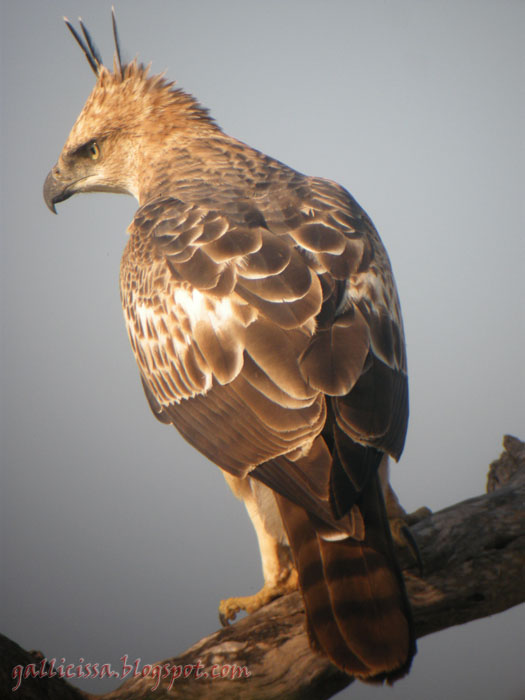
Crested Hawk Eagle Crested Hawk Eagle
Jerdon’s Nightjar spotted by Keith on a snag high up became our ninth night bird of the trip. That was again seen on day thirteen. A prolonged sighting of the same species in a low perch bettered this sighting three days later at Anuradhapura. Our last night bird for the trip was Common Barn Owl, a pair of which was recorded in a stake-out inside shrine in Polonnaruwa.

Concerted attempts at seeing Spot-bellied Eagle Owl, Brown Hawk Owl, Jungle Owlet and Sri Lanka Bay Owl failed on this tour. However, we came agonizingly close to seeing Sri Lanka Bay Owl, twice, but it just did not show up being vocal but staying uncooperatively hidden in dense foliage despite our best efforts to obtain an angle of view. This ultra secretive owl caused a mega twitch in Sri Lanka when it turned up in a daytime roost at Sinharaja in 2007. It is in public domain that at least one local bird watcher took a tuktuk tour all the way from Colombo to see it.

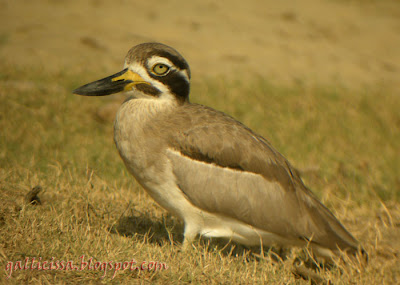
Great Thick-knee
Great Thick-knee on its knees
Our other birds of note recorded during the trip included Grey-headed Lapwing (vagrant & lifer for me seen at Yala thanks to US of Ceylon Bird Club who conveyed the news), Western Reef Egret (white morph one picked skilfully by Keith at Bundala, shown below), Legge’s Hawk Eagle (formely Mountain HE, great overhead views at Sinharaja), Chestnut-winged Crested Cuckoo (a lone individual outside a flock at Sinharaja), Fork-tailed Drongo Cuckoo (spotted expertly by Julie at Kithulgala), Black-backed Dwarf Kingfisher (seen & photographed at point black range at Kithulgala), Indian Reed Warbler (in song at Bundala), Slaty-breasted Rail (Scarce resident with possible migrant populations supplementing resident populations during migratory season, seen at Tissamaharama), White-naped Woodpecker (punctual!), Kashmir Flycatcher (at least 4 sightings with the first being of an adult male), Pied Thrush (great views at Nuwara Eliya) Common Ringed Plover (a scarce migrant, not too exciting to Keith), Dollarbird (seen thanks to G. de Silva Wijeyeratne at Kithulgala) and Eurasian Collard Dove (a scarce resident in Sri Lanka seen at Annaiwilundawa RAMSAR wetland, not too exciting to Keith). A Slaty-legged Crake at Sinharaja, seen only by yours truly, was the only bird species that eluded Keith.

Western Reef Egret - white morph
We had exceptional views of the ultra-elusive Sri Lanka Spurfowls when a female followed by a male were seen over five minutes, walking in the dimly-lit forest floor, totally unaware that we were observing them from a ridge higher up! Such heart-melting sightings of this game bird are rare, and this was one of the best views that I have had of it for quite a long time guiding an overseas birder. Before that we had brief view of it at Kithulgala. It was a case of BVD.

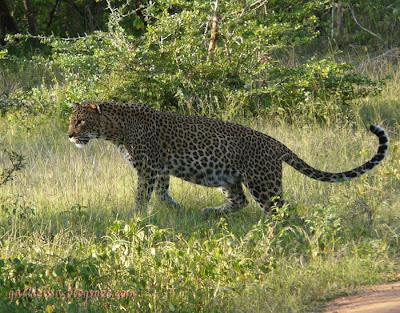
Moving on to non-birding matters, the Leopard shown below (same individual as in the previous post) was clearly our top non-birding highlight. We were the only jeep at the site when we found it. It was first sighted at 5.30 p.m., while resting in a shady spot near a water hole named rawung-wala (meaning circular water-hole) at Meda-para at the Yala National Park—the premier site for Leopards in Sri Lanka. The cat was about 25 m away when we found it first. Soon after we killed the engine of our jeep to observe it, the cat stood up and walked towards the track in front of us. It then continued to walk along it for a while like this, soon going out of view in the bend ahead.

Leopard at Meda-para, Yala National Park
We then approached it to find it again, this time within 5 meters or so from it, enabling us to photograph it at close range. Finally, after giving a good long glance at our jeep, it retreated into the jungle and disappeared out of radar.
Leopard at Meda-para, Yala National Park
More non-birding specials, we saw a pair of Barking Deers (Indian Muntjak) at Welimada. My previous sightings of this deer species has always been at the massive Wilpattu National Park. We exchanged glances with a pair of these before they retreated to the woodier interiors.

Monday, 20 October 2008

Sticky matters.


I led a 17-day "Christmas Bird watching Tour" in December, 2004, for a reputed British nature tour operator. Its ground handing was done by a local travel agency to which I freelanced at that time. This tour stays in my mind for a number reasons.

First, the unfortunate reasons:

1. Briefed and given in writing as a "mostly bird watching oriented tour," this tour had five English people that included:

i. A nature photographer with a keen interest in wild flowers.
ii. A walking enthusiast who just liked to keep on walking.
iii. A natural history enthusiast with a passion for photography and a passing interest in birds.
iv. A hardcore birder who was heavily into listing.
v. A person who didn’t fall into either of the above categories.

It was like a challenge that Donald Trump would have chosen for the final episode of the Apprentice. I did my best to juggle all the balls without dropping any. What can I say,  it was a good learning curve!

2. The Boxing Day Tsunami, which caused havoc killing over 40,000 people in Sri Lanka alone, happened during this tour. We were mopping up the montane endemics at the cloud forests of Horton Plains National Park—the tallest plateau in Sri Lanka some 2,100 m above sea level—when the killer tidal waves devastated the coastal lowlands. And we were to visit this area in two days’ time!

I had the tour rerouted thereafter to stay away from the affected lowlands. I also decided to spend more time in the unaffected endemic rich wet lowlands.

And now, the fortunate reasons:

1. More time in the wet lowlands didn’t harm our burgeoning bird list one bit. This was the first tour in which I showed the avian jewel Serendib Scops Owl Otus thilohoffmanni to an overseas bird watching audience, after its discovery in Jan, 2001. Needless to say, it was a momentous day for mankind!

2. I made a clean sweep all 33 endemic birds on this trip—for the first time having started my guiding career in January in the same year. As a budding bird guide, it was an important rite of passage.

3. An observation that I made at Sinharaja "world heritage" rain forest became the subject of my maiden paper to a peer-reviewed ornithological journal. It is—

Salgado, A. (2006). Some observations on the diet of Red-faced Malkoha Phaenicophaeus pyrrhocephalus in Sri Lanka. Sandy (UK): Forktail Journal of Oriental Bird Club. 22: 122-123.

Click here to download a PDF of it.

Anyway, what I am trying to get at like Sir. Humphrey Appleby is to correct an error that had slipped in the above article by me.

In it, I had a ‘giant stick insect’ preyed upon by a Red-faced Malkoha identified as Palophus sp (Order Phasmatodea) after comparing it with what I thought at that time to be a reliable source of reference.

On 14 October, 2008 its identity was corrected by a world authority on stick insects: Dr. Frank H. Hennemann from Germany, thanks to intervention by Dr. Priyantha Wijesinghe who is a Sri Lankan Entomologist/Systematic Biologist based in the USA.

Accordingly, it is an adult female of Phobaeticus hypharpax (Westwood, 1859).

The classification being:
Order: Phasmatodea. Suborder: Anareolatae. Family: Phasmatidae Subfamily: Phasmatinae Tribe: Pharnaciini.

A better view of the Giant stick insect. Note the rear left limb is a result of an optical illusion created by a limb like branch behind. The actual left rear limb was broken off by the time I took this shot as this was photographed after the above
Dr. Hennemann disclosed that the locality data for all but one of the specimens lodged in the world museums including the type specimen from which Westwood named this species bear nothing beyond "Ceylon."

Therefore, he, was quite happy to receive the locality data of my Phobaeticus hypharpax that eventually ended up in the gut of the above Red-faced Malkoha.

Very interestingly, on 15 October, a day after this e-mail communication, Dr. Hennemann had a revision of the very Tribe: Pharnaciini published in Zootaxa in the form of a 316 paged paper, which included, the above species.

The reference is:
Frank H. Hennemann & Oskar V. Conle (2008). Revision of Oriental Phasmatodea: The tribe Pharnaciini Günther, 1953, including the description of the world's longest insect, and a survey of the family Phasmatidae Gray, 1835 with keys to the subfamilies and tribes (Phasmatodea: "Anareolatae": Phasmatidae. Zootaxa 1906: 1-316 pp. Auckland, New Zealand: Magnolia Press.

According to the above, and as per a personal communication by Dr. Hennemann, in addition to the above species, Sri Lanka has one more species belonging to the tribe: Pharnaciini, which is Phobaeticus lobulatus (Carl, 1915). Its body length is 162.0 mm and is a very similar species to P. hypharpax, which has a body length of 185.0–236.0 mm. The former is only known from the female holotype with the locality data reading again as "Ceylon" only. So far, it has never been recorded since its original discovery in 1915 according to him.

By the way, the world’s longest insect, referred in the title of the aforementioned stick insect revision paper is (drumroll, please) Phobaeticus chani—Chan's megastick from Borneo—with a body length of 333.5–357.0 mm. Its overall length with the limbs stretched out is a whopping 567mm!

This is a completely new species described based on a specimen in the collection of a Malaysian naturalist and insect collector from Sabah Borneo, Chan Chew Lun, who had received it from a local collector. Dr. Philip Bragg named it in honour of Chan who had donated his world record holding megastick to the British Museum of Natural History.

If you are really into sizing up your megasticks, the former record holder for the world’s longest insect title based on body length was Phobaeticus kirbyi with 317.0mm., which is also found in Sabah, Borneo. So the newly described Chan's megastick is 40mm longer!

The former record holder for the overall length with the limbs stretched out was Phobaeticus serratipes distributed in Peninsula Malaysia, Singapore and Indonesia of which one has been measured at 555mm.

The new megastick on the block has beaten that record too by 12mm. However, this recorded would have been greater by 7–10 mm if the specimen of Phobaeticus chani donated by Chan Chew Lun had not been damaged according to Hennemann and Conle, 2008.

So no matter how you size up, the Malaysians get to retain the coveted world record title for the world’s longest insect by a long margin. I am sure Tabib, who is a regular visitor to my blog from Malaysia, will be proud about this.

I’d like to conclude this post by saying a big thank you to Dr. Hennemann for taking his valuable time to help with the identification of my megastick. Last but not least my profound gratitude is due to Dr. Priyantha Wijesinghe, for sending my images to Dr. Hennemann to seek his expert opinion and communicating to me the same and putting me in touch with such a world authority.

Thursday, 13 March 2008

Absolute Birding

Sri Lanka Blue Magpie
My recently concluded 15-day Absolute Birding tour from 31 Jan to 14 Feb., with 4 British birders, was a roaring success. We bagged a whopping 252 species of birds including all thirty-three endemics currently recognised. Additionally, we also bagged forty-two birds endemic to South Asia. And we bagged nine out of the fifteen resident night birds—of which seven were owls. Special birding highlight was seeing a pair of the newly rediscovered breeding resident, Marshall’s Iora at Lunugamwehera. We also had two sightings of Leopard at Yala National Park. Which included a prolonged sighting of a male resting on a rock.

The tour was organised by Peter Nickless from England who was joined by his birding buddies: Roger Dodds, Graham Mant, and Graham Jones. Just before my clients arrived, I visited this garden—just five minutes from the airport—on a scouting mission. During this, I stumbled upon a day roost of two Brown Hawk Owls at a dimly lit thicket. So when picked my four visitors, our first point of call was this day roost. Great start!

Resuming the tour after this great early start, I was determined not to spend too much time over wayside birds, as we would be seeing these often during the course of the tour. Even with such rigorous discipline, our journey to the first accommodation saw us raking in no less than six raptor species, which included Black Eagle, Crested Serpent Eagle and the only Rufous-bellied Hawk Eagle (a rare species in SL) of the trip.

Leopard - adult male resting on a rock at Yala National Park, Sri Lanka on the 7 Feb, 2007
Day-1 at the lush lowlands of Kithulgala got off to a flying start with a daily tally of fifty-six including ten of the thirty-three endemics to give a solid opening stand. Our endemic highlights were Sri Lanka Junglefowl, Sri Lanka Green Pigeon, Sri Lanka Hanging Parrot, Layard’s Parakeet, Chestnut-backed Owlet, Sri Lanka Grey Hornbill, Yellow-fronted Barbet, Sri Lanka Swallow, Black-capped Bulbul and Orange-billed Babbler. Our day-2 brought us more goodies in the form of the South Asian endemic and regular migrant, Indian Pitta, the avian gem, Black-backed Dwarf Kingfisher and more endemics: Spot-winged Thrush, Sri Lanka Spurfowl, Sri Lanka Small Barbet, Sri Lanka Scimitar Babbler, Brown-capped Babbler and Sri Lanka Crested Drongo.

Our day-3 at the endemic hotspot Sinharaja ‘world heritage’ rain forest produced a truly mouth-watering array of specials including endemics: Sri Lanka Scaly Thrush, Ashy-headed Laughingthrush, Legge’s Flowerpecker, Sri Lanka Blue Magpie, Sri Lanka Myna and the avian jewel; Serendib Scops Owl, which evaded bird watchers until 2001. With 2/3 of the endemics bagged at the end of our day-3, we were sitting at a very comfortable position to make a clean sweep of the endemics on this tour.

Rhino-horned Lizard at Hakgala Botanical Gardens, 10 Feb, 2007
Our day-4 yielded four more ticks to our tally of endemics: Red-faced Malkoha, Green-billed Coucal, Sri Lanka White-eye and White-faced Starling. A noteworthy highlight today was Malabar Trogon—endemic to South India and Sri Lanka. By the time we ended our day-4, we had bagged twenty-seven endemics! Our day-5 was essentially a back up day in Sinharaja to nab any elusive suspects. A pre-dawn raid saw us getting cracking views of the Sri Lanka Frogmouth, low down, before a noisy Chestnut-winged Crested Cuckoo took wing to limit our views to a flight silhouette, which was followed with our 3rd views of the Sri Lanka Scaly Thrush. Happy with our haul of the specials, a message was passed on to me declaring the rest of the day a holiday—starting as early as at 8.30 a.m.! The fact that it was the Sri Lanka’s Independence Day commemorating 60 years of independence from the colonial rule of the British didn’t have any reason whatsoever for this. The luxuries of the public holiday that ensued saw a sharp increase in the extras bill for some. We bagged a new trip bird in the form of a dark-morph Booted Eagle—while chilling at Martin's balcony with a few Lion beers as observational aids.

To read the full report with the systematic list click here.
To download a PDF version of the same with images (warning: 23 pages) click here.
To read the full report at Surfbirds.com click here
The above is my contribution to I And The Bird#72 Birding Carnival hosted by Ecobirder in Minnesota, USA.

Friday, 29 February 2008

Huuhkaja!

While reading the excellent birding blog of Timo Janhonen; the Bad Finnish Birdwatcher, I read about an (Eurasian) Eagle Owl Bubo bubo invading a football match played in Finland between the host country and Belgium and that the footage captured of this incident is in Youtube. Finland had won this game according to Timo who sounds happy; mentioning the footie result in the same breath. I had a look at this and thought it had enough merit to share with my blog readers, not that I am overly fond of owls or anything.

Spectators cheer ‘Huuhkaja’, which apparently means owl in finnish. It sounds like a very bad swear word in Sinhalese but I learnt that the bird had since then come to be known as Bubi, a sports commentator in Finland. How fitting considering that its scientific name is Bubo bubo! A related form occurs in Sri Lanka, which is called Forest Eagle Owl Bubo nipalensis (Ulama in Sinhalese), of which the shrilling calls are considered to bring death and misfortune by the locals. I am on the hunt for one of these and I shall break some news if I succeed in my mission. If any of my blog readers have any credible information of this or any other owl in day time roosts in Sri Lanka, please let me know!

Edit: Timo informed me that Huuhkaja means Eagle Owl.

Wednesday, 5 December 2007

Brown Hawk Owls in my Garden

Brown Hawk Owl in my home garden
Mobbing calls of several birds filled the air while I was working in my office on 7 Oct., 2007. I went out to see that their wrath was directed towards a pair of Brown Hawk Owls, which had come to occupy a roost atop a mango tree in my yard. One of the owls was showing up well, while other was hidden in the vegetation.

It's been a while since I saw this owl roosting in my garden. The intensity of mobbing behaviour shown by the mobsters consisting of White-bellied Drongo, Common Tailorbird, Red-vented Bulbul, Purple-rumped Sunbird, Oriental Magpie Robin, and Yellow-billed Babbler had its clear ups and downs. The owls, however, did not give in and they stood their ground. The commotion gradually died down. And the mobsters went silent and left the owls at peace.

They remained at the roost site for the rest of day.

I attempted a few digiscoping shots, but they didn’t turn out well due to angle of light. The photo above is from a previous encounter in my garden, following a similar mobbing episode. Click here to read an article that I did on my garden’s Brown Hawk Owls in Siyoth the journal of the Field Ornithology Group of Sri Lanka (FOGSL).

Wildbird on the Fly
The above was my contribution to I and The Bird #65 hosted by

Roosting Indian Scops Owls in my home garden

Indian Scops Owl in Feb 2006
While birding in my home garden (on 5 Sep, 2007), I peeped into a dense coffee bush in the corner of my garden hoping for a pair of Brown Hawk Owls, which used this tree occasionally for roosting. No luck with them, but I rather serendipitously, I stumbled a pair of Indian Scops Owls. They were huddled together, looking at opposite directions, and were of two colour morphs: grey and brown.

Beucase of my proximity at the time of this encounter, they went into 'alert-mode' with their body slimming considerably, and ear tufts erected well—trying to disguise themselves as a couple of broken branches. I retreated and found a different angle to scope it for my mom, who takes interest in such thingamajigs, and to take a record digiscoping shot. In Feb 2006, I had a day roost of this owl in a dead coconut tree at my place. This tree fell down after decaying and the owls weren’t seen thereafter. So I was very happy to find them again like this.

Indian Scops Owls roosting in my garden

Birding with Adrian Mann

Serendib Scops Owl
I did a 4-day birding trip with Adrian Mann, a British birder, from 23–26 Aug., 2007. I picked him up from a beach hotel in Kalutara in the southwest coast, where he was holidaying with his fiancé and her parents. We first visited Morapitiya rain forest for a full day’s birding on our day 01. Fresh from my experiences a couple of days ago, I was quite pumped up. And I had a 4 WD jeep waiting near the turn off to reach the prime birding area as the access to the prime birding area of Morapitiya is tough for cars.

With high humidity and mostly overcast conditions, birding turned out to be hard work, but overall, we could be happy of what we achieved. Knowing the local conditions, we carried enough water and drinks in a coolbox. And that helped us a great deal to keep ourselves nicely hydrated.

On the birding specifics without further ado, early in our walk, we were rewarded with fine views of Gold-fronted Leafbird, Lesser Hill Myna, Sri Lanka Hanging Parrot, Layard’s Parakeet, Yellow-fronted Barbet, Emerald Dove and Green Imperial Pigeon. The only mixed species bird flock was good, and it had such delights as Orange-billed Babbler, Sri Lanka Crested Drongo, Yellow-browed Bulbul, Black-capped Bulbul, Sri Lanka Scimitar Babbler, Malabar Trogon, Square-tailed Black Bulbul and Black-rumped Flameback—all sought-after specials.

Sri Lanka Spurfowl proved elusive—this shy forest dweller requires a bit of patience, and a bit of hardwork. Adrian didn't like to spend a lot of time over bird, and complying to his likes, I didn't push myself.

Exploring a different trail after feasting on our packetted lunch, we resumed exploring the edge of the forest close to human habitation. Soon, I stumbled upon the scarce endemic, Green-billed Coucal. Unfortunately, Adrian mised seeing its diagnostic green bill. No tick. A pair of Black Eagles soured high above. No problem with that. The good-looking endemic, Crimson-backed Flameback, Black-naped Monarch, and Tickell’s Blue Flycatcher were also added to our growing list as the day wore on.

Dollarbird
Returning to a village home garden for a cuppa in the late afternoon, Adrian picked a bird perched high up in an Alstonia tree, a fair distance away. It turned out to be a Dollarbird—a top rarity in Sri Lanka. It provided prolonged scoped views for us, and for a few smiley village kids. This was followed with the endemic Sri Lanka Small Barbet—one of those soft endemics.

We lingered until dusk for night birds. As dusk envoloped us, we had great views of Sri Lanka Frogmouth, below eye-level, when it emerged from its low day roost. Thereafter, we shifted our focus for the crème de la crème: the newly discovered Serendib Scops Owl. We didn't have to wait for long. As early as 6.55 p.m. we had met our quarry—a perfect sighting low down (picture above).

We got the wheels moving by 7.00 p.m. to commence our journey back our overnight base in Sinharaja. Everybody was quite knackered by the time we reach there. A nice cold shower, chilled Lion beer, and a rice and curry dinner did the trick to recharge our batteries. I started the day at 4.00 a.m. By the time I hit the sack, it was 11.30 p.m.; I slept like a baby!

Early next day, we explored the adjoining forest patch, and had a Spot-winged Thrush on the trail. This was followed by scope views of Green-billed Coucal—the green bill of which was seen well this time! A Malabar Trogon also graced our morning, oblinging with scope views. After obtaining our entrance tickets for today, and meeting our compulsory forest department tracker, we reached the Martin’s Simple Lodge: our overnight base for tonight. It had some rain today, but that didn't hamper our birding—as when it mattered most, it was nice and dry.

Exploring a trail below Martin’s, we encountered five Sri Lanka Blue Magpies, which were seen preening seated close together in a row—soothing sight. We also had several mixed species bird flocks with the usual species. One of these produced scope views of Red-faced Malkoha feeding on a large caterpillar. (I am closely monitoring the feeding ecology of this cuculid, so it was all good!)

Children in Morapitiya
Back in Martin’s during our midday break, a Black Eagle, soaring over the shorter trees around the balcony area, once got about 4 m from us giving heart-stopping views. I picked up a call of a Rufous Woodpecker, which flew in front of Martin’s to perch in a tall tree nearby, but when I tried to find it again for Adrian, it proved elusive.

Our top highlight during the birding session in the second half of the day was Sri Lanka Scaly Thrush. It was scoped on the trail after waiting specifically for it.

Checklist and dinner back in Martin’s marked the end of a nice and easy day in the field.

In the short birding session, which we squeeze in the morning of Day 03 in Sinharaja, we had scope views of 4 White-faced Starlings perched atop an Alstonia tree almost at eye level. This tree had an active Weaver Ant colony (Oecophylla smaragdina). I noticed that the starlings were picking up these ants and rubbing them into their body. This may be to keep parasites off as these ants contain acidic body fluids. All four birds were involved in this ritual for 10 minutes before taking wing. Other highlights included great views of Legge’s Flowerpecker, Hill Munia, Orange Minivet and Sri Lanka Myna.

After this great birding in the lowland wet zone, we reached the dry lowlands of Udawalawe, where a totally different avifuana awaited us.

 As this was the school holidays, the park was full of local visitors and the official manning the ticket office (who happened to be the park’s accountant on this particular day) refused to let us enter until a tracker returns Crested Hawk Eagleafter a safari, as it is compulsory to have one when entering the park. Although I tried my best to convey that we are here to watch birds and delays do not help our course, he was unwilling to consider any alternative in favour of the overseas visitors. In my opinion, the parks should either have enough trackers or look to authorize regular jeep drivers to step in as temporary trackers when they are short-staffed  (for they are quite knowledgeable of the park’s roads, rules, and wildlife) to meet the demands of high visitor numbers during peak holiday seasons. An overseas visitor pays a very high entrance fee (compared to fares in the regional national parks), which is close to Rs. 2,400 per person (around USD 21 with all taxes). This is compared to around Rs. 100 per person (around 0.9 US with taxes) paid by a local visitor. It is a great shame that an overseas visitor is delayed from entering the park on account of lack of local trackers when people in the tourism iIndustry in this country are trying everything possible to get more visitors to this country. And trying give them memorable experiences. With such red tape and tunnel vision, I am afraid overseas visitors will not return home with happier stories; I was quite frustrated. (the official now works at Bundala NP, and is a good friend of mine; he is changed now!).

After a frustrating half an hour at the park’s entrance waiting for a tracker to be available, we finally entered the park at around 3.00 p.m. (Luckily, I had reached the park’s entrance early, so we weren't handicapped too much by the hold up). The tracker who became available was known to me, and instead of sharing one tracker with multiple jeeps (as it happens on busy days), I was able to get him released only for our jeep insisting that we had a different focus.

Coming back to birding, I had a 5.00 o'clock appointment with several woodpeckers at a site in the park’s interior. So I briefed the jeep driver about it at the start, so that he can time the journey, with all our regular birding stops. As this was the peak of the dry season in the dry zone, the park was quite dry with most of the ponds retaining little water with some gone completely dry. Our first birding highlight was Plum-headed Parakeet, which was followed by several dry zone specialties: Malabar Pied Hornbill, Blue-faced Malkoha, Yellow-eyed Babbler, Sirkeer Malkoha, and Yellow-crowned Woodpecker. Yes, the birding was very good. A couple of early migrant were added to our list: Barn Swallows and Grey-bellied Cuckoo—my first records for this migratory season.

This park is simply great for raptors and we had multiple sightings of Black-winged Kite, White-bellied Sea Eagle, Grey-headed Fish Eagle, Crested Serpent Eagle, and Crested Hawk Eagle. As usual Asian Elephants were in good numbers, and we did pause to observe a few family groups.

Our appointment with the Woodpeckers were spot-on and we had brilliant scope views 3 White-naped Woodpeckers; plus a couple of Crimson-backed Flamebacks—early hiccup at the entrance were soon forgotten! What's more, Adrian wanted to come back the following morning!

Close to the woodpecker spot, we also had ten Lesser Adjutants with an assortment of several other big water birds: Wooly-necked Stork, Asian Openbill, Painted Stork and Black-headed Ibis having a feast in a drying water hole. We also bagged Zitting Cisticola (for non-birders, this is not a fizzy drink!), Black-headed Munia, Jerdon's Bushlark, and Crested Treeswift in the later afternoon.
White-naped Woodpecker

While heading back to the park’s exit, we came across a truck belonging to the wildlife department, which apparently had a break down.

The two wildlife department guys in it sought our assistance. And we obliged. Our ulterior motive was because this gave an excuse to linger on at the part until dusk—and Adrian didn't mind seeing a few nightjars.

So our well measured help extended, gave us good long views of Little Indian Nightjar. Checklist a Sri Lankan-styled Chinese dinner marked the end of an eventful day.

No more hiccups at the entrance on our Day 04, as I had the same tracker arranged for our morning's visit to the park. Our top highlight today was a Brown Fish Owl in a day roost. Yellow-wattled Lapwing, Tawny-bellied Babbler, Indian Silverbill, and Jungle Prinia were also added to our tally. After pausing en route in the Bodhinagala Forest Reserve, we returned to Adrian’s beach hotel. That diversion didn’t add anything new to our tally.
Related Posts with Thumbnails