Tuesday, 30 September 2008

Migrant update

Migrants have begun to arrive. I heard my first Blue-tailed Bee-eaters on 23 Sep., over my house and saw three of them the following day at my local wetland patch. An Asian Brown Flycatcher was heard in my backyard three days ago. Yesterday, I had my first Forest Wagtail walking gracefully in a woody corner. Now, that is one bird I need to photograph. But, the question is—how to do it—as it never seem to wait long enough for digi-scoping. May be I'll try one with my Lumix. The Brown-breasted Flycatcher and the Himalayn avian jewel, Indian Pitta are due soon. I 'maintain' a patch in a corner of my yard in a pretty wild state to invite in the latter, which is a high-profile migrant (for me).

I am pretty sure it will accept my invitation this year too. It will be in good company with the endemic Clubtail: Sri Lanka Forktail. I didn't include any images in this post as images are already in this blog for most of the 'things' mentioned here. Please click on their names if you would like to see how they look.

Monday, 29 September 2008

Macro Monday

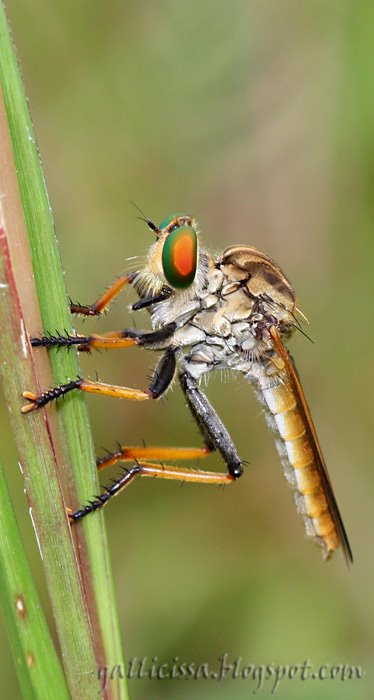
This beautiful Robber fly was shot in my local wetland patch.
Robber flies are extremely skilful hunters and their menu includes among other things, dragonflies.

Robber fly

Sunday, 28 September 2008

Kinky


Any thoughts on this kinkiness?
First, this is a male Painted Waxtail Ceriagrion cerinorubellum, a relatively common damselfly in my yard.

This cannot be a mating related accident, as then the kink should be downwards.
If you are new to damselfly mating, look at this pair in thier orthodox 'wheel position' where the male is on top.

So, how on earth has the rear end of the body turned upwards in this?
A birth defect caused at the emergence from exuvia—you know, when it tries to force itself out?
I don't know!

Let me know what you think, please.

Thursday, 25 September 2008

Coastal Pennant bagged!


This dragonfly was photographed at the Weerawila tank (reservoir) during the Photography tour that I guided last month. It was identified by Odonatologist, Matjaz Bedjanic as a Coastal Pennant Macrodiplax cora.

I was quite pleased about this capture as Matjaz, following the identification, disclosed that the authors of the Dragonflies of Sri Lanka (2007) had tried to photograph this to be included in this photo guide without success. Before that, Karen Conniff, one of its co-authors of this book, had also urged me to look for this elusive dragon on my travels to the deep south.

We arrived at the Weerawila Tank (from Tissamaharama road end) at around 10.00 a.m., on 9 August, 2008 to improve the angle of a big aggregation of water birds seen previously. Unfortunately, there was very little bird photography that we could do due to the strong winds experienced on this day—so much so that we were worried to keep our scopes unattended!

On the positive side, in the grassy belt of land protected by the bund from the gusts was a swarm of dragonflies—with 1000s of dragonflies!

‘Dragonfly swarms’ occur when adults exhibiting a stereotypical tight interweaving flight pattern, form a high-density aggregation within a confined area. Swarms are often composed of multiple species.

The species observed in the order of the abundance (as casually observed) in this particular swarm included Dancing Dropwing Trithemis pallidinervis, Scarlet Basker Urothemis signata signata, Asian Groundling Brachythemis contaminata, Oriental Scarlet Crocothemis servilia servilia, and Coastal Pennant Macrodiplax cora featured here.

I suspect that this particular case of swarming was probably to seek protection from the elements and to feast on insect prey that may have also been sucked into this 'safety zone.'

Related Posts:
Pure Gold!
Zumala
CSI

Wednesday, 24 September 2008

Wordless Wednesday

Elusive Adjutant - adult female WW HQ

CSI

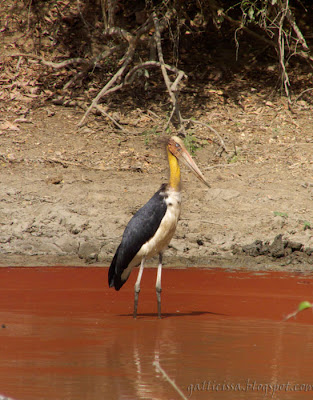
Lesser Adjutant at the Yala National Park
A serial killer in a pool of blood?

We arrived at this crime scene at the Yala National Park during the photography tour that I guided last month. The cold look of the murderer, the bloody scene and eiry silence; we could just about connect the dots. Was it as bad as it seems?

No!

The reddish hue in the water was painted by floral elements falling on it from nearby tree—Tamarind Tamarindus indica. Our prime suspect, the Lesser Adjutant, although has a criminal record of preying on unsuspecting birds, reptiles and small mammals, was innocent at this particular occasion.

Lesser Adjutant is a member of the Stork family and in Sri Lanka, it is mainly found in the dry zone where it is considered a scarce breeding resident. Its bare head almost like that of a vulture is an adaptation to deal with carrion, which account for its severe appearance deficits.
Related Posts with Thumbnails