Wednesday, 15 August 2012


Wednesday, 27 June 2012
Guiding Kate and John Holland
20 February to 5 March, 2012, saw me guiding a 15-day wildlife tour with John and Kate Holland, from England. Both were keen birders, and this was their first visit to Sri Lanka. Kate sported the latest Swarovski SLC 42 HD binoculars, which were superb in clarity. A birthday gift from John, it was on its first overseas trip.
Our final trip list of birds stood at 236 species and that included all 33 endemic birds and 10 out of the 15 resident night birds. Our top wildlife highlights included a couple of Leopards at Yala and several Blue Whales off Mirissa. The photos below show these highlights and more.
Lesser Adjutant
We saw this lone Lesser Adjutant at the Yala National Park, and it proved to be the only sighting of this rare resident bird for the whole trip.

Asian Paradise Flycatcher
We had this species at several locations, and this individual obliged outside the Udawalawe National Park. The white coloured males of this species comes all the way from Northern India during the migratory season. I usually get one of these turning up in my home garden, but in the last season I had none.

Asian Brown Flycatcher
Another regular migrant, Asian Brown Flycatcher usually likes tops of trees with ample lighting. When we found this individual, we were on a second floor of a building, and from our position it presented us with nice eye-level views.

Sri Lanka Blue Magpie
Some of the Sri Lanka Blue Magpies at Sinharaja are quite confiding. This one came to land on my scope, when we were having a break near the research station.

Here's a close up of his head.

Sri Lanka Frogmouth
This juvenile Sri Lanka Frogmouth was huddled together with its farther at Sinharaja rain forest. It was too close for my lens.

The Blue Whale

We had aout fifteen sightings of Blue Whales, consisting of about eight individuals. This was one of them with a limora fish haning on its tail. The whale watches approaching from behind, scared it off.

The clay girl
At Tissa, this girl is the youngest member of a family that engage in pottery. Her play area borders the Tissa wewa, where we go birding. She used to have a pair of Indian Scops Owls in her garden. But as of recently the owls have vacated the roost.

Leopard
This female cub gave us prolonged views at Yala. For a good length of the time, we had it all for ourselves, which was nice. I hate the big crowds and traffic jams at Yala.

Asian Groundling
We saw a good array of dragonflies and this Asian Groundling gave an easy photo opportunity.

Our final trip list of birds stood at 236 species and that included all 33 endemic birds and 10 out of the 15 resident night birds. Our top wildlife highlights included a couple of Leopards at Yala and several Blue Whales off Mirissa. The photos below show these highlights and more.
Lesser Adjutant
We saw this lone Lesser Adjutant at the Yala National Park, and it proved to be the only sighting of this rare resident bird for the whole trip.
Asian Paradise Flycatcher
We had this species at several locations, and this individual obliged outside the Udawalawe National Park. The white coloured males of this species comes all the way from Northern India during the migratory season. I usually get one of these turning up in my home garden, but in the last season I had none.
Asian Brown Flycatcher
Another regular migrant, Asian Brown Flycatcher usually likes tops of trees with ample lighting. When we found this individual, we were on a second floor of a building, and from our position it presented us with nice eye-level views.
Sri Lanka Blue Magpie
Some of the Sri Lanka Blue Magpies at Sinharaja are quite confiding. This one came to land on my scope, when we were having a break near the research station.
Here's a close up of his head.
Sri Lanka Frogmouth
This juvenile Sri Lanka Frogmouth was huddled together with its farther at Sinharaja rain forest. It was too close for my lens.
The Blue Whale
We had aout fifteen sightings of Blue Whales, consisting of about eight individuals. This was one of them with a limora fish haning on its tail. The whale watches approaching from behind, scared it off.
The clay girl
At Tissa, this girl is the youngest member of a family that engage in pottery. Her play area borders the Tissa wewa, where we go birding. She used to have a pair of Indian Scops Owls in her garden. But as of recently the owls have vacated the roost.
Leopard
This female cub gave us prolonged views at Yala. For a good length of the time, we had it all for ourselves, which was nice. I hate the big crowds and traffic jams at Yala.
Asian Groundling
We saw a good array of dragonflies and this Asian Groundling gave an easy photo opportunity.
Wednesday, 20 June 2012
Cuckoos of the World
I got a spanking new copy of the newly published Cuckoos of the World for free!

Authored by Johannes Erritzoe, Clive F Mann, Frederik Brammer and Richard A Fuller, and publised by Christopher Helm, it describes all 144 species of the bird family Cuculidae including cuckoos, malkohas, couas, coucals, roadrunners and other species in exceptional detail. This includes accurate range maps, superb illustrations by four world-renowned artists to show different plumages and sub-species.
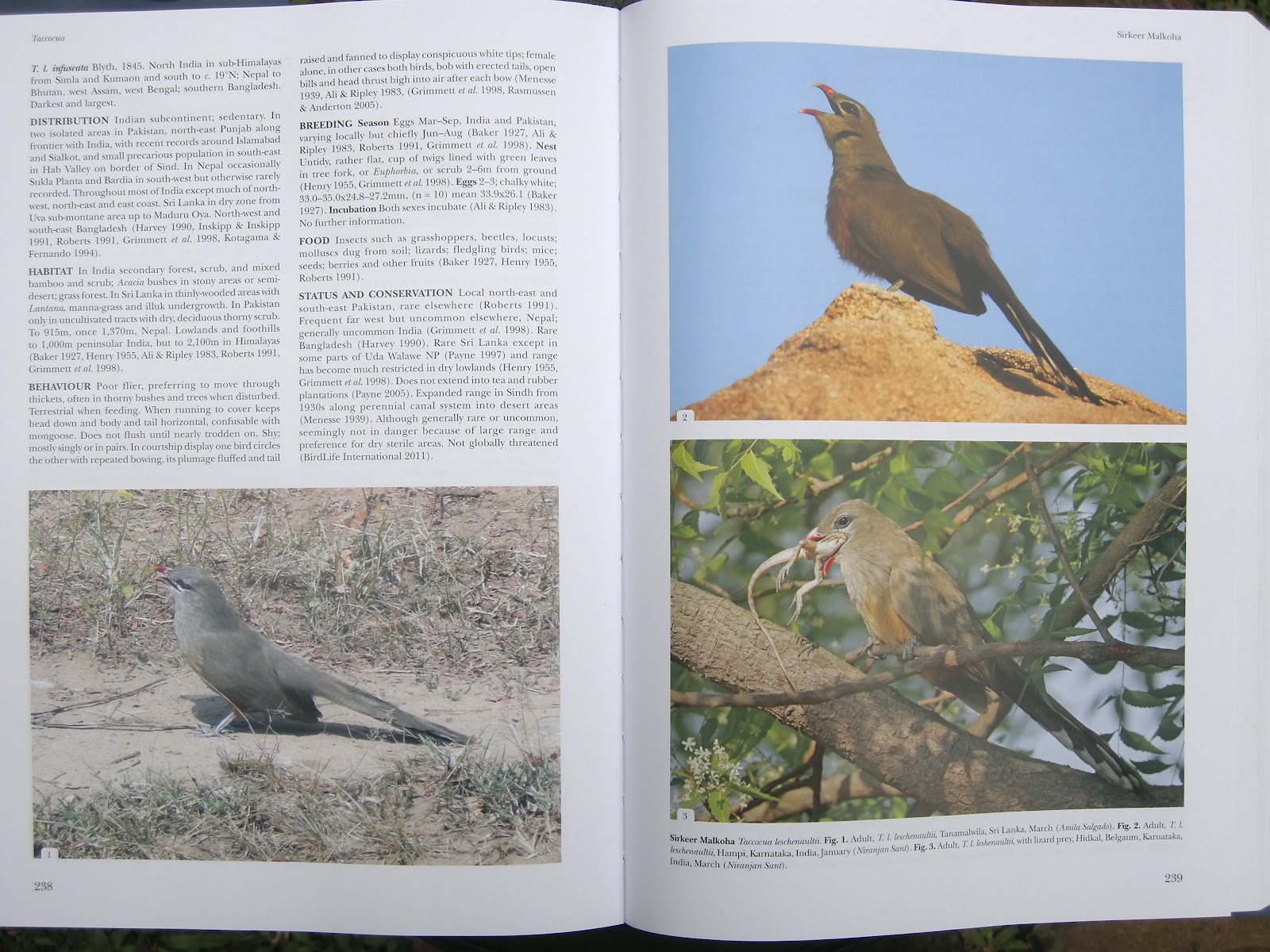
 And photographs of almost all species, which includes three contributed by me. They are of Sirkeer Malkoha, Red-faced Malkoha and Indian Cuckoo.
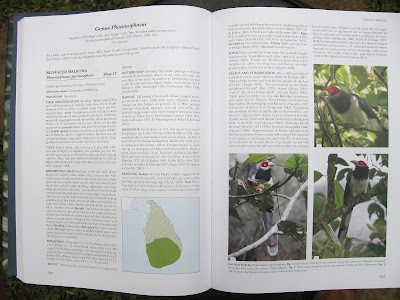 A Red-faced Malkoha devouring a Mega Stick Phobaeticus hypharpax (Westwood, 1859) photographed in December 2004, using Nikon Coolpix 4500 point and shoot camera through a Kowa TSN 823 telescope appears in Page 243 in the Cuckoos of the World.
This explains how I got this freebie!
In the bibiliography it also refers to one of my papers on the feeding ecology of Red-faced Malkoha, which was nice. The book represents the definitive and most up-to-date reference on the identification of cuckoos.
 The Sirkeer Malkoha in page 238 in the Cuckoos of the World was taken using my point and shoot Nikon Coolpix 5100, while guiding Dave Thrussel and Chris Holtby in March, 2010.
A big thank you to Jim Martin, Project Editor of this book for seeking my images, and to my clients who were with me when I photographed these birds (Red-faced Malkoha duing the Christmas Bird Tour, Dec 2004 to January 2005; Dave Thrussel and Chris Holtby, March, 2010).
Hello to all!
Authored by Johannes Erritzoe, Clive F Mann, Frederik Brammer and Richard A Fuller, and publised by Christopher Helm, it describes all 144 species of the bird family Cuculidae including cuckoos, malkohas, couas, coucals, roadrunners and other species in exceptional detail. This includes accurate range maps, superb illustrations by four world-renowned artists to show different plumages and sub-species.

This explains how I got this freebie!
In the bibiliography it also refers to one of my papers on the feeding ecology of Red-faced Malkoha, which was nice. The book represents the definitive and most up-to-date reference on the identification of cuckoos.
A big thank you to Jim Martin, Project Editor of this book for seeking my images, and to my clients who were with me when I photographed these birds (Red-faced Malkoha duing the Christmas Bird Tour, Dec 2004 to January 2005; Dave Thrussel and Chris Holtby, March, 2010).
Hello to all!
Sunday, 5 February 2012
Of the Sri Lanka Bay Owl That I Spotted from a Moving Vehicle

Somewhere in the lowland wet zone, I spotted this Sri Lanka Bay Owl from a moving vehicle!
That was during an Absolute Birding tour that I guided in the second half of January, 2012 for Mark Yates, Gary Thonburn (both from the U.K.) and Brendon Ryan from South Africa.
We were returning to our accommodation 'empty-handed' after specially going to see this scarce owl, which is a rarely seen resident bird species in Sri Lanka. We were not helped by so many elements on this day, which included the weather. During the journey back, which seemed a very long one, I kept spot-lighting randomly, hoping for a consolation Slender Loris or so.
This has worked before.
No loris, but an endemic Yellow-striped Chevrotain seen in the headlights of the vehcile, was a good enough consolation.
That was until I picked another eye-shine, which saw our vehicle coming to a screeching halt. When I trained my binoculars, they belonged to—would you believe—a Sri Lanka Bay Owl!
I soon shared my serendipitous find with my clients, who took a few decent shots. The one above was sent by Gary Thoburn, who wielded a Canon 500mm lens. We left the bird to carry out its hunting and moved on. Soon, I found that during the frenetic moments of spotting the bird, I had lost an eye cup in my Swarovski binoculars; I backtracked about 100 metres on foot to recover it. Glued to the same old perch was a still-busy-foraging Sri Lanka Bay Owl.
With this amazing find, this tour saw us bagging 12 out of the 15 resident night birds. Our tally included 9 owl species. We saw nearly 250 species of birds out of which 190 were photographed.
To see more images of birds and natural history photographed on this trip, visit Gary's photo site in a few weeks.
Related post: A tuktuk trip and a top lifer!
Wednesday, 4 January 2012
Rare Bird Alert: Yellow-rumped Flycatcher at Tanamalwila
I am happy to share the news of a sight record of a vagrant bird species to Sri Lanka—the Yellow-rumped Flycatcher Ficedula zanthopygia.

I saw it on 3 January, 2012, at Tanamalwila, in the sylvan interiors of southeastern Sri Lanka on the tour that I am currently guiding with Hans Veltman and Irene ter Horst from the Netherlands. My visitors are on a 14-day Absolute Birding tour, which came through Inezia Tours, run by my friend Pieter van der Luit.
Hearing an unfamiliar bird call, I ventured off the track a short distance to search for its source. In no time, to my surprise, I found a handsome, male Yellow-rumped Flycatcher—my first lifer for the New Year.
As it happens so often in moments like this, I had no camera with me; hoping to concentrate on just watching birds, I had left it in the vehicle. Soon after showing the bird to my clients, and I dashed like the Road Runner fetch my camera. And dashed back. Come to think of it, I forgot to uttter "mee mee."
But anyway, after an agonizing ten minutes, I found the bird again and was able take the record shot above. We were on our way to Nuwara Eliya, and had some montane birding planned for later that day. So I didn’t spend a lot of time trying to photograph it the way I like. But I guess this will do for the time being.
Its call reminded me of the more familiar highland special Kashmir Flycatcher, which belongs to the same genus as the Yellow-rumped Flycatcher. And at Nuwara Eliya later that day, we also the Kashmir Flycatcher; thereby, bagging two Ficedula species on a single day’s birding in Sri Lanka. Who would have thought that was possible!
Directions
Reach Tanamalwila.
Then in the A2, drive about a kilometer towards Lunugamwehera until you come across a police road block. A dirt track, which leads to the Lunugamwehera National Park, branches off left just there. Take that one. After about 130 metres, that track bends first to the right, and after a few metres, again to the left. The bird was found in between these two bends. It was found on both sides of the track during various times of our observation. Although you can drive right up to the site, I suggest you park the vehicle in the restaurant (“Thuru Sevana Buffet”) on the opposite side to the turn off. The owners there are very nice people and tolerate bird watchers. It will be courteous to buy a drink for using their gardens parking, after you have bagged the bird.
Further reading
The site consists of a secondary forest contiguous with the impressive riverine forest found along the Kiridi Oya. Some of the noteworthy birds that I have found here over the years include the Marshall’s Iora, Orange-headed Thrush, White-naped Woodpecker, Rufous Woodpecker, Black-backed Dwarf Kingfisher, Sirkeer Malkoha, Jungle Owlet, and now, the Yellow-rumped Flycatcher.
Yes, it is one of my patches, and a good one at that.
The site has a fair bit of mosquitoes, and if you have to venture into the jungle, note that the understory is thorny.
Happy New Year!
I saw it on 3 January, 2012, at Tanamalwila, in the sylvan interiors of southeastern Sri Lanka on the tour that I am currently guiding with Hans Veltman and Irene ter Horst from the Netherlands. My visitors are on a 14-day Absolute Birding tour, which came through Inezia Tours, run by my friend Pieter van der Luit.
Hearing an unfamiliar bird call, I ventured off the track a short distance to search for its source. In no time, to my surprise, I found a handsome, male Yellow-rumped Flycatcher—my first lifer for the New Year.
As it happens so often in moments like this, I had no camera with me; hoping to concentrate on just watching birds, I had left it in the vehicle. Soon after showing the bird to my clients, and I dashed like the Road Runner fetch my camera. And dashed back. Come to think of it, I forgot to uttter "mee mee."
But anyway, after an agonizing ten minutes, I found the bird again and was able take the record shot above. We were on our way to Nuwara Eliya, and had some montane birding planned for later that day. So I didn’t spend a lot of time trying to photograph it the way I like. But I guess this will do for the time being.
Its call reminded me of the more familiar highland special Kashmir Flycatcher, which belongs to the same genus as the Yellow-rumped Flycatcher. And at Nuwara Eliya later that day, we also the Kashmir Flycatcher; thereby, bagging two Ficedula species on a single day’s birding in Sri Lanka. Who would have thought that was possible!
Directions
Reach Tanamalwila.
Then in the A2, drive about a kilometer towards Lunugamwehera until you come across a police road block. A dirt track, which leads to the Lunugamwehera National Park, branches off left just there. Take that one. After about 130 metres, that track bends first to the right, and after a few metres, again to the left. The bird was found in between these two bends. It was found on both sides of the track during various times of our observation. Although you can drive right up to the site, I suggest you park the vehicle in the restaurant (“Thuru Sevana Buffet”) on the opposite side to the turn off. The owners there are very nice people and tolerate bird watchers. It will be courteous to buy a drink for using their gardens parking, after you have bagged the bird.
Further reading
The site consists of a secondary forest contiguous with the impressive riverine forest found along the Kiridi Oya. Some of the noteworthy birds that I have found here over the years include the Marshall’s Iora, Orange-headed Thrush, White-naped Woodpecker, Rufous Woodpecker, Black-backed Dwarf Kingfisher, Sirkeer Malkoha, Jungle Owlet, and now, the Yellow-rumped Flycatcher.
Yes, it is one of my patches, and a good one at that.
The site has a fair bit of mosquitoes, and if you have to venture into the jungle, note that the understory is thorny.
Happy New Year!
Wednesday, 7 December 2011
Absolute Birding in November, 2011
I am back after guiding my first birding tour for the winter tour season of 2011/2012. It was a 14-day Absolute Birding tour with Brice and Gail Wells from Perth, Australia from 1–14 November, 2011. Brice, 78, became the oldest birder to survive my Absolute Birding tour.
Our final tally of birds stood at 231 species. We saw all thirty-three endemics extremely well. As usual, we did well in the night birding department, scoring ten out of the fifteen resident night bird species. These included seven owls. Brice had never seen that many owls on a single birding trip before, so he was really pleased.
The rain gods were kind to us: barring the first two days, we had beautiful weather throughout the tour. Several mixed-species bird flocks were seen in full swing at Sinharaja. These yielded all the flock-associated specials such as the Ashy-headed Laughingthrush. Which laughs alright, but never smiles.

This Sri Lanka Swallow didn't mind the wet weather at Kithulgala; it was collecting mud for nest building.

This Sri Lanka Wood Pigeon was fearless when it came to drink in a 'waterhole' on this tree at Welimada.
Right time, right place.

The Grey-headed Fish Eagle was sentinel at Bundala National Park in bright light.

It is only fair to say that we had an impressive array of non-feathered attractions.
One of them is this gleaming elephant in pretty light at the Bundala National Park. Unlike the ones at Yala, the elephants at Bundala are a bit grumpy. So you have approach them with respect and caution. It looks like the ones at Bundala seem to have some 'issues' with the local fishermen who are allowed to enter the park in bikes to engage in fishing.
This elephant made a roadblock to assert its dominance, keeping us, and a few fishermen ahead, waiting.

We had to wait for about fifteen minutes, until it decided to clear the traffic at its own terms!
A similar standoff happened outside the Bundala National Park on another day. This time, it almost cost a few birds for the trip. Regardless, we scored 100 plus species of birds on that day. A bloke from the wildlife department, who happened to use the same road, came to our rescue; he used a couple of fire crackers to 'neutralize' the situation.

At Yala, we saw five Leopards in just two game drives (one in the first and four in the last) all which posed well. On our first visit, some real-time ground intelligence led to this lone young female on a tree close to the Akasha-chaitya junction. We had it for a good fifteen minutes.

Our no.2 and 3 Leopards came together. And in the process, nearly took our breath away!

That was when these two big boys crossed the road in the Jumburagala road. The one that took the lead was blind in the left eye.

Too bad we were at the wrong side of the light.

Otherwise, I could have absolutely nailed them!

No, we photographers are never happy!
As our jeep driver correctly predicted, one of the Leopards, as it turned out the bigger one, settled on a distant rock to nap. Driving on from there minutes later, we had the One-eye, walking along the track marking its territory.

He was a grumpy old fellow. A walking-wounded of sorts. Every now and then it paused to pose. Even the point-and-shooters had a field day.

We were compelled to take a comfort break close to 5.30 p.m. While we were busy, we heard a deer alarm. Quite close! We were making our way out of the park, having had a superb day. Too close and precious to let go, we drove in the direction of that alarm. And minutes later, we found this female.

If not for that desperate leg-stretch, we would have not heard the alarm, which led to this beauty.
Which drove home a golden rule in the jungles: when you want to go, go you must.
Anyway, the female having noticed us, crossed the road and disappeared. Once again, our driver predicted that it may climb a rock nearby, and he made a beeline to that spot. Not even a minute passed by, and the female materialized on the rock in front of us, giving us a bemused stare, "how did you know ...?!"

Our jeep driver said he heard the female calling to its young. So we expected she will soon have some company. About five minutes later, this cute little female cub appeared on the rock!

But, before reaching her mom, she paused to check us out.

At her own pace, she joined her mom.

Some quality family time followed

The little one got a nice clean up, presumably before the evening activity. In the shade of a fig tree, this rock had a peaceful setting of a Buddhist temple. Two Malabar Pied Hornbills whooshed pass vying for their attention. It was nice to see how mindful the Leopards were—even watching birds! We left them there to make our timely exit and to end what a fabulous day with big cats.
While the above passed as our best wildlife day, our best birding day was day-thirteen at Sigiriya. It was significant because of a late afternoon birding session, which produced an avian bonanza consisting of eight new ticks for the trip.
The goodies were Shaheen, Cotton Pygmy-goose, Orange-headed Thrush, Black-backed Dwarf Kingfisher, Indian Blue Robin, White-rumped Shama, 'Fork-tailed' Drongo Cuckoo, Indian Pitta, Jerdon's Nightjar, Spot-bellied Eagle Owl (which was expertly spotted by Brice), and a one-for-the-road Brown Fish Owl.
In terms of numbers, our day-seven was the best with a whopping tally of 118 species.
Birds were superb alright, but I must say those leopards really took the cake on this tour.
Thinking about that day in Yala, I still can't wipe the smile off my face.
Our final tally of birds stood at 231 species. We saw all thirty-three endemics extremely well. As usual, we did well in the night birding department, scoring ten out of the fifteen resident night bird species. These included seven owls. Brice had never seen that many owls on a single birding trip before, so he was really pleased.
The rain gods were kind to us: barring the first two days, we had beautiful weather throughout the tour. Several mixed-species bird flocks were seen in full swing at Sinharaja. These yielded all the flock-associated specials such as the Ashy-headed Laughingthrush. Which laughs alright, but never smiles.
This Sri Lanka Swallow didn't mind the wet weather at Kithulgala; it was collecting mud for nest building.
This Sri Lanka Wood Pigeon was fearless when it came to drink in a 'waterhole' on this tree at Welimada.
Right time, right place.
The Grey-headed Fish Eagle was sentinel at Bundala National Park in bright light.
It is only fair to say that we had an impressive array of non-feathered attractions.
One of them is this gleaming elephant in pretty light at the Bundala National Park. Unlike the ones at Yala, the elephants at Bundala are a bit grumpy. So you have approach them with respect and caution. It looks like the ones at Bundala seem to have some 'issues' with the local fishermen who are allowed to enter the park in bikes to engage in fishing.
This elephant made a roadblock to assert its dominance, keeping us, and a few fishermen ahead, waiting.
We had to wait for about fifteen minutes, until it decided to clear the traffic at its own terms!
A similar standoff happened outside the Bundala National Park on another day. This time, it almost cost a few birds for the trip. Regardless, we scored 100 plus species of birds on that day. A bloke from the wildlife department, who happened to use the same road, came to our rescue; he used a couple of fire crackers to 'neutralize' the situation.

At Yala, we saw five Leopards in just two game drives (one in the first and four in the last) all which posed well. On our first visit, some real-time ground intelligence led to this lone young female on a tree close to the Akasha-chaitya junction. We had it for a good fifteen minutes.
Our no.2 and 3 Leopards came together. And in the process, nearly took our breath away!
That was when these two big boys crossed the road in the Jumburagala road. The one that took the lead was blind in the left eye.
Too bad we were at the wrong side of the light.
Otherwise, I could have absolutely nailed them!
No, we photographers are never happy!
As our jeep driver correctly predicted, one of the Leopards, as it turned out the bigger one, settled on a distant rock to nap. Driving on from there minutes later, we had the One-eye, walking along the track marking its territory.
He was a grumpy old fellow. A walking-wounded of sorts. Every now and then it paused to pose. Even the point-and-shooters had a field day.
We were compelled to take a comfort break close to 5.30 p.m. While we were busy, we heard a deer alarm. Quite close! We were making our way out of the park, having had a superb day. Too close and precious to let go, we drove in the direction of that alarm. And minutes later, we found this female.
If not for that desperate leg-stretch, we would have not heard the alarm, which led to this beauty.
Which drove home a golden rule in the jungles: when you want to go, go you must.
Anyway, the female having noticed us, crossed the road and disappeared. Once again, our driver predicted that it may climb a rock nearby, and he made a beeline to that spot. Not even a minute passed by, and the female materialized on the rock in front of us, giving us a bemused stare, "how did you know ...?!"
Our jeep driver said he heard the female calling to its young. So we expected she will soon have some company. About five minutes later, this cute little female cub appeared on the rock!
But, before reaching her mom, she paused to check us out.
At her own pace, she joined her mom.
Some quality family time followed
The little one got a nice clean up, presumably before the evening activity. In the shade of a fig tree, this rock had a peaceful setting of a Buddhist temple. Two Malabar Pied Hornbills whooshed pass vying for their attention. It was nice to see how mindful the Leopards were—even watching birds! We left them there to make our timely exit and to end what a fabulous day with big cats.
While the above passed as our best wildlife day, our best birding day was day-thirteen at Sigiriya. It was significant because of a late afternoon birding session, which produced an avian bonanza consisting of eight new ticks for the trip.
The goodies were Shaheen, Cotton Pygmy-goose, Orange-headed Thrush, Black-backed Dwarf Kingfisher, Indian Blue Robin, White-rumped Shama, 'Fork-tailed' Drongo Cuckoo, Indian Pitta, Jerdon's Nightjar, Spot-bellied Eagle Owl (which was expertly spotted by Brice), and a one-for-the-road Brown Fish Owl.
In terms of numbers, our day-seven was the best with a whopping tally of 118 species.
Birds were superb alright, but I must say those leopards really took the cake on this tour.
Thinking about that day in Yala, I still can't wipe the smile off my face.
Subscribe to:
Posts (Atom)