Thursday, 16 October 2025

Jackal Jackpot


It is dawn at Bowila Wetland.

The rain falls with quiet persistence, turning reeds into silver threads. Birdsong is muted; the air heavy; the world half-asleep.

One lone bird watcher, braving the drizzle, scans the landscape—hoping to spot new arrivals from the north.

But what unfolds before him today is no tale of wings…It is a story of fur.

Through the rain’s shifting veil, a familiar figure appears—a Golden Jackal, lean and deliberate.

Its mate lies low nearby, hidden perfectly in tawny grass.

The restless partner roams, snout to the ground, its hunger unsoftened by the weather.

Even as the downpour thickens, they do not yield. They pace the embankment, their golden coats darkened by rain.

A glint catches one’s eye—a plastic cup, discarded, reeking faintly of something edible.

It sniffs, inserts its snout—and for a moment, the hunter wears a human-made muzzle.

Finding nothing, it shakes it off, leaping gracefully across the canal with its mate lagging behind.

The female halts. Her ears sharpen. A faint rustle betrays life beneath the earth.

She leaps—no luck.

Then—she digs.

Chunks of soil rain behind her hind legs.

Moments later—she pauses to listen—faint vibes from ground below sound promising than ever before.

With snarled canine linguistics, she alerts her mate that it is breakfast time.

With her mate lured in to close proximity for moral support, she digs fervently—this is really the business end.

Her entire body vanishes into the ground—into a very compromising position—only her tail twitching above the surface like a golden metronome.

For several feeding episodes, the item of prey reveals no visual confirmation to the observer. 

Again, in the frenzy, the jackal seems swallowed by the earth.

Then she wriggles free—a mouse dangling from her jaws, its limp form a testament to the relentless efficiency of the wild.

The male steps forward, hopeful—but the meal is already claimed. At the Bowila buffet, it seems, ladies eat first.

As the pair settles, a new presence shuffles into view.

A juvenile Ruddy-breasted Crake—no more than six feet from the motionless observer.

Still too young to understand its own cautionary instincts, it struts about boldly,

apparently unaware that it is—a crake, for heaven’s sake!—and not meant to be socialising with us bipeds.

The birder watches, motionless, resisting temptation—for to ignore a crake at point-blank range is to invite the wrath of the Birding Gods.

But then, the marsh’s spell is broken.

Out of nowhere comes the electronic chime of the “Chune Paan” tuk-tuk—the roving bread seller, its tune echoing eerily across the wetland, that strange, human melody of commerce drifting into a world of predation.

The jackals pause—ears perked, eyes fixed—momentarily disoriented by this foreign intrusion into their ancient hunt.

Beyond them, life continues as if in another film entirely: children in crisp white uniforms walk briskly to school through the rain, heir laughter mingling with the tuk-tuk’s tune; and nearby, an office-bound lady hurries past, her high heels striking the tarmac with a rhythmic click—a sound that speaks of perfume and deadlines, of a city not far, but worlds away.

Here, in Bowila, the wild and the human coexist uneasily—the jackals and the crake, the bread tune and the raindrops, the hunter and the schoolchild.

And as the rain softens into mist, the pair of jackals disappears once more into the reeds—silent, soaked, and satisfied.

In this small pocket of Colombo’s suburban fringe,

life unfolds in layers—some civilised, some savage—all sharing the same rain, and the same morning light.

#MonsoonChronicles#GoldenJackalhunt#nariya#wildbomiriya#bowilawetland#jackaljackpot

Monday, 13 October 2025

October 11 Big Day


Incredible results from the October Big Day!

🎉 46,300+ birders

🎉 7,737 different species

🎉 103,900+ checklists

Thrilled to have contributed 11 checklists and 56 species from my local patches! Wetland birds for the win!

Credit where it's due:

@Globalbirding

@SwarovskiOptikBirding

@ebird


I joined Team SWAROVSKI OPTIK Birding for the October 11 Big Day.  
While this was my first October Big Day, guiding bird tours in the tropics means I treat every day like a "Big Day," making the most of every sunlit minute! 🌞
Highlights:
• A skulky Slaty-breasted Rail (juv.)
• Large Cuckoo-shrike, a locally rare seasonal visitor.
• A couple of Brown Hawk Owls that showed up during a last ditch effort to locate Greater Painted Snipe at nightfall. (no show today ☹

Massive thanks to Swarovski Optik Birding for their sparkling service in getting my Swarovski ATX eyepiece refurbished—it performed flawlessly and helped seal the deal on the Big Day. 🙏

And a huge shout-out to Dr. Thomas Worthington from the University of Cambridge for pushing me to join eBird! Glad to be among birders that count. 🤛 😎

Check out my Big Day tally: https://ebird.org/tripreport/420502
Check out my Global Bird Weekend tally: https://ebird.org/tripreport/421855
Check out my last bird of Global Bird Weekend: https://youtube.com/shorts/Ny5aOWWSigo?si=G8Fn0JsWeOkdhhRq
#globalbirding#gobirding#globalbirdweekend#seetheunseen#birdsuniteourworld#swarovakioptikbirding#fortheloveofnature#Octoberbigday#birdingsrilanka

Wednesday, 8 October 2025

The Day of the Jackals video

The Day of the Jackal battle you read about is officially live! 🎬 🌟At Bowila Wetland, Bomiriya the boisterous Golden Jackals met the wannabe 'overlords' for a high-stakes canine territorial dispute. 👑🐺


From the unsettling composure of the jackals' slow advance to their military-styled tactical withdrawal, every second of this epic battle is pure suspense.Can the pampered Dogs survive their challenge to the undisputed masters? 🤔 You'll have to watch to see the terrifying end—and the dog’s panic-fueled SOS: "බුදු අයියේ! අපි ඉවරායි!" (Buddha Brother! We are Screwed!) 😱moment! 

The Day of the Jackals video

#DayOfTheJackal#BowilaWetland #CaninePolitics#WildBomiriya #SeeTheUnseen#TacticalWithdrawal#SwarovskiOptik#mustමwatch#fortheloveofnature#MarshyDawgs#wetlandsarentwastelands

Friday, 3 October 2025

The Day of the Jackal: Canine Supremacy—The Candid Truth

A wetland patch was the setting yesterday for an intense territorial dispute. It unfolded at Bomiriya, in one of my local wetland patches —a place of life and death, defined by its receding water-line. The stakes were primal, the battle lines drawn in the mud and reed.


Birding during the golden hour with the first rays of light hitting me from behind, I observed a pair of Golden Jackals (Canis aureus)—a first record for this site. They were on a sun-drenched strip of embankment, claiming their ground—There was a clear statement of ownership.


Jackals are opportunistic architects of the ecosystem; their lives a constant ledger of risk and reward. Unlike their domestic counterparts—for whom free food is a guarantee—for the jackal, there was no such thing as a "free lunch." Survival is a matter of wits and finely tuned fieldcraft.


Their tranquility was abruptly shattered by the arrival of two local domestic dogs. These were the pampered overlords of the patch of road, fuelled by ease and the bravado of an assured next meal. 


They approached, a hysterical blur of raised tails and frantic barks, projecting an image of hyper-agitated dominance. The dogs' tails were held high, hind legs slightly spread, every posture screaming an ill-considered challenge, their adrenaline-fueled energy palpable.


Calm Before the Charge

Yet, the jackals remained an image of raw, assertive calm. They watched, their eyes holding a measure of the wildness the dogs had long forgotten.


Then, the tactical masterstroke: one jackal, oozing an unsettling composure, began a slow, deliberate advance. The invisible FDL (forward defence line) of dogs breached, albeit slowly. This subtle shift in momentum proved to be a powerful mind game sending subliminal messages across enemy lines. 


The alpha dogs—so confident moments before—read the unspoken message: This was not a game. Their aggressive posturing instantly collapsed. In a dizzying moment of reversal, the dogs retreated, vacating the very ground they had so hysterically claimed.


The pioneer jackal moved to occupy the vacated spot, sniffing the terrain and sending an angry snarl. Then, the second jackal too filled the frame, completing the strategic manoeuvre, as they both scent-sniffed the abandoned territory. 


A resonant snarl from the newcomer—a sound of pure, untamed intent—was ominous. 


Meanwhile, a wise crow from above uttered an SOS of the imminent danger, and a lapwing, sensing the ground-based threat, flew off uttering signals of distress—all of which fell on deaf ears for the wannabe canine thugs, blinded by their unrelenting NIMBY attitude. 


Observing the tell-tale signs of submission in the dogs' hurried withdrawal, the jackals launched their attack.


It was a terrifying spectacle of raw canine power. The dogs turned tail, bolting towards the road. To that submissive behaviour, I wasted no time in jibing at them for their folly. The jackals, masters of the open marsh, halted their pursuit, allowing the dogs a foolish attempt at a counter-charge. This time, the jackals executed a military-styled tactical withdrawal, melting into the reedy cover of the open marsh. This was a sanctuary the dogs dared not enter, a place of awkward footing and vulnerabilities.


Decisive Retreat

From this hidden fortress, the jackals launched their devastating final ploy. One jackal zeroed in on a fleeing dog. Outmaneuvered, the other dog was dangerously caught off guard. Yet the charging jackal, though briefly distracted by it, stayed fixed on the original target taken. The chase was on, a primal sprint that ended when the panicked dog hurtled toward the only human observer of the scene. 


Under the rush of cortisol and primal instinct, the idiom of "Man's best friend" was discarded. At that moment, and in this marsh, the truth was simple: a dog's best friend was a man. The dog’s energy, a tangible wave of primal terror, radiated the famous Lankan SOS: "බුදු අයියේඅපි ඉවරායි! (Buddha Brother! We are Screwed!)"


The jackal that pursued the dog, sensing the abrupt presence of the "buzzkillington," that is yours truly, veered off. Had I not been planted myself like a pillar, it would have been sure breakfast for the wild canines.


Establishing the Canine Status Quo

Establishing the Canine Status Quo

The dogs' decision to confront their wild cousins was an act of profound folly, a failure to recognize they were challenging the undisputed masters of the marsh, underestimating a primal force they had long forgotten.


The confrontation was over, but the comedy was not. The defeated domestic duo, quickly abandoning the high-stakes conflict, got distracted by a new alpha arriving at the road, drawn by the commotion. Their aggression, so brutally exposed by the jackals, was immediately redirected onto an easier target—perhaps a convenient excuse to cover up the faux pas.

Meanwhile, the true victors executed a masterful, unhurried withdrawal. 


The Golden Jackals simply moved purposefully back toward the safety of their furthest embankment and, after giving some assertive glances, unhurriedly penetrated deep into the reeds, disappearing seamlessly into the protective curtain of the marsh. 


They melted back into the habitat that defined them—the wild space that the dogs, for all their bluster, would never truly own.


It was a clear victory of calm conviction and superior fieldcraft—a potent reminder that in the wild, the established canine status quo dictates that the truly free spirit will always dominate the domesticated heart.


I was lucky enough to capture this entire, suspenseful exchange on camera. You've read the story—now, get ready for the raw, high-definition proof. Stay tuned—the video footage is coming soon, and it's even more intense than the narrative suggests! 

#CanineStatusQuo

#WildVsWired

#TacticalWithdrawal

#marshwars

#BomiriyaUnplugged


PS. Huge Thanks to Dr. Priyantha Wijesinghe for privately lobbying me to review my old nature blog Gallicissa! You're a lovely specimen of a human being and I wish to dedicate this post to you! 


Thursday, 24 January 2013

Endmics Clean-up with Ben and Ron under Five Days

In August, 2012 I guided a five-day abridged version of my Absolute Birding tour. It was with Ron and Ben Barkley, a farther son duo from the U.S.A. Ben is a student at the prestigious Cornell Lab of Ornithology and was keener birder of the two. Our focus was on the endemic birds of Sri Lanka and other resident species that come along the way.

We saw a whopping 152 species of birds, which was great considering the shorter duration of the trip outside the migratory season. Important, we wrapped up all 33 endemic birds in the last daylight hour of day four. That was a personal best for me. Our trip tally also included six of the fifteen resident night birds. 

White-tailed Iora

Before this trip, Ben was based in India working at a nature resort in Thekaddy area in Kerala, using his vacation for studying birds of India and in return helping the resort develop nature-tourism products for its clients. So he was fresh with a lot of field knowledge of dealing with similar birds to Sri Lanka. And his spotting skills backed by Ron’s enthusiasm greatly helped to rake in such a big tally of birds in real quick time.

One of the special non-endemic highlights was the White-tailed Iora (Marshall’s Iora), which was expertly photographed by Ben while birding on foot at a patch at Udawalawe. He sent me the shot above that he took of it. I am yet to get a decent shot of this newly rediscovered resident bird, despite opportunistically trying to do it while “working.”

Our other highlights include smashing views of an overhead Rufous-bellied Hawk Eagle—a species that I have seen in my dreams too!

The bird flocks at Sinharaja were many. The Red-faced Malkoha treated us for great sightings low-down. Layard’s Parakeets were seen gleaning flowers of feeding of the endemic pioneer Schumacheria castaneifolia (Kakiri-wara). This frequency of sightings of Layard’s Parakeets joining the flock increases in the wet season (April to December) according to the flock researchers Prof. Kotagama and Dr. Eben Goodale.

 Ashy-headed Laughingthrush

The Ashy-headed Laughthrush looked to be busy nesting.

  Sri Lanka Frogmouth 

The female Sri Lanka Frogmouth above appeared to know me.

 Udawalwe National Park

Being at the height of the draught Udawalawe National Park was bone dry.

 Malabar Pied Hornbill

But that wasn't enough to stop Ben from spotting this fruiting tree decorated with Malabar Pied Hornbills. There were nearly 50 of them!

Friday, 21 December 2012

The Indian Pitta in My Garden


The regular migrant Indian Pitta is back in  my garden.

I maintain a woody patch in my backyard to host it. And it accepts my invitation every year. In addition to the allocated one, it frequents a new patch this season. It is 25-feet from my room in the front yard! This new patch is roughly 400 sq.ft in extent, and the bird spends the first half of the day there.

Now, I get to see it doing all sorts of thing from the comforts of room. And sometimes it moons.


The Indian Pitta is known as Aarumani-kuruwi in Tamil, which translates to "six-O'clock-bird" because of its tendency to call roundabout at 6.00 a.m. and 6.00 p.m. In October and November, still early on in its stay in Sri Lanka, its calling is dead on time.

Although it prefers the shady patches, every now and then, it emerges out to forage in sunnier edges.


During that, it basks to dry up and perhaps to get rid of parasites.


This year, the first sighting of it was on 20th October. Over the years, the earliest I have seen it is on 16th October and the latest that I have seen it is on 16th April.

Most birders who visit South India on birding trips see it at a sewage farm, undergoing trying conditions. The Pitta in this patch infamously came to be known as the pitta-in-the-shitta!

Over here in Sri Lanka, we do spare such torture for our visitors.
Har...har. :)

Saturday, 17 November 2012

Guiding Yumi

I guided Yumiko Hatori from Japan in September. It was a two-day natural history tour to Sinharaja.
Not familar with Japanese names, when I went to pick up, I expected a bloke. But, Yumi turned out to be very much a girl. She was on a solo backpacking trip. And this tour was done at the begining of her Sri Lankan adventure. Yumi had a brand new point and shoot camera that she was keen try out on smaller forms of live. To keep matters simple, I left my big lens and went only with my 100mm lens + flash.

We rain into some wet weather.

Luckily, no client has ever complained about rain at Sinharaja. But sometimes it worries me. Would anybody ever ask for a refund after running into wet weather at Sinharaja? What is a suitable disclaimer to include in my itinerary? The rain forest at Sinharaja rain forest can be rainy most of the time?

With the rain as a catalyst, the forest was teeming with all forms of life.
The venture capitalist Yumi got great value for her money.

The Green Pit Viper


Lantana


The Plum Judy


Sri Lanka Cascader


Kangaroo Lizard


Mr. Mantis


Glad-eye Bushbrown


Green Vine Snake or should it be Green Vine-snake?


Shinning Gossammerwing 


Red Skimmer (Sorry, I don't like its other name.)


Mrs. Sri Lanka Frogmouth


On the birding front, other than the usual suspects, my top highlight was a vocal Legge's Hawk Eagle at the Morapitiya rain forest on the way to Sinharaja. It was perched atop a 40 meter canopy giant, and afforded stunning views through my scope.

Wednesday, 15 August 2012

Macro


Wednesday, 27 June 2012

Guiding Kate and John Holland

20 February to 5 March, 2012, saw me guiding a 15-day wildlife tour with John and Kate Holland, from England. Both were keen birders, and this was their first visit to Sri Lanka. Kate sported the latest Swarovski SLC 42 HD binoculars, which were superb in clarity. A birthday gift from John, it was on its first overseas trip.

Our final trip list of birds stood at 236 species and that included all 33 endemic birds and 10 out of the 15 resident night birds. Our top wildlife highlights included a couple of Leopards at Yala and several Blue Whales off Mirissa. The photos below show these highlights and more.

Lesser Adjutant

We saw this lone Lesser Adjutant at the Yala National Park, and it proved to be the only sighting of this rare resident bird for the whole trip. 


Asian Paradise Flycatcher

We had this species at several locations, and this individual obliged outside the Udawalawe National Park. The white coloured males of this species comes all the way from Northern India during the migratory season. I usually get one of these turning up in my home garden, but in the last season I had none.


Asian Brown Flycatcher

Another regular migrant, Asian Brown Flycatcher usually likes tops of trees with ample lighting. When we found this individual, we were on a second floor of a building, and from our position it presented us with nice eye-level views. 


Sri Lanka Blue Magpie

Some of the Sri Lanka Blue Magpies at Sinharaja are quite confiding. This one came to land on my scope, when we were having a break near the research station.


Here's a close up of his head. 


Sri Lanka Frogmouth

This juvenile Sri Lanka Frogmouth was huddled together with its farther at Sinharaja rain forest. It was too close for my lens.


The Blue Whale


We had aout fifteen sightings of Blue Whales, consisting of about eight individuals. This was one of them with a limora fish haning on its tail. The whale watches approaching from behind, scared it off.


The clay girl

At Tissa, this girl is the youngest member of a family that engage in pottery. Her play area borders the Tissa wewa, where we go birding. She used to have a pair of Indian Scops Owls in her garden. But as of recently the owls have vacated the roost.


Leopard

This female cub gave us prolonged views at Yala. For a good length of the time, we had it all for ourselves, which was nice. I hate the big crowds and traffic jams at Yala.


Asian Groundling

We saw a good array of dragonflies and this Asian Groundling gave an easy photo opportunity. 


Wednesday, 20 June 2012

Cuckoos of the World

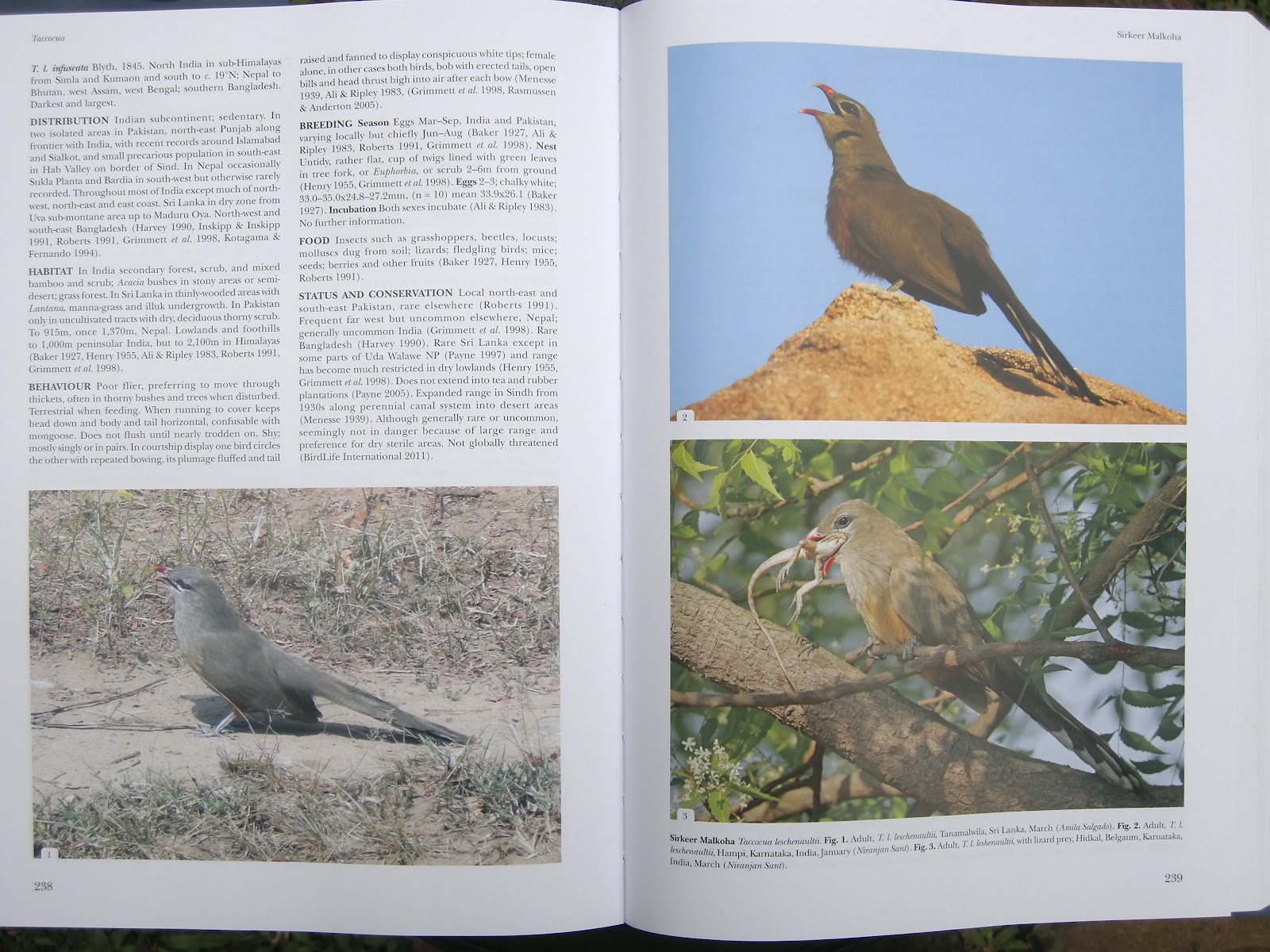
I got a spanking new copy of the newly published Cuckoos of the World for free!


Authored by Johannes Erritzoe, Clive F Mann, Frederik Brammer and Richard A Fuller, and publised by Christopher Helm, it describes all 144 species of the bird family Cuculidae including cuckoos, malkohas, couas, coucals, roadrunners and other species in exceptional detail. This includes accurate range maps, superb illustrations by four world-renowned artists to show different plumages and sub-species.

And photographs of almost all species, which includes three contributed by me. They are of Sirkeer Malkoha, Red-faced Malkoha and Indian Cuckoo.

A Red-faced Malkoha devouring a Mega Stick Phobaeticus hypharpax (Westwood, 1859) photographed in December 2004, using Nikon Coolpix 4500 point and shoot camera through a Kowa TSN 823 telescope appears in Page 243 in the Cuckoos of the World.

This explains how I got this freebie!

In the bibiliography it also refers to one of my papers on the feeding ecology of Red-faced Malkoha, which was nice. The book represents the definitive and most up-to-date reference on the identification of cuckoos.

The Sirkeer Malkoha in page 238 in the Cuckoos of the World was taken using my point and shoot Nikon Coolpix 5100, while guiding Dave Thrussel and Chris Holtby in March, 2010.

A big thank you to Jim  Martin, Project Editor of this book for seeking my images, and to my clients who were with me when I photographed these birds (Red-faced Malkoha duing the Christmas Bird Tour, Dec 2004 to January 2005;  Dave Thrussel and Chris Holtby, March, 2010).

Hello to all!

Sunday, 5 February 2012

Of the Sri Lanka Bay Owl That I Spotted from a Moving Vehicle


Somewhere in the lowland wet zone, I spotted this Sri Lanka Bay Owl from a moving vehicle!

That was during an Absolute Birding tour that I guided in the second half of January, 2012 for Mark Yates, Gary Thonburn (both from the U.K.) and Brendon Ryan from South Africa.

We were returning to our accommodation 'empty-handed' after specially going to see this scarce owl, which is a rarely seen resident bird species in Sri Lanka. We were not helped by so many elements on this day, which included the weather. During the journey back, which seemed a very long one, I kept spot-lighting randomly, hoping for a consolation Slender Loris or so.

This has worked before.
No loris, but an endemic Yellow-striped Chevrotain seen in the headlights of the vehcile, was a good enough consolation.
 
That was until I picked another eye-shine, which saw our vehicle coming to a screeching halt. When I trained my binoculars, they belonged to—would you believe—a Sri Lanka Bay Owl!

I soon shared my serendipitous find with my clients, who took a few decent shots. The one above was sent by Gary Thoburn, who wielded a Canon 500mm lens. We left the bird to carry out its hunting and moved on. Soon, I found that during the frenetic moments of spotting the bird, I had lost an eye cup in my Swarovski binoculars; I backtracked about 100 metres on foot to recover it. Glued to the same old perch was a still-busy-foraging Sri Lanka Bay Owl.

With this amazing find, this tour saw us bagging 12 out of the 15 resident night birds. Our tally included 9 owl species. We saw nearly 250 species of birds out of which 190 were photographed.

To see more images of birds and natural history photographed on this trip, visit Gary's photo site in a few weeks.

Related post: A tuktuk trip and a top lifer!

Wednesday, 4 January 2012

Rare Bird Alert: Yellow-rumped Flycatcher at Tanamalwila

I am happy to share the news of a sight record of a vagrant bird species to Sri Lanka—the Yellow-rumped Flycatcher Ficedula zanthopygia.


I saw it on 3 January, 2012, at Tanamalwila, in the sylvan interiors of southeastern Sri Lanka on the tour that I am currently guiding with Hans Veltman and Irene ter Horst from the Netherlands. My visitors are on a 14-day Absolute Birding tour, which came through Inezia Tours, run by my friend Pieter van der Luit.

Hearing an unfamiliar bird call, I ventured off the track a short distance to search for its source. In no time, to my surprise, I found a handsome, male Yellow-rumped Flycatcher—my first lifer for the New Year.

As it happens so often in moments like this, I had no camera with me; hoping to concentrate on just watching birds, I had left it in the vehicle. Soon after showing the bird to my clients, and I dashed like the Road Runner fetch my camera. And dashed back. Come to think of it, I forgot to uttter "mee mee."

But anyway, after an agonizing ten minutes, I found the bird again and was able take the record shot above. We were on our way to Nuwara Eliya, and had some montane birding planned for later that day. So I didn’t spend a lot of time trying to photograph it the way I like. But I guess this will do for the time being.

Its call reminded me of the more familiar highland special Kashmir Flycatcher, which belongs to the same genus as the Yellow-rumped Flycatcher. And at Nuwara Eliya later that day, we also the Kashmir Flycatcher; thereby, bagging two Ficedula species on a single day’s birding in Sri Lanka. Who would have thought that was possible!

Directions

Reach Tanamalwila.

Then in the A2, drive about a kilometer towards Lunugamwehera until you come across a police road block. A dirt track, which leads to the Lunugamwehera National Park, branches off left just there. Take that one. After about 130 metres, that track bends first to the right, and after a few metres, again to the left. The bird was found in between these two bends. It was found on both sides of the track during various times of our observation. Although you can drive right up to the site, I suggest you park the vehicle in the restaurant (“Thuru Sevana Buffet”) on the opposite side to the turn off. The owners there are very nice people and tolerate bird watchers. It will be courteous to buy a drink for using their gardens parking, after you have bagged the bird.

Further reading

The site consists of a secondary forest contiguous with the impressive riverine forest found along the Kiridi Oya. Some of the noteworthy birds that I have found here over the years include the Marshall’s Iora, Orange-headed Thrush, White-naped Woodpecker, Rufous Woodpecker, Black-backed Dwarf Kingfisher, Sirkeer Malkoha, Jungle Owlet, and now, the Yellow-rumped Flycatcher.

Yes, it is one of my patches, and a good one at that.
The site has a fair bit of mosquitoes, and if you have to venture into the jungle, note that the understory is thorny.

Happy New Year!

Wednesday, 7 December 2011

Absolute Birding in November, 2011

I am back after guiding my first birding tour for the winter tour season of 2011/2012. It was a 14-day Absolute Birding tour with Brice and Gail Wells from Perth, Australia from 1–14 November, 2011. Brice, 78, became the oldest birder to survive my Absolute Birding tour.

Our final tally of birds stood at 231 species. We saw all thirty-three endemics extremely well. As usual, we did well in the night birding department, scoring ten out of the fifteen resident night bird species. These included seven owls. Brice had never seen that many owls on a single birding trip before, so he was really pleased.

The rain gods were kind to us: barring the first two days, we had beautiful weather throughout the tour. Several mixed-species bird flocks were seen in full swing at Sinharaja. These yielded all the flock-associated specials such as the Ashy-headed Laughingthrush. Which laughs alright, but never smiles.


This Sri Lanka Swallow didn't mind the wet weather at Kithulgala; it was collecting mud for nest building.


This Sri Lanka Wood Pigeon was fearless when it came to drink in a 'waterhole' on this tree at Welimada.
Right time, right place.


The Grey-headed Fish Eagle was sentinel at Bundala National Park in bright light.


It is only fair to say that we had an impressive array of non-feathered attractions.

One of them is this gleaming elephant in pretty light at the Bundala National Park. Unlike the ones at Yala, the elephants at Bundala are a bit grumpy. So you have approach them with respect and caution. It looks like the ones at Bundala seem to have some 'issues' with the local fishermen who are allowed to enter the park in bikes to engage in fishing.

This elephant made a roadblock to assert its dominance, keeping us, and a few fishermen ahead, waiting.


We had to wait for about fifteen minutes, until it decided to clear the traffic at its own terms!

A similar standoff happened outside the Bundala National Park on another day. This time, it almost cost a few birds for the trip. Regardless, we scored 100 plus species of birds on that day. A bloke from the wildlife department, who happened to use the same road, came to our rescue; he used a couple of fire crackers to 'neutralize' the situation.


At Yala, we saw five Leopards in just two game drives (one in the first and four in the last) all which posed well. On our first visit, some real-time ground intelligence led to this lone young female on a tree close to the Akasha-chaitya junction. We had it for a good fifteen minutes.


Our no.2 and 3 Leopards came together. And in the process, nearly took our breath away!


That was when these two big boys crossed the road in the Jumburagala road. The one that took the lead was blind in the left eye.


Too bad we were at the wrong side of the light.


Otherwise, I could have absolutely nailed them!


No, we photographers are never happy!

As our jeep driver correctly predicted, one of the Leopards, as it turned out the bigger one, settled on a distant rock to nap. Driving on from there minutes later, we had the One-eye, walking along the track marking its territory.


He was a grumpy old fellow. A walking-wounded of sorts. Every now and then it paused to pose. Even the point-and-shooters had a field day.


We were compelled to take a comfort break close to 5.30 p.m. While we were busy, we heard a deer alarm. Quite close! We were making our way out of the park, having had a superb day. Too close and precious to let go, we drove in the direction of that alarm. And minutes later, we found this female.


If not for that desperate leg-stretch, we would have not heard the alarm, which led to this beauty.
Which drove home a golden rule in the jungles: when you want to go, go you must.

Anyway, the female having noticed us, crossed the road and disappeared. Once again, our driver predicted that it may climb a rock nearby, and he made a beeline to that spot.  Not even a minute passed by, and the female materialized on the rock in front of us, giving us a bemused stare, "how did you know ...?!"


Our jeep driver said he heard the female calling to its young. So we expected she will soon have some company. About five minutes later, this cute little female cub appeared on the rock!


But, before reaching her mom, she paused to check us out.


At her own pace, she joined her mom.


Some quality family time followed


The little one got a nice clean up, presumably before the evening activity.  In the shade of a fig tree, this rock had a peaceful setting of a Buddhist temple. Two Malabar Pied Hornbills whooshed pass vying for their attention. It was nice to see how mindful the Leopards were—even watching birds! We left them there to make our timely exit and to end what a fabulous day with big cats.

While the above passed as our best wildlife day, our best birding day was day-thirteen at Sigiriya. It was significant because of a late afternoon birding session, which produced an avian bonanza consisting of eight new ticks for the trip.

The goodies were Shaheen, Cotton Pygmy-goose, Orange-headed Thrush, Black-backed Dwarf Kingfisher, Indian Blue Robin, White-rumped Shama, 'Fork-tailed' Drongo Cuckoo, Indian Pitta, Jerdon's Nightjar, Spot-bellied Eagle Owl (which was expertly spotted by Brice), and a one-for-the-road Brown Fish Owl.

In terms of numbers, our day-seven was the best with a whopping tally of 118 species.
Birds were superb alright, but I must say those leopards really took the cake on this tour.

Thinking about that day in Yala, I still can't wipe the smile off my face.
Related Posts with Thumbnails