Monday, 24 November 2008

November rain.

brings about lots of pleasant changes in the environment. One of these is it creates temporary pools in most parts of Sri Lanka. This may sound bad news when you think about mosquitoes. But these pools also attract dragonflies, which come to find food and love. Aggressive predators, dragonflies in their aquatic larval stages feed among other things on mosquito larvae. Also at their free flying adult stage; they feed on mosquitoes, quite a bit. Therefore, dragonflies play an important role in controlling these harmful pests, which increase during wetter months.

While birding in a secondary forest patch close to my residence, I came across quite a cute little temporary pool with plenty of dragons. I found myself making two trips to this fantastic wetland reserve to attempt to capture some of its beautiful residents in camera. Here are a couple of dragon shots that I managed.

Blue Pursuer Potamarcha congener -- adult male.

Blue Pursuer Sociable Glider Tramea limbata -- adult male.

Sociable Glider

My birding highlights included Yellow-fronted Barbet - an endemic bird of Sri Lanka that is still holding a small population – probably the closest locality to Colombo in its distribution in Sri Lanka. This endemic is still not recorded in my garden yet; despite the latter being only a 1.5 km away as a Crow Barbet flies. The reason for its absence in my yard is probably is due to the fact that the intervening gap being somewhat heavily built-up. It just shows how habitat-specific some of these endemics are.

Yellow-fronted Barbet

I also saw my first White-browed Fantail in my local area. Primarily a dry country bird, it occurs in the wet zone where vegetation has been cleared and secondary growth has taken over. Therefore, in my opinion, it’s a good indicator species about dryness that is creeping into parts of the wet zone due to increasing human activity.

Fellow blogger; Java Jones lamented once that he doesn’t get to see White-browed Fantail in the garden of his highland retreat anymore. I asked him whether his land has got ‘wetter’ than before. His answer was, a ‘yes’. He had planted a lot of trees for habitat enrichment over the years, which have turned his garden greener and consequently too wet for White-browed Fantail! He mentioned that it is found in nearby tea fields, which are open and sunny but not in his backyard anymore.

Monday, 17 November 2008

.42

My garden about which you have heard a lot is just .42 acres. In case you are new to this blog, it is quite well wooded as well. Most of the trees in it have been planted by me since I was 13 -- from the time I got hooked on nature as a schoolboy. Now that I am 30-something some of those trees stand to remind me how much I have aged as a naturalist. My garden borders to 9 other neighbouring home gardens, some of which are also quite well-wooded. So, by no means it is an island surrounded by lifeless sea of development. The natural riches that I get in my yard are also thanks to my neighbours who keep their gardens greener. This has helped to maintain a large enough area to harbour a decent enough diversity of natural history in what is actually a sprawling residential area.

Some of my neighbours are related to me and I have unfettered access to their gardens 24/7. I have even planted a few trees in them from time to time for habitat enrichment. Some of them are economically important trees. And I happen to derive indirect benifits from having them in the vicinity. So, it is a win-win partnership, as I see it. I have to observe here that none of my dear neighbours are as keen on natural history as I am. In fact they remain wilfully ignorant of the nature around them and lead lives of aloof ordinary citizens.

With that being the state of affairs, my cousin bro, next door decided to a clear what he termed as a 'grassy jungle' in his backyard, which in my world of reality translated into a good dragonfly and butterfly patch. Perhaps, he didn't know that it was a happy hunting ground of mine. Perhaps, I didn't dwell the importance of his backyard patch has to many critters that call it a home. All of a sudden he seemed to have got this preposterous notion of a 'cleaner environment' and turned a NIMBY!. He is not alone in this erratic thinking and quite a few neighbours seem to have their gardens with minimal low vegetation.

Careful diplomacy with my cousin to spare those patches fell on deaf ears. In our close-knit Asian social relationships, we depend on each other -- especially the neighbours for various kindnesses that are not valued in monetary terms. Having had no positive response to save this patch, I had to resort to more persuasive means of negotiations such as by threatening them of 'islolation' and categorising them into 'axis of evil'!Finally, this worked somewhat and I managed to save a few squares of 'grassy jungles' just as Tom Lovejoy saved those rectilineal squares of 1, 10, 100, 1000 sq.km of Amazonian rain forests from being clear-felled in the late 70s when they were being cleared by the Brazilian government to create among other things, cattle ranches to meet the demands of meat-eaters 'Up North'. Tom, I learnt had used less threatening negotiation tactics.

Due to thick overhead vegetation, my garden until recently had very few patches getting direct sunlight at the ground level, which is an important requirement for a good butterfly and dragonfly patch. This is why I decided to create a permanent patch for dragonflies and butterflies in my yard - one that I'd have full control of. After all, I cannot go on to use my bargaining tactics with my neighbours all the time!

For this end, I opened up a sun-lit patch in my backyard by selectively logging a few trees recently. More information of this new patch and a dragonfly pond that I am creating in it as we speak will be dealt in post later on. Until then, here's my .02 of the stuff I found in my .42 in the last few days. Enjoy!

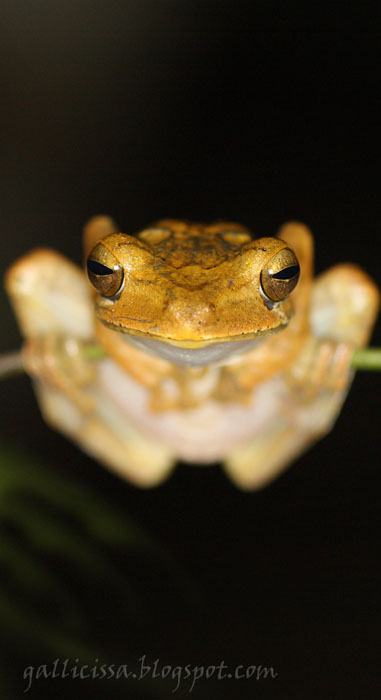
Common Hourglass Tree-frog Polypedates cruciger -- adult female. Endemic species.

Common Hourglass Tree-frog

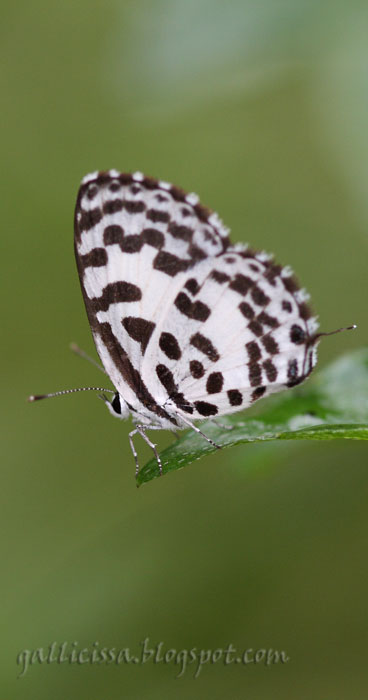
Common Pierrot Castalius rosimon

Common Pierrot

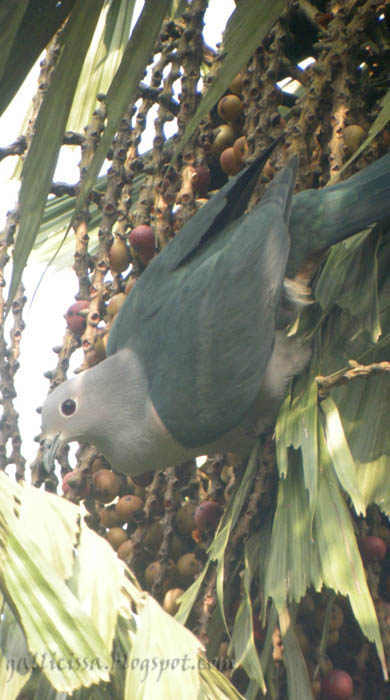
Green Imperiel Pigeon Ducula aenea - feeding on fruits of Fish-tailed Palm Caryota urens. This is a record shot. I have far better shots of this, which is the largest wild pigeon in Sri Lanka. I have 6 Fish-tail Palms in my yard.

Green Imperial Pigeon

Hump-nosed Viper Hypnale hypnale -- found inside a pile of coconut husks while clearing the land for the pond. Venomous but not deadly to humans.

Hump-nosed Viper

Tiny Grass Blue Zizula hylax -- wing span of the adult is about 1.5 cm -- the first butterfly photographed in the new patch.

Tiny Grass Blue

Pied Parasol Neurothemis tullia tuillia -- female

Pied Parasol - female Oh! I had yet another new bird in my yard in the form of a Bar-winged Flycatcher-shrike Hemipus picatus, which is also a new one to my local area. As in other recent new records, I heard it first. An Indian Pygmy Woodpecker and a Large Cuckooshrike were also seen well.

Monday, 10 November 2008

Macro Monday

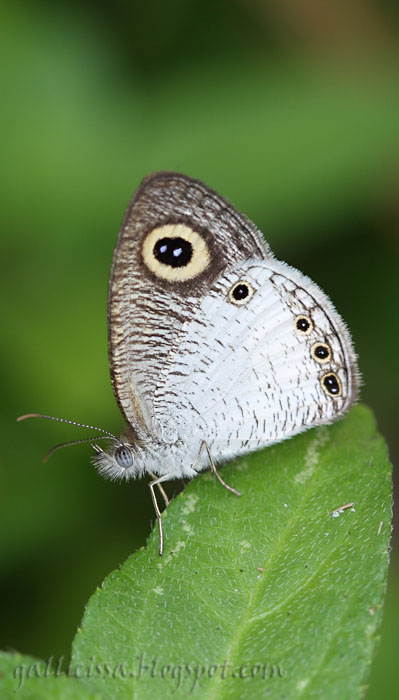
White Four-ring Ypthima ceylonica

White Four-ring

Apefly Spalgis epeus

White Four-ring

Thursday, 6 November 2008

Indian Rockdweller

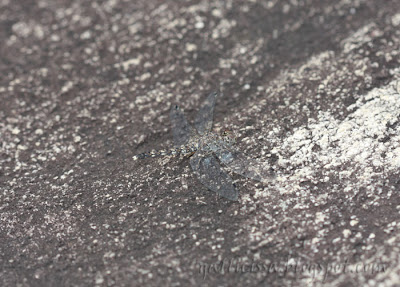
Last month, I explored an abandoned quarry just 70m as a crow dragonfly flies from my place. There are two natural rock pools there, and I found 6 species of dragonflies not recorded in my garden! This Indian Rockdweller Bradinopyga geminata female is one of them. I have shown the original shot I took and 3 crops I made from it to reveal this cryptically coloured dragonfly. A post about other dragonflies of this 'new patch' will be done later on.

Indian Rockdweller female Indian Rockdweller female Indian Rockdweller female Indian Rockdweller female

Thursday, 30 October 2008

Serendipity

Another garden post.

About 5 months ago, while photographing insects in a overgrown section of my yard—"designated" to lure in the Himalayn winter visitor Indian Pitta among other things—I had a brief encounter with a smallish terrestrial mammal. I couldn’t get a good look at it due to thick vegetation. It ran slowly in the under growth, froze for a moment, and moved out of my radar as I strained my eyes to catch a glimpse of it. My gut feeling suggested that it was a mouse deer aka. chevrotain (Me-minna)—a mammal that would not only be new to my yard but also to my local area!

And then, a local man who helps us with our gardening chores, Premadasa, recently mentioned to me a couple of days ago that he saw a Chevrotain in this very section of my yard about a month ago!

He is familiar with this animal as is apparently found in his area, which happens to be thickly wooded. Oh! And my mother too described features of a small mammal with yellow stripes that she saw in one late afternoon!

This is extremely good news, and I will be on the look out for this very special mammal.

After analyzing the skulls and skins of this mammal found in India and Sri Lanka, Groves and Meijaard in 2005, ‘split’ the population of the Mouse Deer found in the wet zone in Sri Lanka into an endemic species. Thus, it is now regarded as Yellow-striped Chevrotain Moschiola kathygre (Groves and Meijaard, 2005). Click here to download that paper published in the Raffles Bulletin of Zoology.

Below is a picture of an unfortunate Yellow-striped Chevrotain preyed a stray dog at the Sinharaja 'word heritage' rain forest. I reported this earlier in this post.


Coming back to my garden's record, this is an extremely exciting news as my area is residential one and is not woody as it used to be.

The most exciting mammalian find in my yard before this, was in mid 2007, when a pair of Golden Jackals turned up at broad-daylight! I showed it to my mother and a few gasping neighbours who at once confessed that they would have easily overlooked them as two stray dogs! I belived them.

Here is a record shot of a pair Golden Jackals seen at Bundala National Park on a bird watching tour that I led with 11 British birders in 2006. Click here to read its full trip report.


On the birding front, 2-days ago, I had a new bird getting added to my garden bird list in the form of Indian Pygmy Woodpecker (formerly, Brown-capped Pygmy Woodpecker). This species is found in my local area at a spot that is 1.5 km away from my residence, but this was the first occasion I had it turning up in my yard. It betrayed its presence by its distinct call, and moments later, I had a good sighting of it.

With this, I now have 4 species of Woodpeckers in my garden list. The other three species are the Black-rumped Flameback (the commonest Woodpecker in most home gardens), Lesser Yellownape (occasional visitor to my garden), and Rufous Woodpecker! The latter is the most exciting one out of this list. It was recorded in 1991—during a fine morning when I was getting ready go to school! It hung around for few days in my yard, betreying its presence by its signtature call. I had no sightings of this species in my garden since then.

A Large Cuckooshrike, which is an occasional visitor to my garden, was also heard a few days ago.

Moving on to invertebrates, I spotted this Long-horned Grasshopper species for the first time.


Its identity was narrowed down by Dr. Priyantha Wijesinghe as follows.
Orthoptera: Tettigoniidae: Phaneropterinae: Mirolliini?

He commented “This is something of a mystery, but that is probably just my lack of familiarity with the species. By the way, it is illustrated on p. 103 of Henry's autobiography 'Pearls to Painting”


I took my copy of G.M.Henry’s autobiography, and turned to page no.103, and—lo and behold—there it was in the form of an excellent work of art by Henry!

This was found low-down in an ornamental plant in the shade of a (Malaysian) Rambutan tree Nephelium lappaceum. As the Zumala that I found in Sinharaja rain forest, this looked rather bizarre with the posterior end of its tegmina looking somewhat like a headdress of an Egyptian Queen!

I was chasing a dragonfly when I ran into this Spiny orb-weaver Gasteracantha geminata (Fabricius, 1798) female (also identified by Dr. DPW). It was dealing with a termite prey. I took only this shot of it as I try not to get distracted with other life forms when I am chasing a particular target.


Looking at the set of pictures that went into my Scrabble and Dragonfly tips post, I found this picture of a juvenile Elusive Adjutant that I had mysteriously overlooked!


It is quite sharply focused in both the eyes than the similar looking picture that I used for that post. I did very little post processing with this as everything was just right. It was shot at natural light, hand-held.

By the way, his kinkiness the Painted Waxtail that I posted in this post was, as I suspected, suffers from a birth defect caused at the immergence from exuvia. This was confirmed by my dragonfly mentor Matjaz Bedjanic. He went on to say that the said individual “….is suffering from a emergence defect and his abdomen is has not been damaged during copula. Normally such specimens [with birth defects] don't survive long”.

That is all for now.

Edit: Dr. Priyantha Wijesinghe has sought opinion from Dr. Sigfrid Ingrisch, an expert on Orthoptera to narrow down the identification of the Long-horned Grasshopper above. And the question mark means it is unidentified.

Sunday, 26 October 2008

Blogoversary

Odontocista - the toothed Lathrecista
Today marks my first blogoversary. I am quite happy that I lasted a year in the blogsphere! I’d like to take this opportunity to say a Big Thank You to all my dear readers and commenters who have been a big force behind this blog through its short journey.

Since I started this blog, I have been asked by several people as to what my blog-name: Gallicissa means. And I think this a good occasion to answer this burning question.

Gallicissa is the name of a "mythical' bird" that I created as part of the logo of this blog. (edit: it has been replaced with what you see now.) It was fusing a images of several endemic birds found in the endemic hotspot that is Sri Lanka. The two central birds that I used for this fusion were Sri Lanka Junglefowl Gallus lafayetti and Sri Lanka Blue Magpie Urocissa ornata, the latter which was formerly known as Cissa ornata—the name that existed in the days that I started birding in 1989. So, I used their generic names, gallus—the plural of which is galli; and cissa to coin the generic name: Gallicissa for my photoshopped bird.

Gosh! I just can't understand why so many people cannot figure this out!

Anyway, apart from the aforementioned two parent birds, I used plumage features of three more endemics to add to the gaudiness of my creation. They were the throat streaks of the Red-faced Malkoha, facial pattern below the eye, pattern in the belly, the ‘spot-wing’ of the Spot-winged Thrush (I used two photographs for this purpose), and the ‘yellow ear’ of the montane endemic Yellow-eared Bulbul.

There you have it.

As far as it is known, Gallicissa Salgado, 2007 is a monotypic genus that is endemic to Sri Lanka.
Related Posts with Thumbnails