Friday, 29 February 2008

Huuhkaja!

While reading the excellent birding blog of Timo Janhonen; the Bad Finnish Birdwatcher, I read about an (Eurasian) Eagle Owl Bubo bubo invading a football match played in Finland between the host country and Belgium and that the footage captured of this incident is in Youtube. Finland had won this game according to Timo who sounds happy; mentioning the footie result in the same breath. I had a look at this and thought it had enough merit to share with my blog readers, not that I am overly fond of owls or anything.

Spectators cheer ‘Huuhkaja’, which apparently means owl in finnish. It sounds like a very bad swear word in Sinhalese but I learnt that the bird had since then come to be known as Bubi, a sports commentator in Finland. How fitting considering that its scientific name is Bubo bubo! A related form occurs in Sri Lanka, which is called Forest Eagle Owl Bubo nipalensis (Ulama in Sinhalese), of which the shrilling calls are considered to bring death and misfortune by the locals. I am on the hunt for one of these and I shall break some news if I succeed in my mission. If any of my blog readers have any credible information of this or any other owl in day time roosts in Sri Lanka, please let me know!

Edit: Timo informed me that Huuhkaja means Eagle Owl.

Monday, 18 February 2008

Israel chasing targets in Sri Lanka

Green Pit Viper in Sinharaja 25 Jan, 2008
I guided Israel Leinbach, a crack US naturalist from Yuma, Arizona on a day tour to Sinharaja. He had reached there independently, a couple of days ago. Returning home after my birding trip with Malcolm and Duan, and just managing forty winks, I was off to Sinharaja at 2.00 a.m., to meet him at an all-suite botique hotel named, Boulder Garden.

As I was just myself, I had my local tuktuk friend, Sarath who had already made a couple of mission-critical-trips to Sinharaja with me, to deliver me there. Israel was the first to tour with me after finding me through my blog. He is reading for his Masters in Entomology, and was quite keen on all types of life forms that come in smaller sizes, especially scorpions. He is also a brilliant photographer with special interests in macro photography, and by the time I met him, he had already found quite a few critters under his own steam including a family of scorpions. They were under a boulder in the boulder-strewn landscape of the hotel gardens. And he also knew where the best looking frogs in the hotel gardens were.

Sri Lanka Whistling Lizard - 25 Jan, 2008
Israel had already made a visit to Sinharaja before I met him. However, he still had several key targets missing in his wish list, which included the endemic Green Pit Viper, Hump-nosed Lizard, and False Lantern-fly. And he didn’t mind the odd snake or two.

Sri Lanka Rock Frog
After meeting him, I got Sarath to drop us at Sinharaja. He enjoyed it.

Before reaching the forest proper, we paused at several roadside patches along the road leading to the ticket office in search of Sinharaja’s abundant natural history.

Our first finds was the endemic Tree-climbing Crab Ceylonthelphusa scansor—a high profile crab, may I add.

We also saw Sri Lanka Rock Frog Nannophrys ceylonensis, the latter found hiding inside moist rock crevices during daytime. Both the above genera are endemic to Sri Lanka—with the later having three representatives in the scientific inventories of which is presumed extinct. It is only found in museum specimens made in the hey days of British era of natural history explorations, and recent field work to find it had drawn blank.

After obtaining our permits and meeting our compulsory local guide, Ranjaka, we took a 4-wd jeep ride up to the forest’s entrance. En route, I paused to scan a tree that I had observed the good looking False Lantern-fly previously. While I was scanning this tree high up, fresh from memories of my most recent encounter with it last December when I found one high up, Israel spotted one quite low down, which was great as it was within the range for close up photography. He got some cracking photographs of it over the next 20 minutes while I searched its vicinity for other thingamajigs.

Israel finds finds a target in Sri LankaOne key target bagged, we drove to Martin’s Simple Lodge for a cuppa and to let him eat his packetted breakfast.

Stripe-tailed Bronze-backWalking up to the forest’s entrance thereafter, I spotted a smallish lizard resting vertically along a tree trunk, quite  low down. A close examination revealed it was the scarce endemic, Sri Lanka Whistling Lizard  Calotes liolepis. Israel had not expected this, and was full of superlatives, and expletives as he macro-photographed it over the next few minutes. Boy! he really does not hide his feedback!

We had still not entered the forest’s main entrance, and Ranjaka delayed our entrance again by spotting another gem—tree snake, Stripe-tailed Bronze-back Dendrelaphis caudolineolatus, resting on a fern patch on a slopy edge. I told Israel to first go for a record shot before getting closer for improved macro shots as this non-venomous snake is calm in disposition, often tolerating closer approaches. This was a useful hint as he was able to do just that taking his own time to try out different settings and compositions, and getting some stunning shots in the process. His close-ups of its head area was unbelievably good. He had not encountered any snakes on his visit to Sri Lanka prior to this, and this was enough to make him declare that his trip to Sri Lanka is now justified.

Green Forest LizardEntering through the forest’s main entrance, we walked along former logging tracks to reach the virgin interiors in search of Israel’s other ‘high-value-targets.’ I announced a count down to another snake encounter and didn’t disappoint him in finding not just one but two Sri Lanka Keelbacked Water Snakes Xenochrophis asperrimus at a known stake-outs. We also found several more critters including the Giant Wood Spider Nephila maculata, Giant Millipede Spirostreptus sp., and two more lizards namely Kangaroo Lizard Otocryptis wiegmanni, and Green Forest Lizards Calotes calote—all of which, despite being found on his previous visit to Sinharaja, kept him busy regularly.

Israel finds a target in Sri LankaStill no Green Pit Viper, and Israel decided to just check a few suitable habitats in his own initiative. I was playing my cards close to my chest, and I took him to a site— following some ‘real time ground intelligence’— to find him a stunningly beautiful Green Pit Viper Trimeresurus trigonocephalus lazing off near a dark corner along the track. Previously unheard of Arizonian superlatives and expletives followed.

That really was an orgasmic encounter!

This sluggish arboreal snake is one of the most photogenic ones if you know how to deal with it, and it took some persuasion to take him away from it.

Walking towards the research camp, I paused in for some wayside avian distractions in the form of a pair of roosting Sri Lanka Frogmouths, found in the previous visit. He had already seen these on his previous entry, but was not dismissive of it, when I offered him scope views. Soon, Israel found and photographed a stunningly beautiful jumping spider, so ornately coloured that it would have got even the most extreme arachnophobiac hooked on spiders. It was seriously bling, bling. Too bad I couldn't shoot it, as it was so tiny, and out of my range, photographically speaking.

We broke off to put our feet up during the midday, which offered some arm-chair birding with several confiding Sri Lanka Blue Magpies and Sri Lanka Junglefowls breaching our personal space before a mixed species bird flocks operating in silence yielded scope views of Malabar Trogon, Sri Lanka Crested Drongo and Ashy-headed Laughingthrush.Green Pit Viper - 25 Jan, 2008
The time was 2.00 p.m. and Israel didn’t seem to be any hungry for lunch (when my hunger index—calculated from 0-10 had already hit an all-time high!), and we continued our quest—living off biscuits and bananas—in search of the remaining high profile endemic, the Hump-nosed Lizard. I took him up deeper into the virgin interiors of the rain forest and to a site where I photographed a pair of these at point blank range last December. En route, we found several good-looking arthropods, which were all nicely macro photographed. Having arrived at the site of the lizard, we searched for it high and low but were unable to locate it.

Thinking that it may have distanced away from the site I found it earlier, I searched the perimeters only to draw a blank again.

Finally, we decided to do our operation in three different fronts sweeping the forest. After an hour or so of searching, Israel exclaimed going into what was then a familiar high, stumbling another Green Pit Viper!

It was a young individual lying in ambush low down in a tiny sapling. This site was quite away from any stream, which was interesting, as Green Pits are usually found alongside streams. Knowing well will be lingering here for some more time, I went back to find the missing lizard, and to re-focus on what I thought to be the "core area," undaunted by the failures.

Soon we hit gold as Ranjaka skilfully spotted an adult male
Hump-nosed Lizard - 25 Jan, 2008
Hump-nosed Lizard settled about 15 feet up a lanky under storey tree—just the 3rd neighbouring tree from where I photographed it in December!

Israel was quickly summoned—and what do you know—it was love at first sight for him. Being out of macro photographic range, some work was necessary to bring it to a manageable height before attempting to photograph it.

It was clearly a day of multiple orgasmic sightings.

I thoroughly enjoyed the time I spent chasing targets for Israel who was great fun to work with. He keep me going with his hunger for nature and great sense of humour. He possessed an amazing field craft, which made every minute that I spent with him at Sinharaja enjoyable. Israel was never short of appreciation of my efforts, and it was such a good feeling to make a clean sweep of all his prime targets.

I believe luck plays a big roll in such limited operations and this man was one lucky dude. A prolonged late Sri Lankan rice and curry lunch at 4.00 p.m. at Martin’s was described by him as the best meal he had since coming to Sri Lanka. I returned home with some great gifts, which included a snake-guard, a streamlight TwinTask 2D flash torch ideal for my nocturnal pursuits.

Tour guides reading this post: if you get an enquiry from this man, Israel Leinbach, do not miss the opportunity to guide him. He is bloody awesome!

Israel Leinbach in a moment of joy - 25 Jan, 2008

Tuesday, 29 January 2008

Birding with Malcolm and Duan

Tickell's Blue Flycatcher
Malcolm McDonald is a Brit working in Kazakhstan (yes, Borat featured in our discussions!), and from 20-24 Jan., he did a 5-day bird watching trip with me focussing on the endemics and subcontinental specials. We were joined by Duan Biggs, (no relative of Jason Biggs; no special liking for baked goods!), a South African bird tour leader currently based in Australia. Duan arrived a day later than originally planned due to an airline issue in India where he had led a bird trip before visiting Sri Lanka.

After meeting Malcolm at 4.30 a.m., I took him to the lush lowlands of Kithulgala, and we arrived in our accommoation in time for some quality early birding in the hotel gardens at first light. Being an airline engineer, Malcolm had visited Sri Lanka many times since the 70s. But had not been on a guided bird tour. So this was a first. And he had not just one, but two bird tour guides to find him birds!

Malcolm & DuanStaying with a former work colleague, who resides in Kandy, Malcolm had seen a few commoner endemics during his previous visits to Sri Lanka. So everything was new. Anyway, oOur first tick of the day turned out to be Sri Lanka Junglefowl. Which had mysteriously eluded Malcolm on his past trips! We had a pair of these game birds (national bird of Sri Lanka) in close quarters. An Indian Pitta was feeding literally under his room (build on an elevated wooden platform), and after first revealing its silhouette, it popped out to the open to give him good views. A flash of red and yellow whizzed pass uttering a familiar sharp call. It turned out to be the ornately plumaged Black-backed Dwarf Kingfisher (aka. Oriental Dwarf Kingfisher), which sat long enough to give decent scope views, albeit in poor light. (Later on I was shown a nest site of it nearby.)

Still very early in the day, we had a small but highly vocal mixed-species bird flock in the hotel gardens. This comprised of the White-bellied Drongo, Orange-billed Babbler, Yellow-billed Babbler, Asian Paradise Flycatcher, Black-naped Monarch, and Lesser Yellownape. A Brown-breasted Flycatcher was also doing its thing low in the under growth. No calls of the Green-billed Coucal, strangely. Metallic calls of the Tickell’s Blue Flycatcher betrayed its presence in the low undergrowth and it was seen well more than once.

Asian Brown Flycatcher

Still on our pre-breakfast walk, we had fine views of a juvenile Crested Hawk Eagle, across the river, basking in the early morning sun. Next came Green Imperial Pigeon, Sri Lanka Grey Hornbill, Yellow-fronted Barbet, Brown-headed Barbet, Sri Lanka Hanging Parrot, Orange Minivet and Square-tailed Black Bulbul, all in quick order. And we also had a Black Eagle soaring.

After enjoying a fine breakfast, we explored the surroundings briefly getting improved views of some of the birds we have already seen; plus bagging a few new ones in the form of Common Iora, Shikra, and Black-capped Bulbul.

Having started at an unearthly hour to pick Malcolm up from the airport, I had not had any overnight sleep, and forty winks were all what I could get in the brief rest we had before lunch. This was because I was rudely woken up by a mobbing party of birds outside my room. I couldn’t see any bird of prey in close vicinity, so I suspected it may have been over some arboreal snake lying in ambush somewhere. Shortly afterwards, I had another sightings of a Black-backed Dwarf Kingfisher near my room. Quite a gem of a bird.
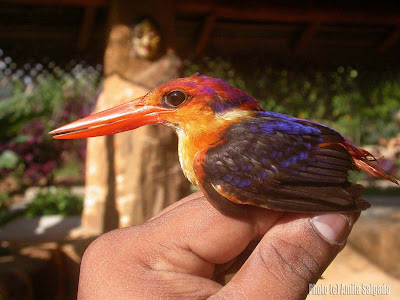
Black-backed Dwarf Kingfisher

After enjoying a superb Sri Lankan rice and curry lunch, we tuktuked a short distance to the ferry point to cross the Kelani River in a Dug-out canoe to reach the Kithulgala Forest Reserve for our afternoon birding birding session. New birds added to our list on this foray were Sri Lanka Green Pigeon, a female Indian Blue Robin, Black-hooded Oriole, Yellow-browed Bulbul, Sri Lanka Crested Drongo, Layard’s Parakeet and Lesser Hill Myna. A pair of Green-billed Councals across the river responded to a booming call imitated by yours truly, but it didn’t cooperate. (Perhaps we weren't patient enough.) Dinner and checklist marked the end of a slightly tiring yet rewarding day.

I gave a wake up call to Malcolm early on the following morning with a scope set in front of his room in focus of a Chestnut-backed Owlet that I managed to spot in the dark undergrowth. It was a good enough view despite the low light. Soon after, another bird was spotted high up in a tree when the light improved, which gave more than decent views. Our next top highlight was the endemic Spot-winged Thrush, which was out in the open feeding alongside a few Babblers. This was also heard singing. No Green-billed Coucal yet though.
After enjoying a birding breakfast; a breakfast interrupted continuously by sightings of two Crested Hawk Eagles and a Stork-billed Kingfisher, we drove to Sinharaja rain forest via Ratnapura. A 4-wd jeep was awaiting our arrival at the ticket office to take us up to our overnight accommodation for two nights; Martin’s Simple Lodge. Before that I paused in a roadside patch to show Malcolm a nest of a Spot-winged Thrush with a brooding adult bird. This was built high up in a branch that was hanging over the road used by vehicles regularly by the visitors and locals.Orange MinivetMartin’s was teeming with humanity when we arrived there during the midday. There was a big Taiwanese bird watching group equipped with all the latest cameras and optics and a school group of over 30 girls (a mixed species bird flock) - which was part of a regular educational workshop conducted by the FOGSL headed by Prof. Kotagama and Rahula Perera with the generous sponsorship of Sri Lanka Telecom as part of their CSR.
Undaunted by the imminent convectional rain, we set off on our first walk in Sinharaja rain forest, soon after lunch. As expected, it rained and rained heavily but that didn’t hamper us from making quick ground towards the bird rich interior hoping for some respite. I was playing my cards close to the chest and this hurried approach amidst inclement weather was especially in anticipation of a particular pre-identified target based on some real-time ground intelligence. We arrived at the said site and within no time Malcolm was enjoying scope views of his first Frogmouths; that of Sri Lanka Frogmouth – a male and a female perched in a Kekiri-wara (Schumacheria castaneifolia) tree in a day roost facing opposite directions at almost eye-level!Sri Lanka Frogmouth in a day roost 22 Jan, 2008 - maleWhen we finally had some respite from the rain, I scouted inside the virgin section of the forest with Malcolm to whistle in a Sri Lanka Scaly Thrush for frame-filling scope-views amply rewarding Malcolm for braving the rain and having faith in my judgement. A Green-billed Coucal offered poor views for Malcolm with only myself picking up the diagnostic green bill before it mysteriously melted away into the chaos of rain forest vegetation. A mixed species bird flock observed amidst rain didn’t produce anything new and we returned to Martin’s for checklist, dinner and overnight stay.
Duan Biggs was arriving at midnight today (he was to arrive at midnight yesterday) and I had a transfer arranged to take him directly to Sinharaja with my best driver for night driving whom I have been using for my shenanigans from time immemorial. When I reached down in a 4wd jeep to pick him up at 4.00 a.m. my man had already delivered him safely fifteen minutes ago! Apparently they had only left the airport area at 1.30 a.m.! I had already told Duan that the driver is a ‘Schumacher of sorts’ and to be cool with his ‘style’. Duan had swallowed a sleeping pill soon at the start of the drive and had slept all the way up to Sinharaja! By the way, this driver is one lucky dude; a few months ago he won the first prize of a local TV quiz (Sirasa TV Ran-depeya) and became the proud owner of a fully furnished 2-storey luxury house worth over 10.2 million Sri Lankan rupees (US $ 94,445) with 24 hour security & free family memberships for a pool and a gym!!!
After briefly exploring a nearby patch for night birds, we arrived at Martin’s in time for the arrival of Sri Lanka Blue Magpies. This early foray didn’t produce anything but provided a clear demonstration of dizzying effects of sleeping pills following short sleep spells! Part of the Taiwanese bird contingent had already arrived and laid claim to some prime vantage points at Martin’s balcony in anticipation of the Sri Lanka Blue Magpies. Ironically, they had arrived from an accommodation named after this bird!! Soon, we enjoyed early tea with 4 Sri Lanka Blue Magpies, which were all around us making an early snack of the insect prey found under lamps; giving a field day for the giddy Taiwanese photographers.
Thereafter, we went on a pre-breakfast bird walk to get nice scope views of Green Imperial Pigeon, Sri Lanka Crested Drongo, Legge's Flowerpecker, Purple-rumped Sunbird, Yellow-fronted Barbet, Sri Lanka Hanging Parrot, Orange Minivet, Layard’s Parakeet, Square-tailed Black Bulbul, Asian Brown Flycatcher & Sri Lanka Grey Hornbill in beautiful morning light. Early in our post breakfast walk, we saw a fairly large raptor flying overhead and perching atop a shorter tree in a patch of tea adjoining the forest. I scoped it through the vegetation to just reveal its identity; a Mountain Hawk Eagle -a rare species in Sri Lanka and my only second sighting in Sinharaja. By the way, my Mountain Hawk Eagle photograph got published in the current issue – Number 8 of BirdingAsia – the bulletin of the Oriental Bird Club.
Soon, a small bird flock we had contained Large-billed Leaf Warbler, Greenish Warbler, Black-capped Bulbul, Dark-fronted Babbler & more Sri Lanka Grey Hornbills, which were observed in close quarters. A fairly good mixed species bird flock was encountered soon after entering the forest proper and we were able to detect a Red-faced Malkoha, which rested in an overhead branch revealing a prolonged ventral view instead of the diagnostic red face and greenish beak we wanted. So, doesn’t count yet. Although it was motionless for considerable time, I anticipated the bird to go up and alerted about this and positioned ourselves strategically a bit away, awaiting the bird to move the way we desired. This worked marvellously as we all had a brilliant scope views in early morning light. As Duan put it so eloquently; it was an orgasmic sighting!!
Walking up to the research camp, Duan picked up a Spot-winged Thrush near the track. We also observed the Black-naped Monarch’s nest that I observed on my previous visit with a brooding adult bird and a newly fledged juvenile. The Sri Lanka Frogmouths were found in the day roost today as well and Duan got good views of them this time perched facing the same direction.
Scouting inside the virgin forest, we had a chance sighting of a Green-billed Coucal flying straight into a thicket with a medium sized Green Wine Snake in the beak. It provided brilliant views for all of us when it ascended up the thicket before going into it. Although I couldn’t detect externally, I suspected that it may be nesting inside this thicket from the manner it flew in so purposefully into the ticket and the way it moved about having done that. Moments later a Green-billed Coucal; probably the same bird observed earlier appeared out and flew back in the same direction the bird we saw first came from. We left the site immediately not to cause any disturbance.
After spending some time around the Research camp seeing more Sri Lanka Junglefowls and Sri Lanka Blue Magpies, we started searching seriously for Malabar Trogon, which was proving tough for no apparent reason. Finally my efforts paid off and I found a pair of females with one spotted quite low down.Malabar Trogon - femaleThe school group was ready to depart by the time we arrived for our late lunch. Malcolm decided to take the afternoon easy to enjoy some arm-chair birding from the comforts of Martin’s balcony. So, I walked with Duan in search of more endemics. Early in this afternoon foray I found him a flock of four Brown-capped Babblers quite close to the track. No Sri Lanka Scaly Thrush despite looking for it but a consolation came, when I decided to backtrack picking some distant calls when we had several Sri Lanka Mynas feeding low together with a mixed species bird flock which contained among other things; Ashy-headed Babblers and more Red-faced Malkohas. Returning to Martin's we heard the somewhat disturbing news that the Black-naped Moarch's fledgling had been predated by a marauding Sri Lanka Blue Magpie. Dinner, checklist and overnight stay at Martin’s.
Early on the following morning calls of Sri Lanka Spurfowl filled the air while we were enjoying our tea at Martin’s. Soon, a pair of them were seen moving nervously, which were picked up only by myself and Duan. White-faced Starling was still pending and as a last resort I visited a patch that has proven fruitful for me over the years and soon I picked up a call of one perched in a dead tree, which was soon joined by 4 others to give us excellent views in good light. Pleasing! Gold-fronted Leafbird, Common Iora, Sri Lanka Swallow and more Barbets & Bulbuls also graced our morning.Grey-headed Canary FlycatcherAfter saying good-bye to Martin we headed off to our next location, which was originally going to be Udawalawe National Park. As this national park was closed temporarily due to some local considerations, I decided to move up to the cooler hills of Nuwara Eliya in the central highlands, where more endemics awaited us! Duan who missed out on Kithulgala had a brief look at this birding site, pausing at the Kithulgala Resthouse for some sandwich lunch. In our long drive up to the highlands, we had great fun listening to the some 12th Man - BONED by the Aussie comedian Billy Birmingham, which neither Malcolm nor Duan had even heard of before, the latter despite hailing from cricket crazy South Africa and living in cricket mad Australia. Would you believe ?
Our driver Sameera did a superb job in taking us in time to squeeze in 40 minutes of precious birding time. This yielded Duan’s first Indian Pitta. No luck with Kashmir Flycatcher, but I found Malcolm a male Indian Blue Robin flitting inside the undergrowth, while Duan was seeking improved views of the Pitta. Following some calls from tree tops, I was able to offer neck-twisting views of a male perched straight up in a thick foliaged tree, in an awkward 'unscopable' angle. Nice! Duan suggested we went for the Sri Lanka Whistling Thrush after I told that I have a reliable site, which had worked for me at dusk. We drove 10 minutes to reach the site and just two minutes after arriving at the site, Malcolm picked up a male Sri Lanka Whistling Thrush, of which the bright blue lesser wing covert patch was clearly visible in my 10 x 42 Leica Trinovid binoculars even though in diminishing light. What good timing once again by Sameera! Good call by Duan to go for it & great spotting by Malcolm! What’s more after it disappeared briefly following our first looks, it was Malcolm who spotted it again for the second time! Talk about team work!
Our overnight accommodation was Alpine Hotel in Nuwara Eliya. We went out for dinner tonight to celebrate the Pied Thrush and Sri Lanka Whistling Thrush with a 5-course fine style dinner at the St Andrew’s Hotel, Nuwara Eliya. Nice!Fine dining at St Andrew'sAfter an early breakfast, we explored Victoria Park at first light in search of the missing Kashmir Flycatcher and to seek improved views of the Pied Thrush. We failed in our first mission despite a lot of hard work and checking out spots diligently where I had two sightings last month but was successful with the latter in scoping first a male followed by a female below eye level; a complete a contrast to the initial sighting! We had two montane endemics in the form of Sri Lanka White-eye and Yellow-eared Bulbul. These were followed by more sightings of Indian Pitta in addition to Forest Wagtail, Grey Wagtail & Blyth’s Reed Warbler. Thereafter, we headed to Bomuru-ella Forest Reserve, where a small mixed species bird flock contained Grey-headed Canary Flycatcher and Bar-winged Flycatcher-shrike among other things. Soon, I spotted a Sri Lanka Wood Pigeon at eye-level, which gave good scope views. No luck with Dull-blue Flycatcher and Sri Lanka Bush Warbler in a second bird wave encountered. We had good looks at the mountain sub-species of Toque Macaque and Purple-faced Leaf Monkey, the latter which is colloquially named as ‘Bear Monkey’ due to its thick coat of fur.
After enjoying a fine buffet lunch, we briefly explored the wetland site in Nuwara Eliya getting a pair of Pied Bushchats and several Paddyfield Pipits. Thereafter, we commenced our descent to Kandy, making a traditional stop en route at the Glenloch Tea Factory for Hill Swallows nesting inside the factory and to get a brief guided tour to see the production process of the fabled Ceylon Tea. And to enjoy a fine cuppa. Malcolms and Duan were dropped off in Kandy to finish a smoothly-run birding tour and I reached home by 10.30 p.m.

Friday, 11 January 2008

In search of a Drongo

Sri Lanka Crested Drongo
I visited Sinharaja rain forest on a solo trip, from 7-10 Jan., to photograph the Sri Lanka Crested Drongo for an article that I am working with Dr. Eben Goodale. Well, I had several ulterior motives too, I must admit. These included checking some sites for certain sought-after specialtiesm ahead of some birding tours, and to enjoy the forest under my own steam. After crashing in a friend’s place in Ratnapura on the previous night, I travelled to Sinharaja early on the 7th with Ranji—a local jeep driver who was bound to Sinharaja.
Sri Lanka Frogmouth in a nest - 7 Jan, 2008
Overall, I was able to accomplish most of my missions. This was despite inclement weather, with overcast conditions lasting almost throughout the day on the first two days, and heavy afternoon rain on all days—conditions which the locals in Sinharaja including my host Martin termed ‘quite unusual’ for January, which is traditionally a nice dry month. This was probably due to the North-East monsoonal rains getting somewhat delayed as observed by me before.Tree Nymph
The period from November to April is when most birds in Sinharaja start nesting, with the rains. Ranji paused in a home garden of one of the local guides to show me a male Sri Lanka Frogmouth in a nest. Sex roles of this avian specialty are reversed. The male attends to brooding activities during the daytime exclusively. The female also takes turn at night, but it is th male that does the bigger share of child caring. The male looks the more cryptically coloured of the two sexes with its lichen-like white patches of its body offering the protective resemblance it requires to disguise itself as a broken branch when engaged in brooding activity. A record shot of the male Sri Lanka Frogmouth is shared here.
Black-naped Monarch in a nest - 7 Jan, 2008
The compulsory local guide who accompanied me on my first walk: Thandula mentioned that he had failed to see any bird flock along the main track of the forest over the past week. Was that because of bad weather? Or has it got anything to do with noisy construction work going on in three spots along the main track? The forest office were building shelters termed in local English as "summer huts" and the first visitor toilet inside the forest—all good. But I think they should have done this avoiding the peak visitor season. I was also thinking, would the nesting duties of the birds be keeping them off from flocking, which account for this apparent lull in flock activity?
Glad-eye Bushbrown
Anyway I was quite lucky to have accomplished my main goal of the trip— just minutes into my first walk. This was while walking up to the barrier gate to meet Thandula when a Sri Lanka Crested Drongo appeared below eye-level to sit just long enough to give my first photograph of it for the trip. It turned out to be the best shot that I could obtain on the while trip! I found this bird in a small flock, which seemed to be slowly forming.
Spot-winged Thrush nest - 8 Jan, 2008
Meeting Thandula, I walked up to the research camp. Along the way he showed me a nest of a Black-naped Monarch, containing a brooding parent bird. We also had a pair of courting Tree Nymphs—clearly blinded by love, as they ignored our close presence. Around the Research camp, we had several obliging Sri Lanka Blue Magpies and Sri Lanka Junglefowls coming to feed on rice thrown out of its kitchen. Thandula mentioned that the Blue Magpie never feeds its nestlings with rice despite showing a great liking to it. We had no bird flocks inside the forest. We broke for lunch with the skies above us looking ominous. Heavy rain called off play in the post lunch session. Well, that's Sinharaja. And there was nobody to thrash at Scrabble. Pretty miserable.
Virginity
Joining me on my walk on the day 02 was Waruna—Thandula's brother. After receiving a tip off of a nest site of the shy endemic Sri Lanka Scaly Thrush from a local tracker, I climbed up about 800 metres along the Mulawella trail to find a thrush nest. From the outside, it looked an untidy aggregation of sticks and decayed leafy matter, probably to deform its profile to prevent detection by predators. Its interior was lined up with rootlets into a neat cup, which held one newly hatched nestling, and a single whitish egg. To me, it looked very much like that of a Spot-winged Thrush being even built on a Pini-baru tree (Lijndenia capitellata, Family: Melastomaceae)—a tree it frequently uses for nesting. We retreated to wait the arrival of parent birds, but despite our waiting quite a distance away, and trying to remain unobtrusive, we were not graced by its arrival. So we left the scene to minimise disturbance. Back on the main track, a Yellow-fronted Barbet posed for a quick set of photos low down. It rained post lunch session, again, and I enjoyed a good sleep to the sound of rain forest in rain.
Yellow-fronted Barbet - 8 Jan, 2008
A new local guide named Dharshana joined me on Day 03, and we had clear blue skies greeting us for the first time during this trip. The day turned out great for birding, and amply made up all those lost hours of the first two days. We climbed up today to the ‘Scaly Thrush nest’ site to see that it was indeed a Spot-winged Thrush nest, as one of the parent birds briefly visited as if to confirm this to us. Since I have photographed this species in the nest earlier, I left the site soon after establishing this fact, to leave the birds at peace. Close to the nest, we had a good bird flock—inside the virgin interiors—of the Sinharaja. Here, I managed to photograph the Drongo once again. This flock contained usual suspects including the two migrants, which join flock during this time of the year: Asian Paradise Flycatcher and Chestnut-winged Crested Cuckoo. The latter was vocal at dawn, and I was able to identify its call straightaway as I had heard, and sound recorded during the last season. This call sounds like a certain car alarm that I've heard.
Hump-nosed Lizard - male 9 Jan, 2008
On the way to the research camp, following another tip off, I visited a site in a virgin section of the forest for the ferocious-looking agamid, Hump-nosed Lizard (Lyriocephalus scutatus). It’s the only representative of its genus, which is endemic to Sri Lanka. This name alludes to its lyre-shaped head. Before checking the precise location given, I stumbled upon a cracking male of the same nearby. Its mate was nearby. I got some good pictures of this rare forest lizard. It is flagship species in Sri Lankan herpetology, with the country's leading herp. journal being named in after its genus.
Hump-nosed Lizard male digi-scoped - note it has got two mosquitos on it
Soon after, I saw a Sri Lanka Blue Magpie being given a chase by a dark coloured bird in the under storey of the forest. The chaser settled on a branch at eye-level, and proved to be the elusive endemic Sri Lanka Scaly Thrush, which afforded jaw-dropping views! It seemed like this one may be nesting close by and had given chase to the Magpie, which may have attempted to predate on its nest contents, for which Magpies are notorious the world over. My first photographs of this rarity was also made just at this very site sometime ago, and I was quite thrilled about this sighting. To be it was the top highlight of the trip.
Hump-nosed Lizard - female digi-scoped. This too has mosquitos on it
After it took wing waiting for 10 minutes of portraits, I looked around this location to see whether I could find its nest. I had three more great sightings of it in the process. And finally, I was able to locate a thrush nest which I suspected to be of its. Which, however, was empty. Has the Blue Magpie removed the eggs/hatchlings? Or was the chasing behaviour to keep a potential prefator off its nest site? I don’t know. What I know is I will keep looking for it next time pass that way.
Giant Earthworm
Moments later, Dharshana also showed me a nest of a Sri Lanka Blue Magpie at a different spot. We also had a good looking butterfly Glad-eye Bushbrown, and a very special creepy crawly in the form of a Giant Earth Worm (Megascoles coeruleus) spanning over a metre in length—a good McWorm Meal for Sri Lanka Blue Magpies!
Sri Lanka Scaly Thrush - 9 Jan, 2008
Our walk back to Martin’s for lunch was delayed considerably by two bird flocks. One of these was found low-down near a stream by the side of the track between the 1ts and 2nd bends from the main entrance at 2.40 p.m. During the midday, I have often encountered flocks, pausing in for bathing at this site. So it was good to see it again. The bathing party consisted of Sri Lanka Crested Drongo, Malabar Trogon, Red-faced Malkoha, Ashy-headed Laughingthrush and Orange-billed Babbler—all of which afforded views below eye level. Here, I was able to photograph the Drongo once more. Late lunch marked the end of a fine field day. It soon started to rain to give time to rest our weary legs.
Sri Lanka Scaly Thrush - 9 Jan, 2008
Brief look around in the following morning didn’t produce anything noteworthy, and leaving Martin’s at 9.05 a.m. some power-trekking was required to catch the 9.30 a.m. bus to Kalawana—the 1st of the three sectors of my return journey. It was pouring down when I reached home at 3.30 p.m.

Saturday, 5 January 2008

A Mountain Hawk Eagle in a dump

Mountain Hawk Eagle - 16 Oct, 2006
How often do you get to see a Mountain Hawk Eagle in full view for over 15 minutes in mist-free perfect light conditions? I would say not very often. That is exactly how lucky two dozen or so FOGSL members including myself were during our annual highland birding trip between 6–8 October, 2006. It happened on the 6th October at 5.30 p.m., on our very first walk and the location was Bomuru-ella forest reserve—close to the official garbage dump of the Municipal Council of Nuwara Eliya. Needless to say it was the highlight of the trip for me and most other participants. It was arguably the best view that I have had of this enigmatic forest dweller. Most of my previous encounters have been of birds passing over head majestically, and disappearing into a veil of mist. It was feeding on a rat and seemingly was more occupied with its meal than in vigilance—the reason why got so lucky.

Monday, 31 December 2007

Sinharaja with an expat family


I visited Sinharaja rain forest with a British expat family over 21-23 Dec. They were referred by Graham Crick who has been on two 15 day birding trips to Sri Lanka in 2004 and 2006, lead by me.

We arrived at our overnight base, Martin’s Simple Lodge, by lunch time. This was after pausing for some wayside attractions, which included a Blue-tailed Bee-eater sitting pretty in good light and a couple of Green Forest Lizards. As usual, on the way to Sinharaja, I did my usual tour commentary, which included, on popular request, an extended version about leeches. To make things exciting for the kids, I announced several challenges and rewards. The first challenge was—"the first person to get a bleeding bite by a leech." It turned rainy after our arrival at Martin’s. But that didn’t matter too much as it was all over by the time we finished our lunch. During the time we stayed at Martin's balcony, we had several birds visiting the tree tops in front. They were Legge’s Flowerpecker, Sri Lanka Hanging Parrot, Square-tailed Black Bulbul and Bar-winged Flycatcher-shrike—all of which stayed long enough to present scope views.


Just before we were ready to set off on our first walk to the forest, we discovered the lucky person to have got the first bleeding leech bite—one of the kids—who was rather excited about it. It probably would have got on when he went out to photograph some flowers before wearing the leech socks provided. The reward for this was a booklet titled “Mixed species bird flocks in Sinharaja” authored by Prof. Sarath Kotagama and Dr. Eben Goodale.

Early in our foray into the forest after lunch a male Malabar Trogon offered heart-melting scope views before disappearing into the woods.


It was overcast not at all helping the player comfort. Our only other birds seen in this session were White-bellied Drongo, Sri Lanka Junglefowl, Pale-billed Flowerpecker and Green Imperial Pigeon.

The second challenge was spotting the first lizard inside the forest. It didn’t take too long—this time, the mother of the kids—spotted a gravid female Kangaroo Lizard. A book titled 'Birds of Sinharaja' authored by Prof. Kotagama, was the prize for spotting the lizard, which ended up with one of the kids who diligently took notes and marked the checklist.

Our final noteworthy critter for the day pair of False Lantern-flies Pyrops maculata.

And we retreated to Martin’s for dinner and overnight stay.


Early next day, we had tea with five Sri Lanka Blue Magpies, which arrived soon after 6.00 a.m. to feed on the insects fallen under lamps at Martin’s. These were followed by a confiding Spot-winged Thrush. After this, an Orange Minivet that visited the tree crowns in front. Soon we went to the forest on a pre-breakfast walk, which gave us fine views of Sri Lanka Crested Drongo, Sri Lanka Junglefowl, Black-capped Bulbul, Yellow-fronted Barbet, to name a few. After meeting our compulsory local guide, Ranjith Premasiri, we went on a longer walk.
Three challenges were today by me: spotting a snake, a monkey and a butterfly named Tree Nymph.

We had no luck with monkeys; we had to contend with only the booming calls of two dominant male Purple-faced Leaf Monkey engaged in vocal distancing. The snake spotting-challenge didn’t go to anybody, as I was the first to spot one—my fine was a Sri Lanka Keelback Water Snake—a regular at Sinharaja.

Ranjith soon followed finding a beautiful Green Whip Snake Ahaetulla nasuta, merged perfectly into the lush undergrowth. Its generic name is same as its local name: Ahaetulla, which means the "eye plucker"
This explains a myth that surrounds to the effect that they attack the eyes of humans—not true.

A book titled "Pictorial Pocket Guide to Mammals in Sri Lanka" by Prof. Kotagama went for one of them for spotting the first Tree Nymph butterfly of the trip. Moving on, Brown-capped Babbler waited just long enough to offer scope views. We had a decent mixed species bird flock with the usual complement of species.

Top highlight in the post-lunch session was a Red-faced Malkoha, which gave multiple scope views for all of us. We were lucky that the weather remained good for most parts. (We had to put up our umbrellas for a couple of short drizzles.) It rained from mid night until 8.30 a.m. in the morning of day 03. We enjoyed a late birding breakfast. An obliging Asian Brown Flycatcher and more Orange Minivets gave good long views from the balcony. On the way back to Colombo, we had a Crested Hawk Eagle, sitting handsomely, on a roadside post and several Chestnut-headed Bee-eaters. Soon, we paused in the Blue Water in the west coast for an artery-clogging buffet lunch and a dip in the pool. Very good.

We played an absorbing game of Scrabble; the final score 294-248 in favour of me doesn’t really reflect how closely the game flowed. Soon after the tour, I got an e-mail from them with a link and seeking my views. It took me to an optics site and to a certain spotting scope special offer.

The gentleman wrote, "we have turned twicthers!"
Related Posts with Thumbnails