I have built a backyard pond to attract dragonflies. Well, my ulterior motive is to photograph those winged beauties that come in search of food and love. This pond is basically a boring rectangular tank like a large communal well. Its dimensions roughly are 17 x 7.5ft with the depth varying from 9 inches to 4ft. It is a concrete structure, and I used over 1000kg of cement for it. And the whole project costed little over US$ 400.
I have added roughly 6 inches of soil to the bottom to provide the habitat necessary for most dragonfly larvae to thrive. In certain sections, I have added pebbles to the bottom for further enrich suitable habitats for nymphs. I have added some aquatic plants in keeping with the spirit of a dragonfly pond. I have erected sticks at various spots, in and out of the pond, for dragonflies to perch. Between you and me, most of these have a strategic importance for my photography!
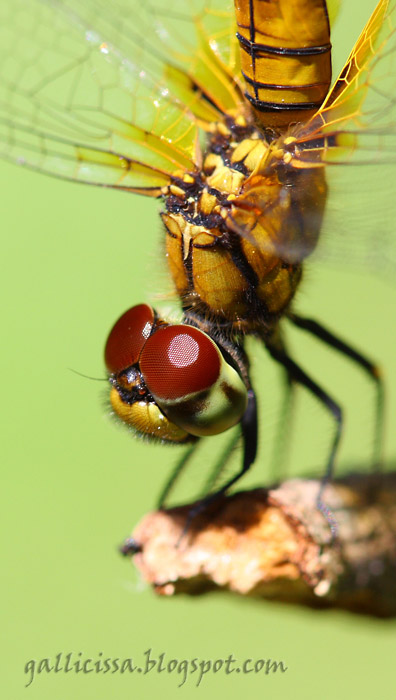
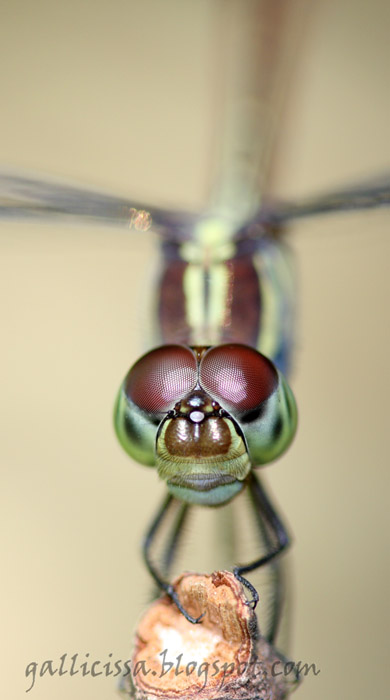
The pictures above and below are of a male Dawn Dropwing Trithemis aurora that visited my pond last Saturday. It was shot at midday while obelisking.
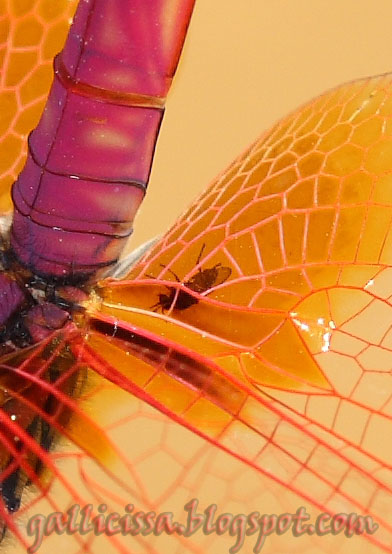
 By the way, did you notice a tiny parasite on the veins of the left hindwing of the above dragon? Here's a closer look. What's your guess, a midge? a wasp?
 I have jammed several images into the 'contact-sheet' below showing the process and progress. Click on it for larger view.
As you can see it is not the most aesthetically pleasing pond in the world! What matters for me is its functionality to suit my style of dragonfly photography. The elevated rim of the pond was made to prevent siltation because of the high rainfall in the 'wet zone' of Sri Lanka that I live in, and to support myself while shooting dragons. Once this outer wall has darkened with time, I hope it will draw this amazingly camouflaged Indian Rockdwellers Bradinopyga geminata that are found 70 metres as a dragonfly flies.
 I have introduced some vegetation around the pond for dragonflies as well as butterflies. In most sections around the pond, I have let the nature take its course.
 Here's a Red Water Lilly Nymphaea pubescens in bloom.
 Before I built this pond, my yard had a tally of 22 species of dragonflies and damselflies. That was with a small pond teeming with fish, built, and managed by my farther. After I did mine, our dragon tally has gone up to 24. There are 4 species that are recorded in an abandoned quarry with natural rock pools just 70 m as a
  I hope the word gets around and I will see those other four turning up in my yard soon! Anyway, looking at my local area numbers, which are higher than my yard and neighbouring rock pool tallies combined, I am confident that my yard list will imporve in the fullness of time.
Here's a close crop of the same. Note, another parasite on the wing.
 Here's a better view of it. Any idea what it could be?
This Pink Skimmer Orthetrum pruinosum neglectum male was one of the first dragonflies to lay claim to the pond.

I have added a few smaller resident fresh water fish to keep mosquitoes at bay, which is an important consideration here in the tropics. These include four Cyprinids: Horadandiya Horadandiya atukorali – a reputed mosquito larvivore, Slender Rasbora Rasbora daniconius, Scarlet Banded Barb Puntius amphibius and Malabar Danio Devario malabaricus. In their company are shoals of Dwarf Panchax Aplocheilus parvus (Aplocheilidae) -another good mosquito larvivore and Common Spiny Loach Lepidocephalichthys thermalis (Cobitidae). I doubt any of these fish will pose a serious threat to dragonfly larvae. On the positive side, the larvae of these fish will also serve as food for dragonfly larvae to set the food chain in motion. I think the pond will have plenty of hiding spots for the dragonfly larvae to protect themselves from fish. Those nyiads are known to be pretty smart operators, anyway.
After a brief absence, Elusive Adjutants Aethriamanta brevipennis brevipennis have started to show up now. Here's a female of that.

In addition to dragonflies, my pond is attracting a fair number of non-odonate visitors to bathe, drink and find food. Most annoying of all the non-dragonfly visitors other than mosquitoes (which aren't too much of a probelm yet) is White-bellied Drongo, which seems to be profiting from the open and well lit area to target and dive bomb at my dragonflies! One of them attempted to catch a dragonfly that I was photographing, inches away from me! Thanks to its amazing vision that focal individual got away.
Here's a mug shot of this avian culprit. Don't be fooled, he is not as innocent as he looks!

I'll take your questions.