Friday, 16 January 2009

Fulgoroid Friday

This planthopper was photographed during a frogging session at Sinharaja 'World Heritage' rain forest during my Christmas birding tour. It was barely 3 cm in length. For you inquiring minds, its classification is as follows.

Kingdom: Animalia, Phylum: Arthropoda, Class: Insecta, Order: Hemiptera, Suborder: Auchenorrhyncha, Infraorder: Fulgoromorpha, Superfamily: Fulgoroidea, Family: Dictyopharidae.

The Biologist Dr. Priyantha Wijesinghe whom I consulted for this had crosschecked its identification with an expert on a related family, and fowarded me his reply. It said, "...I reach the same conclusion as you: probably close to Centromeria viridistigma (or maybe it is that species) but as I am not a Dictyo specialist, I really cannot tell you more..."

?Centromeria viridistigma

Tuesday, 13 January 2009

Top 10 Natural History highlights - 2008

Following are the top 10 Natual History highlights that made me tick in the year 2008. I'd like to thank Duncan Fraser at Ben Cruachan - Natural History for his invitation to do this post.

1. Elusive Adjutant Aethriamanta brevipennis brevipennis-- adult female in my home garden. Winner of Best Dragonfly Moments Macro Capture of 2008. Click here to see all the entries and the voting process and here to see the winning shot of mine announced.

Elusive Adjutant adult female in my home garden at Bomiriya, Kaduwela2. Serendib Scops Owl Otus thilohoffmanni -- Photographed on tour with Thiery Becret, Marie-Andrée Becret and Michelle Gerner from France at Sinharaja 'World Heritage' Rain forest in Aug, 2008. This bird was discovered new to science in 2001. Click here to read more details about it. It is one of the 2 "Endangered" endemics in Sri Lanka and the reason why I bought my Panasonic Lumix FZ-18, after seeing amazing results of a Panasonic Lumix used by Peter Kaestner, who shot this photograph of this rare forest owl on tour with me in September, 2007. Peter is currently placed 6th in the 'world rankings of birders with 8,197 bird species seen out of 10,000 or so species in world.

Serendib Scops Owl

3. Leopard Panthera pardus kotiya. Another one of the many highlights of the aforementioned tour in Aug, 2008. As blogged here, it amply rewarded our persistence. Leopard is the apex predaor in Sri Lanka and day time sightings are regular at Yala National Park's block 1 (141 sq.km) where there is a healthy population of around 40 individuals.

Leopard at Yala National Park

4. White Four-ring Ypthima ceylonica -- a garden delight. I was flat on the ground commando style when I shot this. This is quite a common species but photographing them is really a pain in the neck as they always quite low down.

White Four-ring

5. Elusive Adjutant Aethriamanta brevipennis brevipennis -- Duncan never told me that you cannot repeat a species. This juvenile male was shot in natural light hand-holiding the camera as I usually do. This dragonfly species is very much my 'test' dragonfly that I use to learn close up photography.

Elusive Adjutant - juv

6. Long-horned Grasshopper "Robust Zumala" Zumala robusta -- Photographed on tour with the three French photographers mentioned above. This was my top non-birding highlight of that tour. It was identified by Biologist, Dr. Priyantha Wijesinghe- - one time Entomologist in the National Museum of Sri Lanka. He wrote "...your photographs are excellent and I was very glad to see them, not having come across a live specimen of Zumala myself". I blogged about this here.

Zumala robusta

7. Black-backed Dwarf Kingfisher Ceyx erithaca -- As blogged the previous post, this was bagged during my Chirstmas Birding trip with Richard and Anne Bishop from Kenya in Dec, 2008. This was scored at Kithulgala and was the first bird we raised our binoculars to watch on this tour!

Black-backed Dwarf Kingfisher

8. Purinosed Bloodtail Lathrecista asiatica asiatica -- young female photographed in my yard. I bagged her just three days after getting my first dSLR and she put a smile in my face for that reason. And I put a smile back in her face in celebration of my first blogoversary.

Lathrecista asiatica asiatica young female

9. "Ornate Rakwana Grasshopper" Rakwana ornata.-- Another one of the top highlights seen on tour with the French photographers in Aug, 2008. Read comments on this post for details. This was shot using my old Panasonic Lumix-FZ-18 and ultra stealth mode. Dr. Wijesinghe who identified this for me was very happy to see its image too. He wrote to me "Although this species lacks wings and is flightless it has extremely good jumping powers and very acute vision (note the very large and prominent eyes), so it is very hard to approach both for capture and photography."

Rakwana ornata10. Common Hourglass Frog Polypedates cruciger -- This female was shot at night in my home garden.

Common Hourglass FrogSo, what is your pick?

Saturday, 10 January 2009

Masala – 2

It’s time for another masala post.
As promised, I am sharing some of the non-birding highlights recorded on the Christmas Birding tour that I led last month. Let's start off with amphibians. We did several frogging walks at the Sinharaja rain forest. It produced a few goodies.
One of the top findings was this strikingly coloured endemic shrub frog described in 2005 as Labugama Shrub Frog Philautus abundus.
Labugama Shrub Frog
Its discovery was published in this paper in the Raffles Bulletin of Zoology 2005 Supplement No.12 that announced 27 new species of shrub frogs of the genus Philautus. This paper was authored by the indefatigable Biologist duo, Kelum Manamendra-Arachchi and Rolex Award laureate, Rohan Pethiyagoda, who have put Sri Lanka on the global map of the amphbian hotspots with the discovery of 100 species new to science!
I presume this is an Orange-canthal Shrub Frog Philautus stictomerus. We didn't handle any of these but merely tried to put names looking at their externally diagnosable features without disturbing them. Some of them are difficult to tell without handling as their diagnstics are not all visible in casual view.
probable Orange-canthal Shrub FrogHere’s a Common Paddy field Frog aka. Cricket Frog Fejervarya limnocharis . This colour morph with a bright orange mid-dorsal stripe is more attractive than its other drab-coloured morphs.
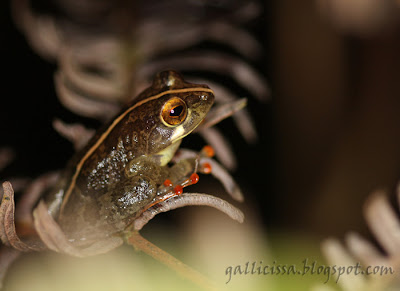
Common Paddy field Frog I found this endemic Bronzed Frog Rana temporalis on a shrub.
Bronzed Frog
To change the topics completely, have you heard any rumours about the new Nikon D3x? It looks like a pretty awesome camera to me. You need to have pretty deep pockets to get one of those though. Sadly it is out of reach for me and a few people I know including this bloke, Hitler. Check this out.

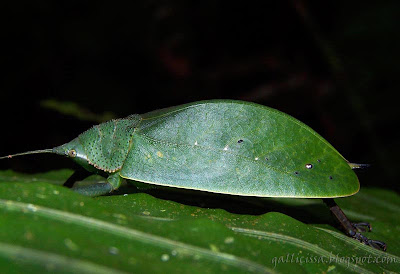
Moving on to invertebrates, this endemic Long-horned Grasshopper, was my top non-birding highlight of the trip. It was identified by Dr. Priyantha Wijesinghe to be Temnophylloides astridula . It was found by yours truly at Sinharaja in an afternoon walk. According to Priyantha, this was described by G.M Henry in 1939 in the following paper:
Henry, G. M. 1939. A new tettigoniid genus and species from Ceylon. Spolia Zeylanica [=Ceylon Journal of Science Section B Zoology and Geology] 21(3): 229-232, pl. XX.
The genus; Temnophylloides is a monotypic one meaning that there is only a single species representing it, which in this case is endemic to Sri Lanka. We encountered it on the way back too, frozen in the same posture, at the same spot. It started to drizzle a bit then when I attempted this picture. I presume it is a nocturnal insect as when we passed this spot during the frogging walk at night it was gone.
Click here to read report of a similar looking Zumala robusta photographed in Aug, 2008. Temnophylloides astridula
No masala post is complete without a tagging game. And Christopher at Picus Blog has tagged me for a yet another tagging game named Six Random Things. Here are 6 random things...
1. My favourite daytime drink is Fresh Lime Soda.
2. My cultural book collection is bigger than my bird and natural history one.
3. I am a pretty amazing bathroom singer.
4. I had 2 US birders from NJ cancelling their 16-day Sri Lankan bird & culture tour schuled for Aug, 2009 soon after the Mumbai Attacks. They booked it in Aug, 2008.
5. I hope to get a new lens and some other camera accessories soon.
6. I consider “Step Brothers” as the funniest comedy movie of 2008. What? You don’t like it? Okay tell me a good one then!
I saved the best for last. Yesterday, my blog was picked as the “Best Photoblog of 2008” in the 2008 Blogging Awards by the irresistible London Lanka and Drums, the popular life-style blog that rocks the Sri Lanka blogsphere and beyond. Click here to see the amazing nominees and here to see the continuation of the very encouraging speech done by the Guest Judge –- photographer extraordinaire, Dominic Sansoni, who is one of the Three Blind Men in Sri Lanka. I’d like to say a big thank you to both RD and Dom for this very special honour! It feels very special to be recognized this way.
In the 2007 Blogging Awards, Gallicissa was picked as the “Best New comer” See the star-studded award ceremony here.

Thursday, 1 January 2009

Christmas Birding

Happy New Year!
Black-backed Dwarf Kingfisher
I am back after a successful Christmas Birding tour with Richard and Ann Bishop—two worldlisters from Britain living in Kenya for last twenty years. They both had over 4,300 species of birds in their individual lists, and were pretty serious birders. We were joined in the last quarter of the trip by Mike Watts, a keen British birder with plenty of 'other' interests.

Indian Cormorants - juvenile at left
As the Bishops had travelled to northern India and southeast Asia several times, priority was given for the Sri Lankan and South Indian specials. This explains why we ended up with a relatively modest tally of 222 species of birds—about 10-20 short of usual numbers recorded on a 15-day bird watching tour during November to early April—the peak birding season in Sri Lanka when migrants supplement resident birds.

Bishops scored 32 of the 33 endemics currently recognized. We missed out on the scarce and “endangered” endemic, Sri Lanka Whistling Thrush. However, it was scored by Mike on our second attempt (out of a total of four)—in rugby terms, that was one blind-sided try by Mike!

Indian Silverbill
Sri Lanka is home to two endangered endemics, and the other one: Serendib Scops Owl, discovered new to science in 2001, did not disappoint us. It gave exceptional views at the Sinharaja ‘world heritage’ rain forest during a profitable owling session, which also yielded Sri Lanka Frogmouth.

Crested Hawk EagleThe sought-after western Himalayan delight, Kashmir Flycatcher, which almost exclusively winters in the highlands of Sri Lanka, afforded  five sightings at three different sites. This was special as it was the highest number of sightings ever of this scarce migrant on a 15-day birding tour for me! Another himalayan special, Pied Thrush showed well on our second attempt at its regular site at Nuwara Eliya. It was the most-wanted bird for Richard, and he was quite elated about it.

Spot-billed PelicanThe ultra-secretive Sri Lanka Spurfowl showed up “unsatisfactorily." It was when a silent female that crossed the track at Sinharaja was followed seconds later by a silent male, about 10 m ahead of us. Heart-melting sighting of this game bird is usually rare. Anyway as far as the Bishops were concerned, this was a case of BVD: better views desired!

Apart from endemics and specials mentioned above, some of our other birding highlights were as follows.

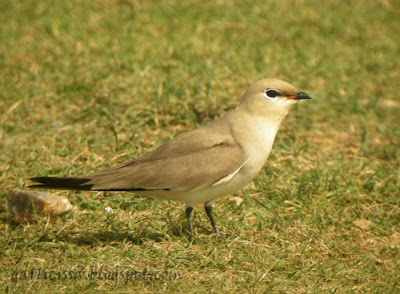
Dollarbird, Black-backed Dwarf Kingfisher (topmost pic), Malabar Trogon, Indian Pitta, Besra, Indian Blue Robin, Common Hawk Cuckoo, Black-throated Munia, Grey-headed Fish Eagle (bottommost pic), Hill Swallow, Malabar Pied Hornbill, White-naped Woodpecker, Jerdon’s Bushlark, Blyth’s Pipit, Forest Wagtail, Citrine Wagtail (local rarity), Indian Silverbill (3rd from top), Spot-billed Pelican (5th from the top), Crested Hawk Eagle (4th from top), Small Pratincole (6th from top), Watercock, Black Bittern, Yellow Bittern, Indian Reed Warbler, and finally, the Blue-faced Malkoha—scored at the "injury time" on the final day!

Small Pratincole
The only lifer for me on this trip came at Tissamaharama in the form a Slaty-breasted Rail—a record shot of which is shown below. Very important, this was also a lifer for my visitors, which made it a good tick for all of us.

Slaty-breasted Rail
As usual, we had plenty of natural history delights on this trip. These included “Zumala” (probable Zumala robusta, thanks to Dr. D.P Wijeysinghe)—a bizarre looking Long-horned Grasshopper. We also had Hump-nosed Lizard, Leaf-nosed Lizard (seen at Knuckles), Sri Lanka Krait (seen at Kithulgala) and butterflies: Blue Admiral and Painted Sawtooth.

An Eurasian Otter seen while trying for Sri Lanka Scaly Thrush at the wet lowlands, a Giant Grey Flying Squirrel seen at the highlands while trying for Sri Lanka Whistling Thrush and an unidentified feline (which Richard and I agreed to disagree on) seen at dusk at the dry lowlands while trying for Indian Nightjar were some of the noteworthy highlights of a nineteen or so mammals seen on this trip.

We also did a few frogging forays whenever it was possible. These and other non-birding highlights seen on this trip will be blogged in a separate posts to come.

Grey-headed Fish Eagle
In other news, yesterday I received my complementary copies of Thayer Birding Software’s Gold Edition DVD Birds of North America with my Brown Hawk Owl image in it plus Thayer Birding Software’s Guide to Birds of North America version 3.9. They both look absolutely fantastic! You North American birders are so darn lucky to have such great birding resources available for you!
Click here to view my New Year Greeting e-card for you.

Monday, 15 December 2008

Birding with a Royalist

Another trip to Sinharaja 'World Heritage' rain forest. My visitors this time were Chandanie Wanigatunge and her son Lahiru. Chandanie is a specialist physician and a senior lecturer in pharmacology at a top university in Sri Lanka. Lahiru, a Royalist, was the birder of the two, having got hooked on birds at the age of 6, following a school project. He had just turned 13—the age at which I myself got hooked on birds following a school project at St Peter’s.

Blue-tailed Bee-eater
I wasted no time in reminding Lahiru the 41-0 thrashing we gave to Royal at the School’s under-20 Rugby in 2007. This was very special for me as it was the first victory that I witnessed over Royal, having tasted many bitter and painful defeats—even in 1995, the year that I passed out, the year in which we were a formidable force in schools' rugby. We lost to Royal that year too! That was also the year Lahiru was born, I learnt.

Moving on to matters that are birding, we made our first wayside birding stop on the way to Sinharaja scoring a Crested Serpent Eagle sentinelled on a wayside lamp post. Several migrant Blue-tailed Bee-eaters and a Brown Shrike brought about more stops, thereafter.

Reaching Sinharaja, we bagged several False Lanternflies glued to a wayside tree near the ticket office. After obtaining our permits, and meeting our local guide, we reached our overnight base, Martin’s Simple Lodge, in time for a power lunch—a Sri Lankan rice and curry. It was a bit gloomy when we got there.

False Lanternfly
This pawpaw tree with splayed leaves smack in front of Martin’s restaurant/lounging/birding balcony was obstructing all decent angles for scoping birds that visit the trees in front. And it was blocking the spectacular view of the primary forest, yet nobody had done anything to get rid of it.

Pawpaw tree the pain
And the frigging tree produced no pawpaws! After careful diplomacy, I got the nod of approval for "selectively logging" this alien angiosperm. And soon, it was delegated to a person in martin's ‘inner circle,’ as it's usually done.

We went for our first walk to the forest, anticipating some soggy play. And as expected we made use of our brollies several times as it rained in an ‘on-off’ fashion. No mixed-species bird flocks. However, by the time we finished, we had a moderate haul of birds, with Sri Lanka Junglefowl, Legge’s Flowerpecker, Sri Lanka Crested Drongo, Crimson-backed Flameback, Bright Green Warbler, Dark-fronted Babbler, Black-capped Bulbul, Indian Swiftlet and Brown-breasted Flycatcher all in our list.

Birding was tough work today due to the rainy weather. We returned to Martin’s a bit early as the skies were looking really ominous. And the Pawpaw tree was still standing to cause more misery. Checklist and dinner and we retired early, as we had a 6 o’clock appointment with a flock of Sri Lanka Blue Magpies the following morning.
Asian Brown Flycatcher
We gathered at the restaurant/lounging area for a cuppa just before six the following morning. Distant raucous calls of the Sri Lanka Blue Magpies announced that they were on schedule. When the calls were closing in, I alerted everybody to get ready. Soon, about three Blue Magpies came to land on the railings, chairs and tables to find easy moth-prey under lights. It was amazing how confiding they were, at times even landing within three feet from us! After five minutes or so they vanished into the jungle but soon returned for a second serving.

Reaching a sun-lit edge after breakfast, we had good birding with Orange Minivets, Sri Lanka Hanging Parrots, Sri Lanka Green Pigeons and more Legge's Flowerpeckers keeping us regularly busy. When Chandanie was busy photographing a wood spider, I took Lahiru to see a nest of a Sri Lanka Scimitar Babbler found by our local guide earlier. As we were seeing this nest built on an embankment, I heard faint calls of a few Ashy-headed Laughingthrushes moving in the undergrowth, and soon went for them.

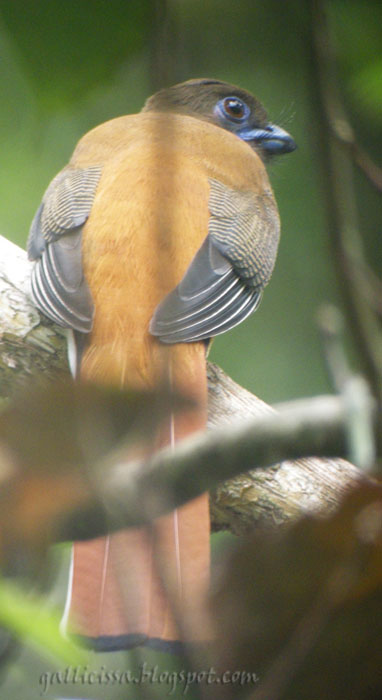
It was then that we realised that we had caught what was actually a tail-end of a mixed species bird flock. The laughingthrush calls that I picked were heard from an otherwise muted mixed species bird flock. Which also looked to be in fast forward mode! Quick footwork to keep up with them gave Lahiru an overdose of lifers. These included Ashy-headed Laughingthrush—which betrayed the presence of the flock, Sri Lanka Crested Drongo—the playmaker of the flock, Red-faced Malkoha—enough said, and Sri Lanka Scimitar Babbler. A Malabar Trogon eluded Lahiru, but I made amends by drawing a female after a pitched vocal dual lasting fifteen minutes! Brilliant scope views amply rewarded our perseverance.

Malabar Trogon
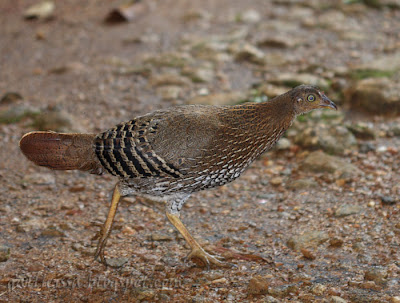
Some of the Sri Lanka Junglefowls are also getting quite tame around the main trail, and we had a male and a female posing nicely for us.

Sri Lanka Junglefowl
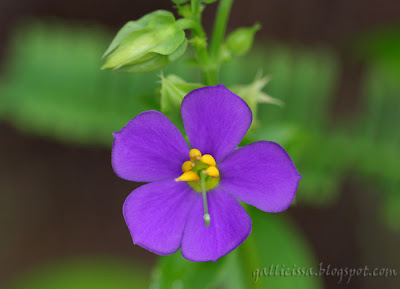
Few trees were in bloom, and a top highlight among them was this showy endemic Exacum trinervium (Binara in Sinhala).
Binara
When we returned to Martin’s before heading back home, the Pawpaw tree was still there, assaulting my senses. A man’s go to do what a man’s got to do and I had to execute this task myself before the "permit" expired. All for the benefit of the birding community!

Thursday, 4 December 2008

Masala

A masala post, bluuurp. Excuse me!

These days, there are regular sightings of Yellow Bitterns, and Black Bitterns at my local wetland patch . Their resident populations seem to have got boosted by migrant populations as it usually happens.
A new bird got added to my bathroom birding list. And it is is this lovely Black-rumped Flameback.

Black-rumped Flameback
The bathroom birding list comprise of birds seen from the bathroom windows (and occasionally doors), when occupied variously in it. My bathroom takes the form of a decent bird watching hide because of its strategic position. Other birds to have made to this pretty exclusive list include Brown Hawk Owl (aka. Brown Boobook) and Orange-headed Thrush! (One bird photographer even called over to photograph the latter using my bathroom as a hide!).
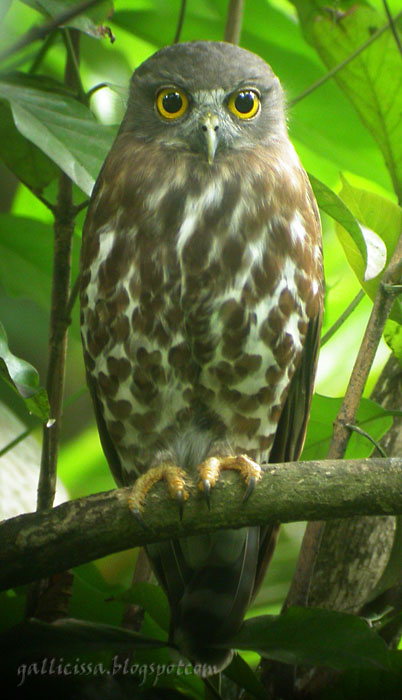
Brown Hawk Owl
Brown Hawk Owl vocalisations are a regular feature at the dusk soundsape these days. I observed a pair calling and chasing each other in what appeared to be a courtship ritual yesterday. I did not use a flash light, as it would disturb them. It’s the beginning of the breeding season for a lot of birds including this one.

BTW, the above picture of Brown Hawk Owl, shot at my yard, will appear in the Thayer Birding Software’s Gold Edition DVD – Birds of North America to be released on 12 December, 2008.

For your information, a Brown Hawk Owl was recorded by a tour guide named Jake Mohlmann at the rarity Mecca, St Paul’s Island off the coast of Alaska in North America in August, 2007. It stayed on untill September.

So, it’s officially now made its way to the ABA checklist.

Click here to see the pictures of the errant bird and to read the very interesting account written by Jake on this mega sighting. Also read this post by N8’s account at The Drinking Bird on the same.

The aforementioned DVD lists 2,850 photos, 708 songs, 551 videos ( including 493 new action videos), 837 abundance maps, thousands of variations of over 700 quizzes, 957 range maps ( including 695 new detailed maps), 957 birds seen in the U.S. or Canada (including accidental and extinct species), November 2008 additions to the ABA checklist; plus all features found in version 3.9.6. Click here to order this DVD.

Sorry to if I had given you more Christmas shopping!

I am expecting the construction work of my dragonfly pond to be completed before the end of this weekend. It’s taken longer than I expected. A female Asian Skimmer that dropped by for ovipositing at an inch-deep puddle of rain water in it as it was being built became the first dragonfly to officially lay claim to it first!

This was interesting as it was also a ‘first’ to my yard’s burgeoning dragonfly list. She appeared to be at a desperate breeding rush and had no decency whatsoever to wait until I declare the pond open.

I will be leading 15-day Christmas Birding tour in the last two weeks of this month. I’d like to break the radio-silence from time to time. Can anybody tell me how to do a ‘scheduled-post’ in blogger please? I searched blogger help but couldn’t find it.

My 32nd birthday is coming up on the 1 Jan, people. I accept greeting cards and gifts at 146 A, Pahala Bomiriya, Kaduwela, Sri Lanka from now onwards. As for gift items, birding and natural history related books, CDs and DVDs are appreciated, thank you.

I received a couple blogging awards recently. First of these were this beautiful award from the flowergirl at Madras Ramblings from India.
Arte-y-pico award And the second was this award from the fishing guy from OH, US.

Hot Blog Award
I'd like to thank both of you for these wonderful awards! It’s been a while since I received a blog award. So it is a good feeling to be recognized this way. I hope I will be forgiven for not complying with your full set of rules!

I got my first decent shot of a dragonfly in flight at the rain water pool that I blogged about in my last post.
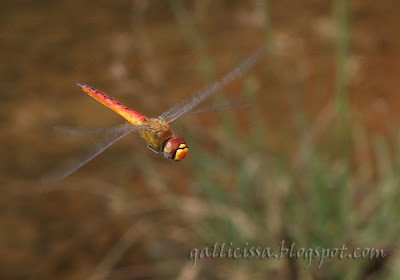
Wandering Glider
It was this world famous Wandering Glider aka. Globe Skimmer Pantala flavascens, which is a globe trotting species considered as the most widely distributed dragonfly in the world. It is a known temporary pool breeder and is almost always found flying—which was what pressed me to attempt the above shot.

My Canon 40 D and Canon 100 mm f2.8 Macro Lens stopped auto-focussing last week when I was shooting dragons at the aforementioned puddle. I took them to the repair centre of the local Canon dealer. It turned out that it wasn’t the lens. So they kept the camera body for further checking. After a week or so they called me to say that it is working okay. Apparently the auto-focussing problem has happened due to humidity. All what they had done was to clean to contacts of the camera body with a soft cloth. The bloke there told me to repeat it if it happens again, but before doing that, to make sure that I remove the battery to prevent short-circuiting.

I guided and facilitated a photo shoot of leaves in my garden, to be used for a desktop calendar for a local corporate. They were after leaves of 14 species of native/endemic flora to select from them, 12 to go with each month. I found them about 16 with various hues and textures to surpass their requirements. The two ladies who came got a few leeches too. Which was more than what they bargained for!

Now, I know I have admitted that I do not have leeches in my yard in a comment somewhere in this blog. Things have changed, folks. A small leech population has established probably after an accidental introduction caused by yours truly, when leech socks and boots were brought home straight from the rain forests without de-leeching them at the forest!

And let me tell you that some people that I know of are not too amused by this. So it is official that my home garden is a safe heaven for home-grown-terror. The first person to get a bleeding bite was my mom.

My friend Java Jones has tagged me for a blogging game called "I never".

Okay here goes my reply Mr. Jones. I’ve never.

1. thought that I would switch from Lion to Carlsberg in this lifetime. Seriously.

2. eaten a better tasting Chinese chop suay rice (mixed meat/sea food) than at the ‘late’ Garden restaurant that used to be near the Liberty Roundabout at Colpetty. Does anybody know whether it’s been relocated, please?

3. ad better arm-chair birding in Sri Lanka than from the balcony at Martin’s Simple Lodge, Sinharaja.

4. expected that a full body massage at La Passion, Battaramulla 90210., would be so awesome after a good day’s manual labour (at the pond).

5. think that anybody in this country could give a better earth-shattering head and shoulder massage as Ananda at Vajira Salon, Bamba.

6. thought that St Peter’s would thrash Royal 41-nil at Rugby as it happened magically in 2007 in our own den.

I end this masala post with this beauty that I photograged at my local wetland patch.

It is an Oriental Scarlet aka Scarlet Skimmer Crocothemis servilia servilia. Apparently this is also found in outside the Orient despite the local common name; "Oriental Scarlet" suggested in the Sri Lankan dragonfly guide, which in my opinion ought to be revised. According to the “Dragonflies through Binoculars – A Field Guide to Dragonflies of North America”, it was “discovered in Miami in 1975, I has spread to Orlando by 1986….It now occurs in the FL Keys, Cuba, and Hawaii and in the Old World ranges from the Middle East to Japan and Australia.”
Related Posts with Thumbnails