Malcolm McDonald is a Brit working in Kazakhstan (yes, Borat featured in our discussions!), and from 20-24 Jan., he did a 5-day bird watching trip with me focussing on the endemics and subcontinental specials. We were joined by Duan Biggs, (no relative of Jason Biggs; no special liking for baked goods!), a South African bird tour leader currently based in Australia. Duan arrived a day later than originally planned due to an airline issue in India where he had led a bird trip before visiting Sri Lanka.
After meeting Malcolm at 4.30 a.m., I took him to the lush lowlands of Kithulgala, and we arrived in our accommoation in time for some quality early birding in the hotel gardens at first light. Being an airline engineer, Malcolm had visited Sri Lanka many times since the 70s. But had not been on a guided bird tour. So this was a first. And he had not just one, but two bird tour guides to find him birds!
 Staying with a former work colleague, who resides in Kandy, Malcolm had seen a few commoner endemics during his previous visits to Sri Lanka. So everything was new. Anyway, oOur first tick of the day turned out to be Sri Lanka Junglefowl. Which had mysteriously eluded Malcolm on his past trips! We had a pair of these game birds (national bird of Sri Lanka) in close quarters. An Indian Pitta was feeding literally under his room (build on an elevated wooden platform), and after first revealing its silhouette, it popped out to the open to give him good views. A flash of red and yellow whizzed pass uttering a familiar sharp call. It turned out to be the ornately plumaged Black-backed Dwarf Kingfisher (aka. Oriental Dwarf Kingfisher), which sat long enough to give decent scope views, albeit in poor light. (Later on I was shown a nest site of it nearby.)
Still very early in the day, we had a small but highly vocal mixed-species bird flock in the hotel gardens. This comprised of the White-bellied Drongo, Orange-billed Babbler, Yellow-billed Babbler, Asian Paradise Flycatcher, Black-naped Monarch, and Lesser Yellownape. A Brown-breasted Flycatcher was also doing its thing low in the under growth. No calls of the Green-billed Coucal, strangely. Metallic calls of the Tickell’s Blue Flycatcher betrayed its presence in the low undergrowth and it was seen well more than once.

Still on our pre-breakfast walk, we had fine views of a juvenile Crested Hawk Eagle, across the river, basking in the early morning sun. Next came Green Imperial Pigeon, Sri Lanka Grey Hornbill, Yellow-fronted Barbet, Brown-headed Barbet, Sri Lanka Hanging Parrot, Orange Minivet and Square-tailed Black Bulbul, all in quick order. And we also had a Black Eagle soaring.
After enjoying a fine breakfast, we explored the surroundings briefly getting improved views of some of the birds we have already seen; plus bagging a few new ones in the form of Common Iora, Shikra, and Black-capped Bulbul.
Having started at an unearthly hour to pick Malcolm up from the airport, I had not had any overnight sleep, and forty winks were all what I could get in the brief rest we had before lunch. This was because I was rudely woken up by a mobbing party of birds outside my room. I couldn’t see any bird of prey in close vicinity, so I suspected it may have been over some arboreal snake lying in ambush somewhere. Shortly afterwards, I had another sightings of a Black-backed Dwarf Kingfisher near my room. Quite a gem of a bird.

After enjoying a superb Sri Lankan rice and curry lunch, we tuktuked a short distance to the ferry point to cross the Kelani River in a Dug-out canoe to reach the Kithulgala Forest Reserve for our afternoon birding birding session. New birds added to our list on this foray were Sri Lanka Green Pigeon, a female Indian Blue Robin, Black-hooded Oriole, Yellow-browed Bulbul, Sri Lanka Crested Drongo, Layard’s Parakeet and Lesser Hill Myna. A pair of Green-billed Councals across the river responded to a booming call imitated by yours truly, but it didn’t cooperate. (Perhaps we weren't patient enough.) Dinner and checklist marked the end of a slightly tiring yet rewarding day.
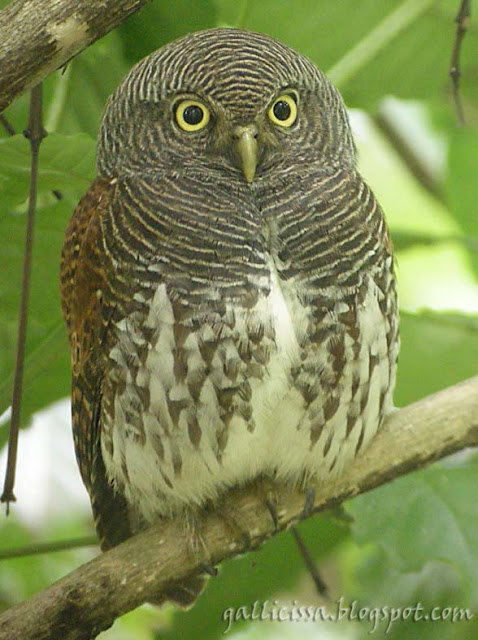
I gave a wake up call to Malcolm early on the following morning with a scope set in front of his room in focus of a Chestnut-backed Owlet that I managed to spot in the dark undergrowth. It was a good enough view despite the low light. Soon after, another bird was spotted high up in a tree when the light improved, which gave more than decent views. Our next top highlight was the endemic Spot-winged Thrush, which was out in the open feeding alongside a few Babblers. This was also heard singing. No Green-billed Coucal yet though.
After enjoying a birding breakfast; a breakfast interrupted continuously by sightings of two Crested Hawk Eagles and a Stork-billed Kingfisher, we drove to Sinharaja rain forest via Ratnapura. A 4-wd jeep was awaiting our arrival at the ticket office to take us up to our overnight accommodation for two nights; Martin’s Simple Lodge. Before that I paused in a roadside patch to show Malcolm a nest of a Spot-winged Thrush with a brooding adult bird. This was built high up in a branch that was hanging over the road used by vehicles regularly by the visitors and locals.
 Martin’s was teeming with humanity when we arrived there during the midday. There was a big Taiwanese bird watching group equipped with all the latest cameras and optics and a school group of over 30 girls (a mixed species bird flock) - which was part of a regular educational workshop conducted by the FOGSL headed by Prof. Kotagama and Rahula Perera with the generous sponsorship of Sri Lanka Telecom as part of their CSR.
Undaunted by the imminent convectional rain, we set off on our first walk in Sinharaja rain forest, soon after lunch. As expected, it rained and rained heavily but that didn’t hamper us from making quick ground towards the bird rich interior hoping for some respite. I was playing my cards close to the chest and this hurried approach amidst inclement weather was especially in anticipation of a particular pre-identified target based on some real-time ground intelligence. We arrived at the said site and within no time Malcolm was enjoying scope views of his first Frogmouths; that of Sri Lanka Frogmouth – a male and a female perched in a Kekiri-wara (Schumacheria castaneifolia) tree in a day roost facing opposite directions at almost eye-level!
 When we finally had some respite from the rain, I scouted inside the virgin section of the forest with Malcolm to whistle in a Sri Lanka Scaly Thrush for frame-filling scope-views amply rewarding Malcolm for braving the rain and having faith in my judgement. A Green-billed Coucal offered poor views for Malcolm with only myself picking up the diagnostic green bill before it mysteriously melted away into the chaos of rain forest vegetation. A mixed species bird flock observed amidst rain didn’t produce anything new and we returned to Martin’s for checklist, dinner and overnight stay.
Duan Biggs was arriving at midnight today (he was to arrive at midnight yesterday) and I had a transfer arranged to take him directly to Sinharaja with my best driver for night driving whom I have been using for my shenanigans from time immemorial. When I reached down in a 4wd jeep to pick him up at 4.00 a.m. my man had already delivered him safely fifteen minutes ago! Apparently they had only left the airport area at 1.30 a.m.! I had already told Duan that the driver is a ‘Schumacher of sorts’ and to be cool with his ‘style’. Duan had swallowed a sleeping pill soon at the start of the drive and had slept all the way up to Sinharaja! By the way, this driver is one lucky dude; a few months ago he won the first prize of a local TV quiz (Sirasa TV Ran-depeya) and became the proud owner of a fully furnished 2-storey luxury house worth over 10.2 million Sri Lankan rupees (US $ 94,445) with 24 hour security & free family memberships for a pool and a gym!!!
After briefly exploring a nearby patch for night birds, we arrived at Martin’s in time for the arrival of Sri Lanka Blue Magpies. This early foray didn’t produce anything but provided a clear demonstration of dizzying effects of sleeping pills following short sleep spells! Part of the Taiwanese bird contingent had already arrived and laid claim to some prime vantage points at Martin’s balcony in anticipation of the Sri Lanka Blue Magpies. Ironically, they had arrived from an accommodation named after this bird!! Soon, we enjoyed early tea with 4 Sri Lanka Blue Magpies, which were all around us making an early snack of the insect prey found under lamps; giving a field day for the giddy Taiwanese photographers.
Thereafter, we went on a pre-breakfast bird walk to get nice scope views of Green Imperial Pigeon, Sri Lanka Crested Drongo, Legge's Flowerpecker, Purple-rumped Sunbird, Yellow-fronted Barbet, Sri Lanka Hanging Parrot, Orange Minivet, Layard’s Parakeet, Square-tailed Black Bulbul, Asian Brown Flycatcher & Sri Lanka Grey Hornbill in beautiful morning light. Early in our post breakfast walk, we saw a fairly large raptor flying overhead and perching atop a shorter tree in a patch of tea adjoining the forest. I scoped it through the vegetation to just reveal its identity; a Mountain Hawk Eagle -a rare species in Sri Lanka and my only second sighting in Sinharaja. By the way, my Mountain Hawk Eagle photograph got published in the current issue – Number 8 of BirdingAsia – the bulletin of the Oriental Bird Club.
Soon, a small bird flock we had contained Large-billed Leaf Warbler, Greenish Warbler, Black-capped Bulbul, Dark-fronted Babbler & more Sri Lanka Grey Hornbills, which were observed in close quarters. A fairly good mixed species bird flock was encountered soon after entering the forest proper and we were able to detect a Red-faced Malkoha, which rested in an overhead branch revealing a prolonged ventral view instead of the diagnostic red face and greenish beak we wanted. So, doesn’t count yet. Although it was motionless for considerable time, I anticipated the bird to go up and alerted about this and positioned ourselves strategically a bit away, awaiting the bird to move the way we desired. This worked marvellously as we all had a brilliant scope views in early morning light. As Duan put it so eloquently; it was an orgasmic sighting!!
Walking up to the research camp, Duan picked up a Spot-winged Thrush near the track. We also observed the Black-naped Monarch’s nest that I observed on my previous visit with a brooding adult bird and a newly fledged juvenile. The Sri Lanka Frogmouths were found in the day roost today as well and Duan got good views of them this time perched facing the same direction.
Scouting inside the virgin forest, we had a chance sighting of a Green-billed Coucal flying straight into a thicket with a medium sized Green Wine Snake in the beak. It provided brilliant views for all of us when it ascended up the thicket before going into it. Although I couldn’t detect externally, I suspected that it may be nesting inside this thicket from the manner it flew in so purposefully into the ticket and the way it moved about having done that. Moments later a Green-billed Coucal; probably the same bird observed earlier appeared out and flew back in the same direction the bird we saw first came from. We left the site immediately not to cause any disturbance.
After spending some time around the Research camp seeing more Sri Lanka Junglefowls and Sri Lanka Blue Magpies, we started searching seriously for Malabar Trogon, which was proving tough for no apparent reason. Finally my efforts paid off and I found a pair of females with one spotted quite low down.
 The school group was ready to depart by the time we arrived for our late lunch. Malcolm decided to take the afternoon easy to enjoy some arm-chair birding from the comforts of Martin’s balcony. So, I walked with Duan in search of more endemics. Early in this afternoon foray I found him a flock of four Brown-capped Babblers quite close to the track. No Sri Lanka Scaly Thrush despite looking for it but a consolation came, when I decided to backtrack picking some distant calls when we had several Sri Lanka Mynas feeding low together with a mixed species bird flock which contained among other things; Ashy-headed Babblers and more Red-faced Malkohas. Returning to Martin's we heard the somewhat disturbing news that the Black-naped Moarch's fledgling had been predated by a marauding Sri Lanka Blue Magpie. Dinner, checklist and overnight stay at Martin’s.
Early on the following morning calls of Sri Lanka Spurfowl filled the air while we were enjoying our tea at Martin’s. Soon, a pair of them were seen moving nervously, which were picked up only by myself and Duan. White-faced Starling was still pending and as a last resort I visited a patch that has proven fruitful for me over the years and soon I picked up a call of one perched in a dead tree, which was soon joined by 4 others to give us excellent views in good light. Pleasing! Gold-fronted Leafbird, Common Iora, Sri Lanka Swallow and more Barbets & Bulbuls also graced our morning.
 After saying good-bye to Martin we headed off to our next location, which was originally going to be Udawalawe National Park. As this national park was closed temporarily due to some local considerations, I decided to move up to the cooler hills of Nuwara Eliya in the central highlands, where more endemics awaited us! Duan who missed out on Kithulgala had a brief look at this birding site, pausing at the Kithulgala Resthouse for some sandwich lunch. In our long drive up to the highlands, we had great fun listening to the some 12th Man - BONED by the Aussie comedian Billy Birmingham, which neither Malcolm nor Duan had even heard of before, the latter despite hailing from cricket crazy South Africa and living in cricket mad Australia. Would you believe ?
Our driver Sameera did a superb job in taking us in time to squeeze in 40 minutes of precious birding time. This yielded Duan’s first Indian Pitta. No luck with Kashmir Flycatcher, but I found Malcolm a male Indian Blue Robin flitting inside the undergrowth, while Duan was seeking improved views of the Pitta. Following some calls from tree tops, I was able to offer neck-twisting views of a male perched straight up in a thick foliaged tree, in an awkward 'unscopable' angle. Nice! Duan suggested we went for the Sri Lanka Whistling Thrush after I told that I have a reliable site, which had worked for me at dusk. We drove 10 minutes to reach the site and just two minutes after arriving at the site, Malcolm picked up a male Sri Lanka Whistling Thrush, of which the bright blue lesser wing covert patch was clearly visible in my 10 x 42 Leica Trinovid binoculars even though in diminishing light. What good timing once again by Sameera! Good call by Duan to go for it & great spotting by Malcolm! What’s more after it disappeared briefly following our first looks, it was Malcolm who spotted it again for the second time! Talk about team work!
Our overnight accommodation was Alpine Hotel in Nuwara Eliya. We went out for dinner tonight to celebrate the Pied Thrush and Sri Lanka Whistling Thrush with a 5-course fine style dinner at the St Andrew’s Hotel, Nuwara Eliya. Nice!
 After an early breakfast, we explored Victoria Park at first light in search of the missing Kashmir Flycatcher and to seek improved views of the Pied Thrush. We failed in our first mission despite a lot of hard work and checking out spots diligently where I had two sightings last month but was successful with the latter in scoping first a male followed by a female below eye level; a complete a contrast to the initial sighting! We had two montane endemics in the form of Sri Lanka White-eye and Yellow-eared Bulbul. These were followed by more sightings of Indian Pitta in addition to Forest Wagtail, Grey Wagtail & Blyth’s Reed Warbler. Thereafter, we headed to Bomuru-ella Forest Reserve, where a small mixed species bird flock contained Grey-headed Canary Flycatcher and Bar-winged Flycatcher-shrike among other things. Soon, I spotted a Sri Lanka Wood Pigeon at eye-level, which gave good scope views. No luck with Dull-blue Flycatcher and Sri Lanka Bush Warbler in a second bird wave encountered. We had good looks at the mountain sub-species of Toque Macaque and Purple-faced Leaf Monkey, the latter which is colloquially named as ‘Bear Monkey’ due to its thick coat of fur.
After enjoying a fine buffet lunch, we briefly explored the wetland site in Nuwara Eliya getting a pair of Pied Bushchats and several Paddyfield Pipits. Thereafter, we commenced our descent to Kandy, making a traditional stop en route at the Glenloch Tea Factory for Hill Swallows nesting inside the factory and to get a brief guided tour to see the production process of the fabled Ceylon Tea. And to enjoy a fine cuppa. Malcolms and Duan were dropped off in Kandy to finish a smoothly-run birding tour and I reached home by 10.30 p.m.