Showing posts with label Guiding. Show all posts

Wednesday, 27 June 2012

Guiding Kate and John Holland

20 February to 5 March, 2012, saw me guiding a 15-day wildlife tour with John and Kate Holland, from England. Both were keen birders, and this was their first visit to Sri Lanka. Kate sported the latest Swarovski SLC 42 HD binoculars, which were superb in clarity. A birthday gift from John, it was on its first overseas trip.

Our final trip list of birds stood at 236 species and that included all 33 endemic birds and 10 out of the 15 resident night birds. Our top wildlife highlights included a couple of Leopards at Yala and several Blue Whales off Mirissa. The photos below show these highlights and more.

Lesser Adjutant

We saw this lone Lesser Adjutant at the Yala National Park, and it proved to be the only sighting of this rare resident bird for the whole trip. 


Asian Paradise Flycatcher

We had this species at several locations, and this individual obliged outside the Udawalawe National Park. The white coloured males of this species comes all the way from Northern India during the migratory season. I usually get one of these turning up in my home garden, but in the last season I had none.


Asian Brown Flycatcher

Another regular migrant, Asian Brown Flycatcher usually likes tops of trees with ample lighting. When we found this individual, we were on a second floor of a building, and from our position it presented us with nice eye-level views. 


Sri Lanka Blue Magpie

Some of the Sri Lanka Blue Magpies at Sinharaja are quite confiding. This one came to land on my scope, when we were having a break near the research station.


Here's a close up of his head. 


Sri Lanka Frogmouth

This juvenile Sri Lanka Frogmouth was huddled together with its farther at Sinharaja rain forest. It was too close for my lens.


The Blue Whale


We had aout fifteen sightings of Blue Whales, consisting of about eight individuals. This was one of them with a limora fish haning on its tail. The whale watches approaching from behind, scared it off.


The clay girl

At Tissa, this girl is the youngest member of a family that engage in pottery. Her play area borders the Tissa wewa, where we go birding. She used to have a pair of Indian Scops Owls in her garden. But as of recently the owls have vacated the roost.


Leopard

This female cub gave us prolonged views at Yala. For a good length of the time, we had it all for ourselves, which was nice. I hate the big crowds and traffic jams at Yala.


Asian Groundling

We saw a good array of dragonflies and this Asian Groundling gave an easy photo opportunity. 


Sunday, 5 February 2012

Of the Sri Lanka Bay Owl That I Spotted from a Moving Vehicle


Somewhere in the lowland wet zone, I spotted this Sri Lanka Bay Owl from a moving vehicle!

That was during an Absolute Birding tour that I guided in the second half of January, 2012 for Mark Yates, Gary Thonburn (both from the U.K.) and Brendon Ryan from South Africa.

We were returning to our accommodation 'empty-handed' after specially going to see this scarce owl, which is a rarely seen resident bird species in Sri Lanka. We were not helped by so many elements on this day, which included the weather. During the journey back, which seemed a very long one, I kept spot-lighting randomly, hoping for a consolation Slender Loris or so.

This has worked before.
No loris, but an endemic Yellow-striped Chevrotain seen in the headlights of the vehcile, was a good enough consolation.
 
That was until I picked another eye-shine, which saw our vehicle coming to a screeching halt. When I trained my binoculars, they belonged to—would you believe—a Sri Lanka Bay Owl!

I soon shared my serendipitous find with my clients, who took a few decent shots. The one above was sent by Gary Thoburn, who wielded a Canon 500mm lens. We left the bird to carry out its hunting and moved on. Soon, I found that during the frenetic moments of spotting the bird, I had lost an eye cup in my Swarovski binoculars; I backtracked about 100 metres on foot to recover it. Glued to the same old perch was a still-busy-foraging Sri Lanka Bay Owl.

With this amazing find, this tour saw us bagging 12 out of the 15 resident night birds. Our tally included 9 owl species. We saw nearly 250 species of birds out of which 190 were photographed.

To see more images of birds and natural history photographed on this trip, visit Gary's photo site in a few weeks.

Related post: A tuktuk trip and a top lifer!

Wednesday, 4 January 2012

Rare Bird Alert: Yellow-rumped Flycatcher at Tanamalwila

I am happy to share the news of a sight record of a vagrant bird species to Sri Lanka—the Yellow-rumped Flycatcher Ficedula zanthopygia.


I saw it on 3 January, 2012, at Tanamalwila, in the sylvan interiors of southeastern Sri Lanka on the tour that I am currently guiding with Hans Veltman and Irene ter Horst from the Netherlands. My visitors are on a 14-day Absolute Birding tour, which came through Inezia Tours, run by my friend Pieter van der Luit.

Hearing an unfamiliar bird call, I ventured off the track a short distance to search for its source. In no time, to my surprise, I found a handsome, male Yellow-rumped Flycatcher—my first lifer for the New Year.

As it happens so often in moments like this, I had no camera with me; hoping to concentrate on just watching birds, I had left it in the vehicle. Soon after showing the bird to my clients, and I dashed like the Road Runner fetch my camera. And dashed back. Come to think of it, I forgot to uttter "mee mee."

But anyway, after an agonizing ten minutes, I found the bird again and was able take the record shot above. We were on our way to Nuwara Eliya, and had some montane birding planned for later that day. So I didn’t spend a lot of time trying to photograph it the way I like. But I guess this will do for the time being.

Its call reminded me of the more familiar highland special Kashmir Flycatcher, which belongs to the same genus as the Yellow-rumped Flycatcher. And at Nuwara Eliya later that day, we also the Kashmir Flycatcher; thereby, bagging two Ficedula species on a single day’s birding in Sri Lanka. Who would have thought that was possible!

Directions

Reach Tanamalwila.

Then in the A2, drive about a kilometer towards Lunugamwehera until you come across a police road block. A dirt track, which leads to the Lunugamwehera National Park, branches off left just there. Take that one. After about 130 metres, that track bends first to the right, and after a few metres, again to the left. The bird was found in between these two bends. It was found on both sides of the track during various times of our observation. Although you can drive right up to the site, I suggest you park the vehicle in the restaurant (“Thuru Sevana Buffet”) on the opposite side to the turn off. The owners there are very nice people and tolerate bird watchers. It will be courteous to buy a drink for using their gardens parking, after you have bagged the bird.

Further reading

The site consists of a secondary forest contiguous with the impressive riverine forest found along the Kiridi Oya. Some of the noteworthy birds that I have found here over the years include the Marshall’s Iora, Orange-headed Thrush, White-naped Woodpecker, Rufous Woodpecker, Black-backed Dwarf Kingfisher, Sirkeer Malkoha, Jungle Owlet, and now, the Yellow-rumped Flycatcher.

Yes, it is one of my patches, and a good one at that.
The site has a fair bit of mosquitoes, and if you have to venture into the jungle, note that the understory is thorny.

Happy New Year!

Wednesday, 7 December 2011

Absolute Birding in November, 2011

I am back after guiding my first birding tour for the winter tour season of 2011/2012. It was a 14-day Absolute Birding tour with Brice and Gail Wells from Perth, Australia from 1–14 November, 2011. Brice, 78, became the oldest birder to survive my Absolute Birding tour.

Our final tally of birds stood at 231 species. We saw all thirty-three endemics extremely well. As usual, we did well in the night birding department, scoring ten out of the fifteen resident night bird species. These included seven owls. Brice had never seen that many owls on a single birding trip before, so he was really pleased.

The rain gods were kind to us: barring the first two days, we had beautiful weather throughout the tour. Several mixed-species bird flocks were seen in full swing at Sinharaja. These yielded all the flock-associated specials such as the Ashy-headed Laughingthrush. Which laughs alright, but never smiles.


This Sri Lanka Swallow didn't mind the wet weather at Kithulgala; it was collecting mud for nest building.


This Sri Lanka Wood Pigeon was fearless when it came to drink in a 'waterhole' on this tree at Welimada.
Right time, right place.


The Grey-headed Fish Eagle was sentinel at Bundala National Park in bright light.


It is only fair to say that we had an impressive array of non-feathered attractions.

One of them is this gleaming elephant in pretty light at the Bundala National Park. Unlike the ones at Yala, the elephants at Bundala are a bit grumpy. So you have approach them with respect and caution. It looks like the ones at Bundala seem to have some 'issues' with the local fishermen who are allowed to enter the park in bikes to engage in fishing.

This elephant made a roadblock to assert its dominance, keeping us, and a few fishermen ahead, waiting.


We had to wait for about fifteen minutes, until it decided to clear the traffic at its own terms!

A similar standoff happened outside the Bundala National Park on another day. This time, it almost cost a few birds for the trip. Regardless, we scored 100 plus species of birds on that day. A bloke from the wildlife department, who happened to use the same road, came to our rescue; he used a couple of fire crackers to 'neutralize' the situation.


At Yala, we saw five Leopards in just two game drives (one in the first and four in the last) all which posed well. On our first visit, some real-time ground intelligence led to this lone young female on a tree close to the Akasha-chaitya junction. We had it for a good fifteen minutes.


Our no.2 and 3 Leopards came together. And in the process, nearly took our breath away!


That was when these two big boys crossed the road in the Jumburagala road. The one that took the lead was blind in the left eye.


Too bad we were at the wrong side of the light.


Otherwise, I could have absolutely nailed them!


No, we photographers are never happy!

As our jeep driver correctly predicted, one of the Leopards, as it turned out the bigger one, settled on a distant rock to nap. Driving on from there minutes later, we had the One-eye, walking along the track marking its territory.


He was a grumpy old fellow. A walking-wounded of sorts. Every now and then it paused to pose. Even the point-and-shooters had a field day.


We were compelled to take a comfort break close to 5.30 p.m. While we were busy, we heard a deer alarm. Quite close! We were making our way out of the park, having had a superb day. Too close and precious to let go, we drove in the direction of that alarm. And minutes later, we found this female.


If not for that desperate leg-stretch, we would have not heard the alarm, which led to this beauty.
Which drove home a golden rule in the jungles: when you want to go, go you must.

Anyway, the female having noticed us, crossed the road and disappeared. Once again, our driver predicted that it may climb a rock nearby, and he made a beeline to that spot.  Not even a minute passed by, and the female materialized on the rock in front of us, giving us a bemused stare, "how did you know ...?!"


Our jeep driver said he heard the female calling to its young. So we expected she will soon have some company. About five minutes later, this cute little female cub appeared on the rock!


But, before reaching her mom, she paused to check us out.


At her own pace, she joined her mom.


Some quality family time followed


The little one got a nice clean up, presumably before the evening activity.  In the shade of a fig tree, this rock had a peaceful setting of a Buddhist temple. Two Malabar Pied Hornbills whooshed pass vying for their attention. It was nice to see how mindful the Leopards were—even watching birds! We left them there to make our timely exit and to end what a fabulous day with big cats.

While the above passed as our best wildlife day, our best birding day was day-thirteen at Sigiriya. It was significant because of a late afternoon birding session, which produced an avian bonanza consisting of eight new ticks for the trip.

The goodies were Shaheen, Cotton Pygmy-goose, Orange-headed Thrush, Black-backed Dwarf Kingfisher, Indian Blue Robin, White-rumped Shama, 'Fork-tailed' Drongo Cuckoo, Indian Pitta, Jerdon's Nightjar, Spot-bellied Eagle Owl (which was expertly spotted by Brice), and a one-for-the-road Brown Fish Owl.

In terms of numbers, our day-seven was the best with a whopping tally of 118 species.
Birds were superb alright, but I must say those leopards really took the cake on this tour.

Thinking about that day in Yala, I still can't wipe the smile off my face.

Monday, 31 October 2011

Leopards and Scrabble Tour


22–29 October, 2011 saw me guiding my first "Leopards and Scrabble" tour. It was with Diane Lofthouse from Sydney, Australia. The trip centred around Yala National Park—the celebrated wildlife hotspot in South East Sri Lanka.

Diane had turned 70 just days before the trip. And seeing a Leopard in the wild I was told was on top of her "bucket list!"

She was able to achieve that on the first game drive itself—seeing not just one, but three Leopards. They were—surprise, surprise—the celebrity Rukwila cubs (two out of three) and their "supermom."

Born little over an year ago, the Rukwila cubs are too bold, too photogenic and too ignorant that they are Leopards. And as most Leopard cubs at Yala, they have still not come to realise that as Leopards they are supposed be shy and elusive.

The handsome one above was seen on our seventh and last game drive on 28 October. We drove along the Patanangala bungalow road from the seaside and found ourselves stopping behind a jeep that had arrived earlier. The one above was sitting in a roadside thicket first.

That was while its sibling was resting on the track farther away. It was out of photographic reach for us because the track ahead snaked just enough to obstruct a direct view. A few jeeps, which had come from the main road side, were behind that Leopard cub. Which to their dissatisfaction, faced away from them.

As more jeeps crowded the scene from the main road side, the lounging individual got up and ambled to towards the one sitting in the thicket near us. Soon, it veered off and retreated to the thicket.

In the meantime, the one near our jeep got up and walked in the opposite direction—that is, towards the jeep track in front of us.

It then sat there giving us jaw-dropping views!

It was almost as if it was rewarding our good behaviour—by that I mean us being not too under its nose. And from 6.21 to 6.41 a.m. we had it posing for us beautifully. It was such a sweet reward for our patience and field craft.


Soon, more jeeps arrived from our end, eventually forcing the poser in the direction of more intimate company.

After this superb sighting, Diane told me that she can finally die happy!
 
Dying happy, unfortunately, was not case for one of the Leopards at Yala in October this year. We learnt, to our sadness, that a female Leopard cub had been found dead by the main road. This had happened before we arrived at Yala. It was first rumoured to have been killed by a Wild Boar. We were told that the carcass had been taken away by the wildlife department to conduct an autopsy.

There is some confusion as to whether the deceased was one of the Rukwila cubs or a different cub that had been near their territory. This is because of a few alleged sightings of all three Rukwila cubs together since the incident.

But I have my doubts about those alleged sightings.

Diane and I visited the Yala park from 23–28 October doing seven game drives. When ever we encountered the Rukwila family, the maximum number of individuals seen by us did not exceed three. And when all three were seen together, they included a markedly bigger individual. Which appeared be the mother of the cubs.

In the meantime, I got to know after returning home through Namal that the autopsy carried out by the animal hospital in Udawalawe had concluded that the cause of death to be a result of it being hit by a vehicle. Apparently, it had suffered damages to its ribs and internal organs—with very little damage to its exterior! If that autopsy is accurate, this death marks the second such case this year. Very, very sad. 

I fear this kind of incidents may happen again.
This is because jeeps exiting the park at dusk/evening are requested to keep their front lights switched off to "minimize disturbance to animals." As some jeeps try to hurry their way out to keep to the time of exiting the park, this kind of tragic accidents would be hard to avoid. Allowing front lights to be kept on in the vehicles (in a dimmed-state) when visibility drops, and having strict guidelines to avoid speeding inside the park at all times may help to avoid accidents like this in my opinion. Bringing the time to exit the park forward would be the wrong way to do things. 

Coming back to our tour, we had about twenty sightings of Leopards involving seven individuals. Most of the sightings were of the celebrity cubs of Rukwila, seen in all sorts of postures!


And scurrying across the track, sandwiched between jeeps.


In addition to Leopards, we saw plenty of wildlife, which included Sloth Bear and plenty of Asian Elephants.

More tragic news, I got thrashed 3-1 at Scrabble!


Which, take my word, had not happened for a long time. I lost 280–292 in the first game and got totally steamrolled 280–362 in the second.


I came back to win the third 328–314 in a close battle, but she had the last laugh with a runaway 368–298 win in the final game.

Thursday, 6 October 2011

Sinharaja in August

I am back after guiding several trips.

One of them was a two-day trip to Sinharaja rain forest from 28–29 August. It was with Dr. Jane Rosegrant, who is the outgoing country director of VSO (Voluntary Services Overseas) in Sri Lanka. An American married to a Scot, Jane holds a PhD in Human Ecology from the University of Edinburgh. The work of her organization here is mainly to do with assisting Sri Lankan people involved in the treatment of mentally ill. Jane was a keen birder and the main purpose of her trip with me was to see as many endemic birds as possible. While working towards that goal, she also did not mind seeing a representation of natural history that Sinharaja had in store.

I thought all the good karma that Jane had accrued from her altruistic line of work had a positive effect on our trip: we saw forty-nine species of birds, including twenty endemics, most of which obliged to provide scope views; we encountered four mixed-species bird flocks in full swing, first of which was found just two minutes into our very first walk; we were able to find one of these mixed-species bird flocks engaged in a midday bath, with several of the high-dwelling specials, some of which are found in the forest's canopy thirty-five to forty metres above ground level, obliging to give superb views low down; in between birding, we encountered a superb array of natural history, which included nine individual snakes belonging to four species, over a dozen butterflies species, and several mammal species including two species of monkey.

I am sharing below some of the highlights that cooperated.

Red-faced Malkoha

Red-faced Malkoha
This attractive cuckoo family bird proved to be one of the top endemic lifers for Jane. This particular individual was spotted on day two, while it was basking in beautiful early morning light, close enough to provide frame-filling views through in my Swarovski scope at twenty-five times zoom—orgasmic!

Mountain Hawk Eagle (Legge’s Hawk Eagle)

Mountain Hawk Eagle
This rare forest-dwelling raptor was found close to the Morapitiya rain forest, rather serendipitously, during a leg stretching stop that we did on the way to Sinharaja. It was perched atop a roadside 40-metre canopy giant. My lens didn't have enough reach to capture this well, so this is just a cropped and dirty record shot. This was only the third time in which I had been able to see this bird of prey while perched, so I was very pleased, as was Jane.

Red-spot Duke

Red-spot Duke
The nymphalids were in force, especially at midday and this rare gem was seen twice.

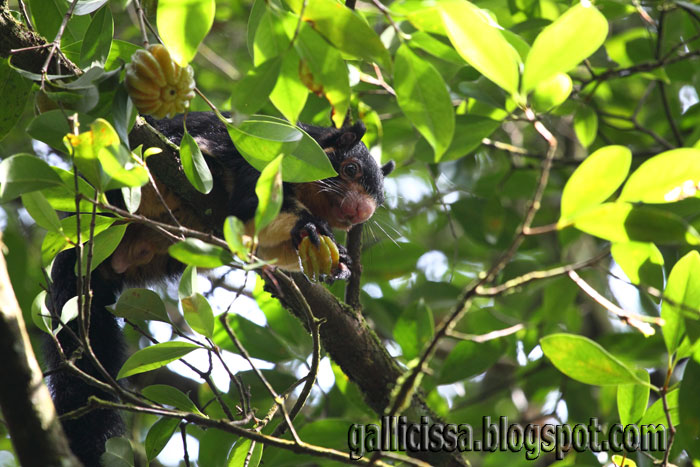
Grizzled Giant Squirrel

Grizzled Giant Squirrel
This chose to ignore us and nibble away at a fruit of the Malabar Tamarind Garcina gummi-gutta (Goraka in Sinhala), which is a resident tree species in Sri Lankan rain forests. Its fruit is a regular curry condiment in cuisine in our part of the world. Which I think makes this squirrel is a curry muncher! Or a real Gorakaya, if you like.

Anyway, this squirrel is one of the favourite prey species of the Mountain Hawk Eagle. Detecting one of these eagles soaring above the canopy, it would make “a blood-curdling” alarm call, which is not a strange to people who frequent rain forests. As a matter of fact, I use that call as a reliable indicator to spot airborne birds of prey.

I have planted a Goraka tree in my garden. It has reached nearly twelve metres, but is yet to bear fruit.

Striped Bronzeback 

Striped Bronzeback
This is one of the nine individual snakes we encountered, thanks largely to the superb snake-spotting skills of our local guide Dee. I have better shots of this snake taken on previous visits, just for the record. 

Sri Lanka Keelback

Sri Lanka Keelback
We found three individuals of this water snake at two sites.

Cruiser

Cruiser, male
Here’s another pretty Nymphalid butterfly that we saw at close quarters. It is christened Vindula erota scientifically, presumably because of its erotic nature.

Blue Glassy Tiger 

Blue Glassy Tiger
Although supposed to be "not found more than 20 miles from the coast" according to "The Butterflies of Ceylon" by Bernard d' Abrera, this butterfly is found at Sinharaja rain forest, which is more than 70 miles inland from coast.

Toque Macaque

Toque Macaque at Sinharaja
The Toque Macaques in Sinharaja are not forthright and confiding as those found in cultural sites, where they accost humans for handouts, and often commit snatch theft on anything that they see as food. The ones in Sinharaja are quite wary of humans, presumably because villagers have/are hunting them (in villages close to the forest) for bush-meat.

The Land Snail Arcavus superbus

The Land Snail Arcavus superbus
Here's a Gondwanaland relic land snail species in an endemic Nelu tree (Strobilanthes sp.) in bloom.

Apart from above specials, I also was able to photograph the Sinhalese Bushbrown—a butterfly lifer for me. And I got a decent sound recording of the Sri Lanka Scaly Thrush. Our birding highlights included Serendib Scops Owl and Sri Lanka Spurfowl, arguably two of the toughest endemic birds to see. And we saw a brooding male Sri Lanka Frogmouth in a nest.

Change of topics, who do you think will win the Rugby World Cup 2011? My money is on Ireland Australia! New Zealand!!

Thursday, 28 July 2011

Absolute Birding in January, 2011

In January 2011, I guided Jan Henriksson and Britt Marie Skoglund from Sweden on a 16-day Absolute Birding tour. We saw a total of 255 species of birds, including all endemics and other usual suspects. Jan has done a brief report in Swedish, and just so your Swedish is not up to scratch, you can get it translated using Google Translate.

Jan was the keener birder and photographer of the two, while Britt tagged along giving moral support, and at times, dazzling us with her sharp spotting skills.

Jan works in a prison in Sweden. He told me that it was a stressful job, having to deal with bad guys on a regular basis. And birds and photography were his "releases" from all that. He was a demure person, and often chose to enjoy birds silently. Britt on the other hand, was quite expressive, and was the official go-between on most matters. Oh, and Jan was a huge fan of Two and a Half Men; he said he had all the 8 Seasons of it in DVD with Swedish subtitles!

Some pictures from our trip:

Indian Roller


Our vehicle came to an abrupt halt after seeing this on a roadsides post at Udawalawe. We used our vehicle as a hide to get close to it and shoot this at point blank range.

Red-wattled Lapwing


For this, we used a safari jeep as a hide at Bundala National Park, where we had beautiful morning light.

Yellow-eared Bulbul


This stayed frozen at Nuwara Eliya in a cool morning. It was too lazy to fly despite us approaching it close. In 2000, I went for a job interview of a nature tour company, and one of the questions thrown at me was to name the Latin name of Yellow-eared Bulbul! I rattled off Pycnonotus penicillatus, and if I remember right, murmuring a dah, after that.

I was selected.

This is the bird that appears on the new Rs. 5,000 currency note, so it is by no means a cheap bird.

Sri Lanka Frogmouth


Beej once commented here, "The Frogmouths always wear a precious expression—bedraggled and slovenly but infinitely adorable."

We found this adorable pair of Sri Lanka Frogmouth at the Sinharaja rain forest. When found in day roosts, this bird is almost always found in low-light; I shot this bumping up the ISO to a crazy high—of 4000. There was a nest of another individual quite high up.

Painted Stork


We had a mustering of Painted Storks foraging close together at Bundala National Park, which I find a peaceful place for bird photography (compared to the melee that is Yala N.P.) I photographed this one when it strayed from the rest.

Chestnut-headed Bee-eater


This one too obliged at the superb Bundala National Park. A very small population of this species is found in my village in the lush valleys of the Kelani River.

Grey-headed Canary Flycatcher


This one appeared as if was dressed to go to war, sporting what looked like an iron helmet. I like to freeze birds in such poses, when they appear to look straight at me. This one was real a hyperactive little fellow, rarely staying still for long. We photographed it at Hakgala.

Little Indian Nightjar


It was trying to pass as a rock. Here's a close crop  of it looking all sleepy.


We found this at the Udawalawe National Park, very close to a track.

 Dull-blue Flycatcher


Patience pays off when it comes to dealing with the endemic Dull-blue Flycatcher. This is the bird that appears in the new Rs.50 currency note—a rather cheap denomination for such a pretty bird, if you ask me. Especially considering that it is already insulted scientifically as a sordid bird in Eumiyas sordida. 

Related Posts with Thumbnails