Showing posts with label Twitching. Show all posts

Wednesday, 14 October 2009

Dear Lord

14 October, 2009

Indra,
The Lord of the Gods and Chief Rain Maker,
South Asian Affairs,
Heaven.

Rain to the dry zone in Sri Lanka

Dear Lord,

How are you?

It's been a while since I wrote to you. Pardon me for this slightly longish communication.

First, thank you very much for the new Canon 100-400mm lens! I have been thoroughly enjoying it, as you can see from the pictures embedded in this letter. I am now sort of admiring the looks of the Canon 500mm f4.5 lens, its amazing curves and all that.

My Lord, why I am writing to you this time is for a totally different matter. I visited Bundala and Yala National Parks in the dry zone from 5-10 October, just by myself. As you are aware, that part of Sri Lanka is experiencing a severe drought right now. Which of course in anothing new—it being a usual weather pattern. My previous local experiences suggest that you are extremely meticulous in ending this prolonged drought by the mid October. This being that time of the year, I just thought of writing to you to give you a gentle reminder—what with you having to deal with global climatic distabilisation and all that. As you may have heard from many, rains are badly needed to the 2/3rd of this island that makes the dry zone.

I know that you are generous enough to bring rains to the wet zone too during this time of the year. Frankly, we have had plenty of rain where I live in the wet zone, so if you are like in a squeeze or something, please feel okay to direct all those rain clouds to the dry zone—the area with a more pressing need for rain right now.

Coming back to the aforementioned trip, the nearest reason for undertaking this twitching trip (pardon my birding slang) was a Pectoral Sandpiper that was reported by my friend, Chinthaka Kalutota, from the Bundala National Park. Despite making three visits to this magnificent Ramsar wetland site, I drew a blank. Other local birders too had failed to locate it. It's not like I did not try, my Lord. I walked for miles in hot, baking sun in the Bundala lagoon, barefoot, getting feet like this. No, those gum-boots of mine just won’t work in our mudflats. Just, where the hell is that bird? I heard somebody mentioning that only God knows it. Hence the question, pardon me.

My dear Lord, thank you for that Glossy Ibis. Gosh! I mean, God! That really was a consolation! It remained a bogey bird of sorts for me for...god knows how many years, until you finally revealed it. A pair of them at the Embilikala lagoon. Just great!

The Oriental Darter population is doing extremely well at Bundala. This one was doing a Usain Bolt and I thought you might like it, as it sort of would remind you of the weapon you wield: thunderbolt, which you use to slay the dragon, who is like causing all this drought—by enveloping the rain clouds. Just an innocent attempt at imitative magic, that's all.

The Usain Bolt bird
Those Oriental Pratincoles, which you revealed in flight, were also good, though you only gave me record shots.

Noteworthy migrants that formed larger flocks were Curlew Sandpiper, Lesser Sand Plover, Black-tailed Gotwit, and Little Stint. A single non-breeding Red-necked Phalarope and several Sanderlings were some of the other interesting ones. Here's the kind of flocks you revealed to me.


Did you know that Yala National Park, which is traditionally closed from 1 Sep to 15 Oct annually, was kept opened for visitors this year by the wildlife authorities? That is right, no unofficial 'open season' for poachers this year! Taking advantage of this, I visited this premier National Park on four game drives.

Words cannot express my gratitude for you for finding this Leopard, just minutes after entering the park, on my first game drive.


It was just 3.30 in the afternoon. We had just arrived at a waterhole named, Palugas-wala No.1—a popular Leopard hotspot at Yala. Suddenly, alarm calls of the Hanuman Langurs filled the air. They beckoned that that a Leopard may be close by.

Hanuman Langur

There were just two other jeeps at the site. Before I could even get my pair of binoculars to scan the surroundings, our sharp-eyed tracker, Sujith, spotted that Leopard making its way towards the now dried up northern end of the waterhole. It was a very sturdy-looking male. And I couldn't help going, “OMG!”

Did you hear it?  Just kidding!

It turned out to be this individual rather meanly meanly nicknamed by the locals as “Pottaya”—a derogatory reference to person who is blind in one eye in Sinhala.

Pottaya
Do you know why it's blind in one eye? I heard one commenting that only god knows; hence the question.

Anyway, it did a very measured circuit around the waterhole, walking very confidently in the open theatre-like conditions at the site. It was watched closely by a large Wild Buffalo chilling in the mud, which held its ground unintimidated, after repositioning itself not to lose sight of the predator. During its stroll, the Leopard marked its territory by spraying urine to several of the trees, you know, like cats usually do.
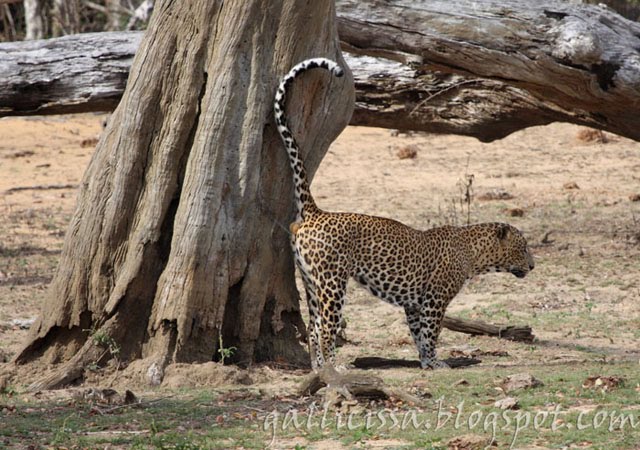
Territory marking
I observed this magnificent cat for a good 1 1/2hours, even though you were willing to give me a longer views, if I had wanted.

You were so lovely to have punctuated this prolonged Leopard sighting with plenty of non-feline pleasures. This Green Bee-Eater that sat nearby was just one of them.

Green Bee-eater
Again, you were terrific in giving me interesting compositions of the Leopard and the Wild Buffalo.

Face off
Here's a crop of the feline half, and showing its better half.
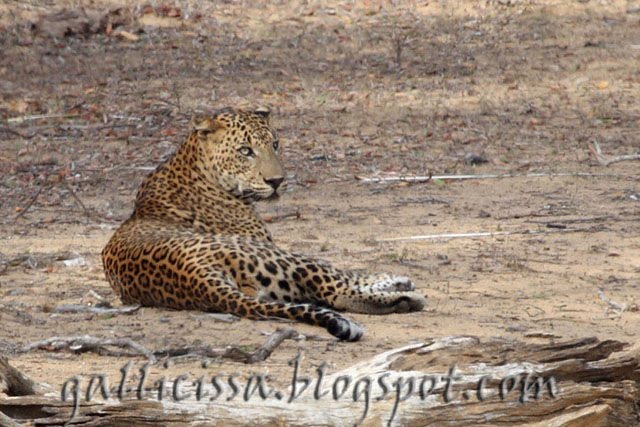
The feline half
After a while, a Wild Boar male arrived to quench his thirst; thereby forming this tense triangle
.
A tense triangle
It was like finding RD, DB, and NB in the same bar.
As the Leopard went into a marathon lounging session., it was behaving more like our pet cats. And by 5.00 p.m., I've had enough of this view.

More revealing
Guess it was telling us to just get lost!

While Sujith suggested that we stayed to see whether it would come to drink at the waterhole nearer to us, with a huge Wild Buffalo laying claim to it, I thought it may not happen too early.

Therefore, instead of lingering on at that site, I suggested to move on to explore other sites good for Leopards, as the time was just right for them. This turned out to be a good move as minutes after entering the main road, that's like at 5.40 p.m., we saw a Leopard crossing the road. Two jeeps that arrived at the junction at that very moment, however, missed that brief crossing episode.

While that saw them making a beeline to the point where the said crossing took place, Sujith came up with a battlefield manoeuver, and commanded the driver to take a different road to outflank the Leopard. Having done that, he then got the driver to kill the engine and bring the jeep to a gradual stop at a certain point. And then, he urged everybody to keep an eye on a particular area. Expecting the low light conditions, I had my camera ready with appropriate settings to take the target before that. Seconds later, a Leopard materialised slowly from the thick shrubbery, and Sujith was the first to spot it.

I managed to get a burst of shots of this glance, which it held for about 20 seconds, clearly looking bemused as to how we had managed to zero in on it!

Bemused
What brilliant field craft by Sujith!

Returning to my hotel after this exciting game drive, I learnt from those who hung around near the first Leopard site that it had not come to drink but instead vanished to the jungle few minutes after we left. God! You really work in mysterious ways. Don’t You?

Although the three game drives done after this, yielded just 2 Leopards between them, they gave us plenty of other interesting wildlife sightings. One of them was observing a bask of over 90 Mugger Crocodiles in the dried beds of Buttuwa Tank.

A crowded scene with Asian Openbill, Mugger Crocodiles, Black-crowned Night Herons and Little Egrets
It was a veritable croc farm. On my last game drive I found this dead Wild Buffalo there, surrounded by, you know who. Need I remind you of the severity of the drought?

dinna
Gosh! I should stop now. One last request; could you please go easy on lightening this time? I just don't want to lose another router.

Thanking you,

Respectfully yours,

Amila Salgado

Saturday, 18 July 2009

Sewage birding

Early this year, news reached me through a Ceylon Bird Club source about a Ruddy-breasted Crake near the Lunawa Lagoon at Ratmalana. Crakes are secretive birds that are usually difficult to see either due to their rarity or because of their skulky nature. So the bird watchers have a special liking for them because of the challenge they present.

I visited this site one balmy afternoon with my trusty tuktuk companion Sarath. Directions were provided over the phone by my friend Namal Kamalgoda, who had been there earlier to check the site but not seen the bird. After reaching the site I was further guided by the owner of the house in front as to where I should stand exactly if I want to see the bird!

And, after heeding his advice, this, was what greeted my eyes—a sewage canal.
Not a pleasant sight! But crakes are indifferent to such insalubrious sites. So, here, I waited.

the site
The man was dead right; I hardly had to wait for 2 minutes before I set my eyes on a Ruddy-breasted Crake wading in the sewage water. It was easily my best view of this scarce bird.

Ruddy-breasted Crake
The resident populations of Ruddy-breasted Crake are boosted by migrants during the winter; therefore, its status ought to be described as “scarce resident and migrant”.

I had my second Ruddy-breasted Crake for the 2008/2009 bird watching season, from a safari jeep, while guiding Andreas Prevodnik (in February 2009) at Bundala National Park.

Monday, 16 March 2009

Leopards galore

Leopard at point blank range, Yala National Park
I am a firm believer that for getting ‘tickable views’ of rare species on tours that are usually limited in duration, you need lots of good luck. You can be a birder or a naturalist with good field craft & have all the latest tools in the trade, but if you don’t have enough luck, you are bound to head back home empty-handed.
Over the years of guiding birders and naturalists I have met persons of varying levels of field craft. Some of them were extremely skilled naturalists but they just lacked that luck factor while others were average as far as field craft was concerned but brought with them lots of luck to the equation. Naturally, with the latter types we end up seeing lots of specials, surpassing expectations. No other person that I have guided so far had bought field craft and luck in equal high measures as Dr. Andreas Prevodnik of Swedish Society for Nature Conservation.
Leopard at Yala National Park
I had the fortune of guiding him on what turned out to be a high-adrenaline ‘Bird and Natural History’ tour from 10-17 Feb. This tour came to me through Red Dot Tours, a British Tour Operator to which I freelance in between my tours. It turned out to be an absolutely fantastic trip in terms of both numbers and quality of sightings. We both worked tirelessly and ended up bagging a whopping 216 species of birds including 31 of the 33 endemics currently recognized, which was quite something given the short duration of the trip. We missed out on the Sri Lanka Wood Pigeon and Sri Lanka Small Barbet. Our best efforts to see them failed, driving home, another crucial fact - you sometimes need time too!
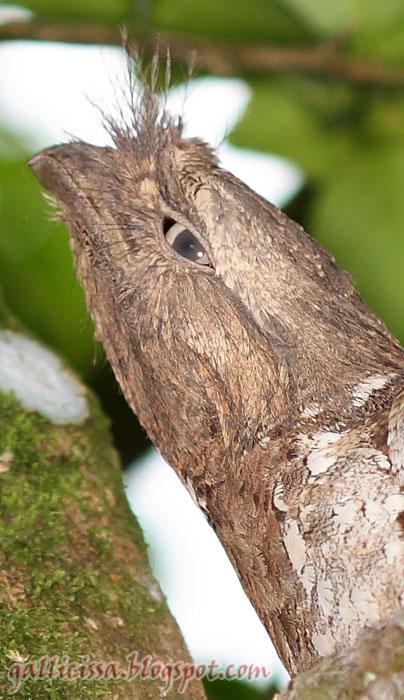
Our final bird tally included 6 of the 15 resident night birds, which included Serendib Scops Owl, Chestnut-backed Owlet, Brown Wood Owl, Indian Scops Owl, Indian Jungle Nightjar & Sri Lanka Frogmouth – another brooding male shown below cooperating to offer stunning views.

A special natural history highlight of the trip was seeing 7 Leopards in 2 game drives at the amazing Yala National Park. Four of these were recorded on the first game drive. We just couldn’t stay away from Leopards at Yala on this tour as they turned up every time we were after other targets. I hate to admit this, but Leopards were a big distraction on this tour!
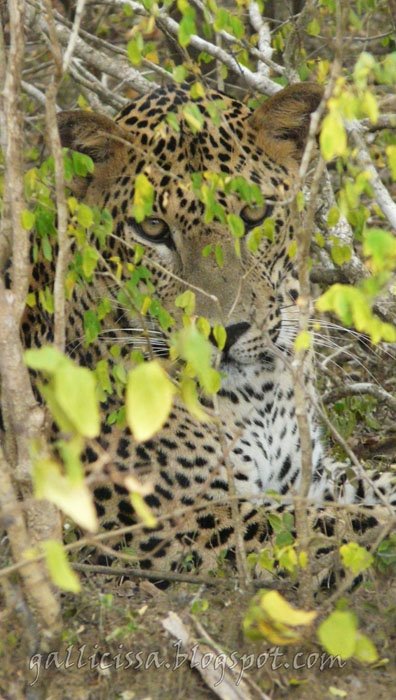
The first of the Leopards to grace our visit to Yala (shown at the top) settled under the shade of a tree by the roadside at the beginning of the Uraniya road and gave us stonking views just, 2.5m away from our safari - after 30 minutes from entering the park.
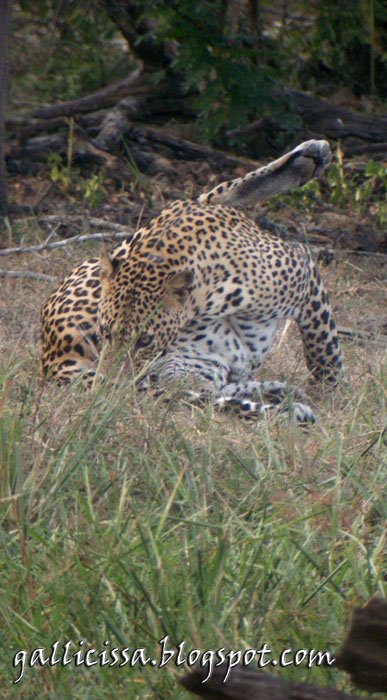
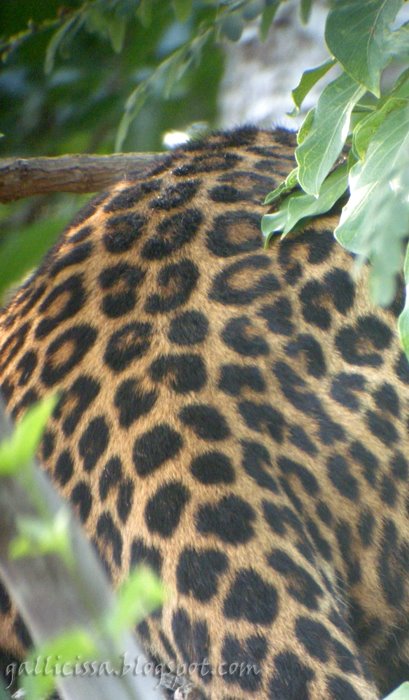
Our second Leopard found at an area casually named as ‘Ahelagas-wala’ at the famous Leopard zone, Meda-para was this stubborn cub, who refused to give us any decent look at it except a bum view.
Leopard at Yala National Park
Our third Leopard only offered a fleeting glimpse as it crossed the track a bit ahead of the location where the above brat cub was 'misbehaving'. Our fourth and final Leopard was sighted in full view close to Uraniya road when it came down to the ground from a Palu tree when we were exiting the park.
Our 5 & 6th Leopards were spotted together on our second safari, guarding over a Water Buffalo kill from a safe distance. Despite their intimidating presence near the carcass, a Golden Jackal, and a Wild Boar and several birds crashed the party and helped themselves for a quick McBuffalo meal. Here’s what happened, shot from about 70m away.

When we were observing this, news arrived that a male Leopard is out in the open at the nearby Palugaswewa No.1. We wasted no time in going for it to find this beautiful Leopard. (note: the colours are wrong.)
Leopard at Yala National Park
It was well worth it as this male really put up a show for us with a curious male Sri Lanka Junglefowl also playing a support role. Check this out.

We also chanced upon 2 Jungle Cats outside the park while returning to our accommodation on the 2 days that we visited the park. Andreas photographed one of them at point blank range.
Apart from the endemics, our other birding highlights include Black-backed Dwarf Kingfisher, Malayan Night Heron (adult in clear view – easily my best sighting ever), Painted Snipe, White-cheeked Tern, Western Reef Egret, Western Marsh Harrier, Ruddy-breasted Crake, Watercock, Black-necked Stork, Pied Thrush, Fork-tailed Drongo Cuckoo, Small Pratincole, Broad-billed Sandpiper, Red-necked Phalarope, Malabar Pied Hornbill, Blue-faced Malkoha, Indian Pitta, Indian Blue Robin, Rufous Woodpecker, Marshall’s Iora, Black Bittern, Yellow Bittern & Streaked Weaver.
Sri Lanka Frogmouth

Saturday, 21 February 2009

Birding with Keith and Julie Ellis

Sri Lanka Frogmouth male
I led an 18-day 'birds, wildlife and culture tour' with Keith and Julie Ellis from Kent, UK from 23 Jan – 9 February. Keith was a serious birder with over 3,000 world birds in his life list. He knew most of the species that he wanted to see by their scientific names and was a sharp birder. Julie had broader interests, which included culture. She was supportive and tolerant—two traits that I admire in non-birding spouses accompanying serious birders! A cultural extension added to the tour to please her took us to several Unesco world heritage sites that included Anuradhapura—the first capital of Sri Lanka from 4th century B.C to early 11th century AD, Polonnaruwa—the medieval capital from 11-13th century A.D, Sigiriya—popularly, a pleasure capital of a single king named Kashyapa in the 5th century A.D, and Kandy—the last Sinhalese capital from 16th to 19th century A.D, which is home to the Temple of The Sacred Tooth Relic, where a Sacred Tooth of the Buddha is encased in jeweled caskets that sit on a throne. In Anuradhapura, we also visited Mihintale—the cradle of Sinhalese Buddhist civilization and birded in the world’s first declared wildlife sanctuary, announced as early as in the 3rd century B.C.!

The 'World Heritage' Sigiriya Rock Fortress
We were quite lucky with the weather, and experienced nice dry conditions throughout the tour, which was perfect for birding. In total, we bagged 253 species of birds including all thirty-three endemic birds currently recognized. Nineteen of these endemics were bagged during our first two days at Kithulgala—in the "power play" stage of the tour. And this reduced the ‘asking rate’ during the rest of the tour considerably!

Some of the high-profile endemic targets bagged at Kithulgala included Serendib Scops Owl, Sri Lanka Spurfowl, Crimson-backed Flameback, Red-faced Malkoha, and Sri Lanka Blue Magpie.
The latter two species are usually considered as Sinharaja specials, but we made good ground by bagging them in advance to free up time to look for bonus birds. Our last endemic to be seen on the trip, Sri Lanka Bush Warbler was the one that gave us the hardest time. As it was proving elusive at my regular sites at Nuwara Eliya, a pre-dawn visit was undertaken to the cloud forests of Horton Plains National Park just to see it. The temperature at at the site we settled to look for this LBJ at the Horton Plains was just about 3 degrees centigrades! Not my cuppa tea! It was so cold that there was ground frost. Jesus Christ!

After 45 minutes of searching, I managed to spot one Sri Lanka Bush Warbler skulking in low bamboo thicket, thus making a clean sweep of the endemics. I suspect the reason for its inactivity at elevations low-down probably may be due to the very dry weather experienced at those sites.

Painted Stork
Painted Stork
A special highlight of the tour was seeing ten out of the fifteen resident night birds—with most offering multiple orgasmic views! This figure comprised of seven owls, two nightjars and the only frogmouth species found in Sri Lanka. This night bird number beat a previous high recorded on my tours of nine—seen on a 15- day birding tour in February, 2008 with four crack team of British birders.

Touching in the specifics of the haul of night birds and other things, our first owl of the trip was Chestnut-backed Owlet (shown below), and it was spotted by Keith while it was actively foraging at daytime close to our accommodation. The same species was seen moments later in another patch close by, with its characteristic call betraying its hide-out in the dense vegetation.

Chestnut-backed Owlet
Our second species of owl for the trip, a roosting Indian Scops Owl was picked by me quite by chance moments later, when I was looking for the skulking endemic, Green-billed Coucal in a thicket. We got decent views of the hoped for coucal and as dusk approached the scops owl cooperated at a more open branch to present us full view of its profile. Indian Scops Owl was recorded again at a nest hole towards the tail end of the holiday (that's like, work, for me) at Anuradhapura during the cultural leg.

Our day 2 at Kithulgala saw us getting cracking views of the highly-sought-after endemic, Serendib Scops Owl. This rain forest owl was discovered in 2001 and is one of the 2 ‘endangered’ endemics (which I believe should go up to 3 with Sri Lanka Bush Warbler added to it!). The other endemic bestowed with this conservation status, Sri Lanka Whistling Thrush gave an untickable view on our first dusk vigil, but did not disappoint us on our second attempt when a female showed up over 10 minutes. A change of strategy adopted by me did the trick for us: Keith and I occupying two different spots, at several metres apart, covering two vital angles. Both of us got it almost at once when the bird emerged secretly.

Our fourth Owl species for the trip and second for day two came in the form of a vocal Brown Fish Owl in flight. The same species gave cracking views at Nuwara Eliya, Sigiriya and Anuradhapura, the last at daytime courtesy of a mob of smaller birds harassing it.

Our fifth resident night bird for the trip came in the form of a brooding male Sri Lanka Frogmouth (shown below and again, at the very top) at Sinharaja on day three. Rather sadly, we learnt the on the following day from our local guide, Ranjaka, that this nest had been ‘predated’ under mysterious circumstances. A Human involvement was suspected, which if true, was very very sad.

Sri Lanka Frogmouth - a brooding male
The day three also brought us the ultra-elusive Brown Wood Owl, which was our fifth owl and sixth night bird for the trip. We manage to see the same species on the following day too courtesy a mob of short-tempered Sri Lanka Crested Drongos. They dive-bombed it with no mercy at dusk pin-pointing us of the exact location!

Several Indian Jungle Nightjars seen at Udawalawe on day six proved to be our seventh night bird for the trip. This species offered very good views at close range at Yala too. Our eighth night bird and sixth Owl for the trip seen at Sigiriya saw us cleaning up all three Scops Owls of Sri Lanka, when Keith expertly zeroed in on an Oriental Scops Owl on day thirteen. It was calling teasingly close for over fifteen minutes. Its location remained hidden in the dense foliage for most angles available. When we found it, we had to make do with unsatisfactory back views of it due to the location of its perch.

The following morning saw us making a return visit to this site for it. After a bit of hardwork, I spotted a pair of this cute little Owls at dawn to give absolutely stonking views within three metres. Sadly, we had no camera with either of us to record this moment of magic. (Isn't that typical!).

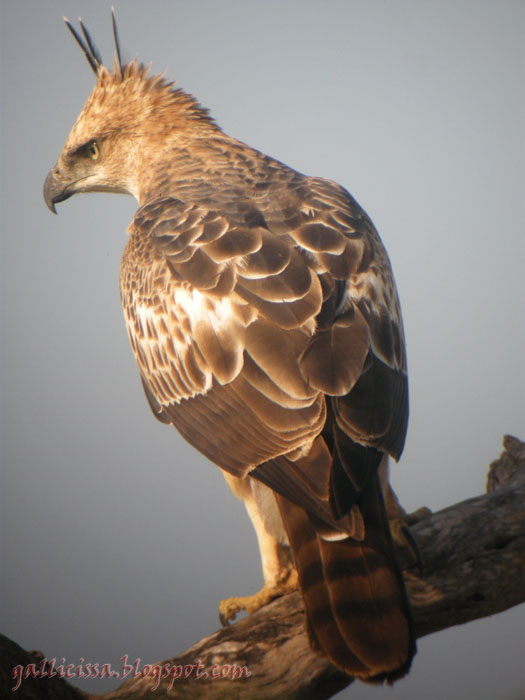
Crested Hawk Eagle Crested Hawk Eagle
Jerdon’s Nightjar spotted by Keith on a snag high up became our ninth night bird of the trip. That was again seen on day thirteen. A prolonged sighting of the same species in a low perch bettered this sighting three days later at Anuradhapura. Our last night bird for the trip was Common Barn Owl, a pair of which was recorded in a stake-out inside shrine in Polonnaruwa.

Concerted attempts at seeing Spot-bellied Eagle Owl, Brown Hawk Owl, Jungle Owlet and Sri Lanka Bay Owl failed on this tour. However, we came agonizingly close to seeing Sri Lanka Bay Owl, twice, but it just did not show up being vocal but staying uncooperatively hidden in dense foliage despite our best efforts to obtain an angle of view. This ultra secretive owl caused a mega twitch in Sri Lanka when it turned up in a daytime roost at Sinharaja in 2007. It is in public domain that at least one local bird watcher took a tuktuk tour all the way from Colombo to see it.

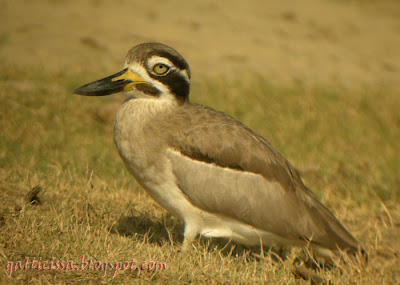
Great Thick-knee
Great Thick-knee on its knees
Our other birds of note recorded during the trip included Grey-headed Lapwing (vagrant & lifer for me seen at Yala thanks to US of Ceylon Bird Club who conveyed the news), Western Reef Egret (white morph one picked skilfully by Keith at Bundala, shown below), Legge’s Hawk Eagle (formely Mountain HE, great overhead views at Sinharaja), Chestnut-winged Crested Cuckoo (a lone individual outside a flock at Sinharaja), Fork-tailed Drongo Cuckoo (spotted expertly by Julie at Kithulgala), Black-backed Dwarf Kingfisher (seen & photographed at point black range at Kithulgala), Indian Reed Warbler (in song at Bundala), Slaty-breasted Rail (Scarce resident with possible migrant populations supplementing resident populations during migratory season, seen at Tissamaharama), White-naped Woodpecker (punctual!), Kashmir Flycatcher (at least 4 sightings with the first being of an adult male), Pied Thrush (great views at Nuwara Eliya) Common Ringed Plover (a scarce migrant, not too exciting to Keith), Dollarbird (seen thanks to G. de Silva Wijeyeratne at Kithulgala) and Eurasian Collard Dove (a scarce resident in Sri Lanka seen at Annaiwilundawa RAMSAR wetland, not too exciting to Keith). A Slaty-legged Crake at Sinharaja, seen only by yours truly, was the only bird species that eluded Keith.

Western Reef Egret - white morph
We had exceptional views of the ultra-elusive Sri Lanka Spurfowls when a female followed by a male were seen over five minutes, walking in the dimly-lit forest floor, totally unaware that we were observing them from a ridge higher up! Such heart-melting sightings of this game bird are rare, and this was one of the best views that I have had of it for quite a long time guiding an overseas birder. Before that we had brief view of it at Kithulgala. It was a case of BVD.

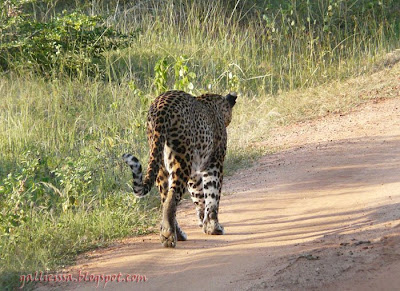
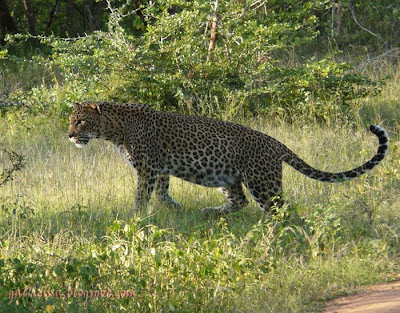
Moving on to non-birding matters, the Leopard shown below (same individual as in the previous post) was clearly our top non-birding highlight. We were the only jeep at the site when we found it. It was first sighted at 5.30 p.m., while resting in a shady spot near a water hole named rawung-wala (meaning circular water-hole) at Meda-para at the Yala National Park—the premier site for Leopards in Sri Lanka. The cat was about 25 m away when we found it first. Soon after we killed the engine of our jeep to observe it, the cat stood up and walked towards the track in front of us. It then continued to walk along it for a while like this, soon going out of view in the bend ahead.

Leopard at Meda-para, Yala National Park
We then approached it to find it again, this time within 5 meters or so from it, enabling us to photograph it at close range. Finally, after giving a good long glance at our jeep, it retreated into the jungle and disappeared out of radar.
Leopard at Meda-para, Yala National Park
More non-birding specials, we saw a pair of Barking Deers (Indian Muntjak) at Welimada. My previous sightings of this deer species has always been at the massive Wilpattu National Park. We exchanged glances with a pair of these before they retreated to the woodier interiors.

Monday, 20 October 2008

Sticky matters.


I led a 17-day "Christmas Bird watching Tour" in December, 2004, for a reputed British nature tour operator. Its ground handing was done by a local travel agency to which I freelanced at that time. This tour stays in my mind for a number reasons.

First, the unfortunate reasons:

1. Briefed and given in writing as a "mostly bird watching oriented tour," this tour had five English people that included:

i. A nature photographer with a keen interest in wild flowers.
ii. A walking enthusiast who just liked to keep on walking.
iii. A natural history enthusiast with a passion for photography and a passing interest in birds.
iv. A hardcore birder who was heavily into listing.
v. A person who didn’t fall into either of the above categories.

It was like a challenge that Donald Trump would have chosen for the final episode of the Apprentice. I did my best to juggle all the balls without dropping any. What can I say,  it was a good learning curve!

2. The Boxing Day Tsunami, which caused havoc killing over 40,000 people in Sri Lanka alone, happened during this tour. We were mopping up the montane endemics at the cloud forests of Horton Plains National Park—the tallest plateau in Sri Lanka some 2,100 m above sea level—when the killer tidal waves devastated the coastal lowlands. And we were to visit this area in two days’ time!

I had the tour rerouted thereafter to stay away from the affected lowlands. I also decided to spend more time in the unaffected endemic rich wet lowlands.

And now, the fortunate reasons:

1. More time in the wet lowlands didn’t harm our burgeoning bird list one bit. This was the first tour in which I showed the avian jewel Serendib Scops Owl Otus thilohoffmanni to an overseas bird watching audience, after its discovery in Jan, 2001. Needless to say, it was a momentous day for mankind!

2. I made a clean sweep all 33 endemic birds on this trip—for the first time having started my guiding career in January in the same year. As a budding bird guide, it was an important rite of passage.

3. An observation that I made at Sinharaja "world heritage" rain forest became the subject of my maiden paper to a peer-reviewed ornithological journal. It is—

Salgado, A. (2006). Some observations on the diet of Red-faced Malkoha Phaenicophaeus pyrrhocephalus in Sri Lanka. Sandy (UK): Forktail Journal of Oriental Bird Club. 22: 122-123.

Click here to download a PDF of it.

Anyway, what I am trying to get at like Sir. Humphrey Appleby is to correct an error that had slipped in the above article by me.

In it, I had a ‘giant stick insect’ preyed upon by a Red-faced Malkoha identified as Palophus sp (Order Phasmatodea) after comparing it with what I thought at that time to be a reliable source of reference.

On 14 October, 2008 its identity was corrected by a world authority on stick insects: Dr. Frank H. Hennemann from Germany, thanks to intervention by Dr. Priyantha Wijesinghe who is a Sri Lankan Entomologist/Systematic Biologist based in the USA.

Accordingly, it is an adult female of Phobaeticus hypharpax (Westwood, 1859).

The classification being:
Order: Phasmatodea. Suborder: Anareolatae. Family: Phasmatidae Subfamily: Phasmatinae Tribe: Pharnaciini.

A better view of the Giant stick insect. Note the rear left limb is a result of an optical illusion created by a limb like branch behind. The actual left rear limb was broken off by the time I took this shot as this was photographed after the above
Dr. Hennemann disclosed that the locality data for all but one of the specimens lodged in the world museums including the type specimen from which Westwood named this species bear nothing beyond "Ceylon."

Therefore, he, was quite happy to receive the locality data of my Phobaeticus hypharpax that eventually ended up in the gut of the above Red-faced Malkoha.

Very interestingly, on 15 October, a day after this e-mail communication, Dr. Hennemann had a revision of the very Tribe: Pharnaciini published in Zootaxa in the form of a 316 paged paper, which included, the above species.

The reference is:
Frank H. Hennemann & Oskar V. Conle (2008). Revision of Oriental Phasmatodea: The tribe Pharnaciini Günther, 1953, including the description of the world's longest insect, and a survey of the family Phasmatidae Gray, 1835 with keys to the subfamilies and tribes (Phasmatodea: "Anareolatae": Phasmatidae. Zootaxa 1906: 1-316 pp. Auckland, New Zealand: Magnolia Press.

According to the above, and as per a personal communication by Dr. Hennemann, in addition to the above species, Sri Lanka has one more species belonging to the tribe: Pharnaciini, which is Phobaeticus lobulatus (Carl, 1915). Its body length is 162.0 mm and is a very similar species to P. hypharpax, which has a body length of 185.0–236.0 mm. The former is only known from the female holotype with the locality data reading again as "Ceylon" only. So far, it has never been recorded since its original discovery in 1915 according to him.

By the way, the world’s longest insect, referred in the title of the aforementioned stick insect revision paper is (drumroll, please) Phobaeticus chani—Chan's megastick from Borneo—with a body length of 333.5–357.0 mm. Its overall length with the limbs stretched out is a whopping 567mm!

This is a completely new species described based on a specimen in the collection of a Malaysian naturalist and insect collector from Sabah Borneo, Chan Chew Lun, who had received it from a local collector. Dr. Philip Bragg named it in honour of Chan who had donated his world record holding megastick to the British Museum of Natural History.

If you are really into sizing up your megasticks, the former record holder for the world’s longest insect title based on body length was Phobaeticus kirbyi with 317.0mm., which is also found in Sabah, Borneo. So the newly described Chan's megastick is 40mm longer!

The former record holder for the overall length with the limbs stretched out was Phobaeticus serratipes distributed in Peninsula Malaysia, Singapore and Indonesia of which one has been measured at 555mm.

The new megastick on the block has beaten that record too by 12mm. However, this recorded would have been greater by 7–10 mm if the specimen of Phobaeticus chani donated by Chan Chew Lun had not been damaged according to Hennemann and Conle, 2008.

So no matter how you size up, the Malaysians get to retain the coveted world record title for the world’s longest insect by a long margin. I am sure Tabib, who is a regular visitor to my blog from Malaysia, will be proud about this.

I’d like to conclude this post by saying a big thank you to Dr. Hennemann for taking his valuable time to help with the identification of my megastick. Last but not least my profound gratitude is due to Dr. Priyantha Wijesinghe, for sending my images to Dr. Hennemann to seek his expert opinion and communicating to me the same and putting me in touch with such a world authority.

Thursday, 1 November 2007

MonaLisa TV crew, France, 16-25 Feb, 2007

interviewing bird flock researcher Dr. Eben Goodale at Eastern Sinharaja
This tour came to me through Sri Lanka Wildlife Conservation Society (SLWCS). It was a two-man French film crew doing a documentary on ‘animal instincts’ with particular reference to the boxing day Tsunami in 2004. The general angle covered was how animals reacted before the tsunami and how humans/other animals got alerted to these signals & saved their lives.

Our first interviewee was my colleague Uditha Hettige, and when we visited him, he was convalescencing from a nasty road accident while going to see the Sri Lanka Bay Owls early this month. On the fretful day of the Tsunami, Uditha had been having breakfast at the 60 plus-roomed Yala Safari Game Lodge. Just before the dangerous tsunami wave hit, reducing the hotel to a couple walls, Uditha had seen a flock of water birds taking wing suddenly. Soon after he'd seen a big tidal wave coming in towards the land, and had run for his life shouting others around to do the same. Scaling a tree, he'd escaped with only minor injuries. The manager, accountant and his spouse, front office manager, cheff—all my friends—were not as lucky, and they all died. As did several in-house guests.

After shooting the interview with Uditha, we drove to Yala National Park. Thereafter, we visited Udawalawe National Park and the eastern Sinharaja to interview Dr. Eben Goodale who studies mixed species bird flocks.

We had fantastic Elephant footage in Udawalawe and a couple of Leopard sightings in Yala. On the way to Yala, I paused at the Udawalawe causeway for a quick scan, and I was able to see a White Wagtail (race dukhunensis) a scare migrant, which had been turning up at this site regularly. My first sighting of this was at the same site in 2001.

While the crew were busy filming ‘Elephant stories’ with an expert based in a village close to Udawalawe National Park, a mix bag of swifts caught my eye and it contained to my surprise, several White-throated Needletails, a species not in the Sri Lankan bird list! I could positively identify them from a combination of features seen including clear white throat, prominent white mantle and a horse-shoe shaped white marking in the ventral area –the later feature as in the Brown-backed Needletail. As soon as I saw them, it was obvious to me that the tone of the white colour of the throat area and the ventral area was similar. As for the size, it appeared smaller than Alpine Swift, and therefore, definitely smaller than the Brown-backed Needletail. Based on these facts, I was able to confidently excluding these two species. The other species recorded in this flock of swifts included House Swift, Indian Swiftlet, and Asian Palm Swift.

White-throated Needletail was claimed in Sinharaja by a visiting British birder on a tour that I organized in 2002/2003. His record submission to the Ceylon Bird Club’s Rarities Committee was later rejected.  I have submitted mine and am awaiting acceptance.

Wednesday, 31 October 2007

Sinharaja 26-30 Jan, 2007

I got another telephone call from Sinharaja on 26 Jan., with the news that a pair of Bay Owls had been sighted, the day before. Due to limitations of digi-scoping, my previous captures of this top owl was a tad unsatisfactory; most of them were not in sharp focus. January, which usually is a busy month was looking very bad work wise this year with only 3 days of work with a single client for me after a couple of the big tours that I was expecting got cancelled because of Sri Lanka hitting the news headlines for wrong reasons. So basically, I had plenty of time to spare this January—arguably one the best months for birding in Sri Lanka. And this is very true for Sinharaja too because of the migrants joining the flocks to boost the quality and quantity of birding, most birds engaging in nesting, and overall dry weather—which means less leaches, though they bug me not. All these reasons amply justified a second visit to Sinharaja this month and after the first tuktuk trip; it was way too tempting not to try it again. So I had to call my trusty tuktuk companion, Sarath, once again.

White-faced Starling
Leaving late, I reached the site by 5.15 a.m. and Thandula guided me to a and was in a terrible angle for digi-scoping. Before even I could mount my camera, it began to rain heavily and I had to wait until it settles down before attempting even a record shot. Adding to my woes, the light also began to deteriorate. So after a few record shots I had to call it a day. In the period I was in Sinharaja the Sri Lanka Bay Owl remained in spots where it was difficult for me to digiscope, so I just got on with other birding. I found that my camera was not getting zoomed in properly—after getting exposed to rain on the previous day. So this trip was a disaster in terms of photography. In the period that I was in Sinharaja from 26-30 Jan, the following noteworthy sightings were made.

Chestnut-winged Crested Cuckoo—I saw one while it was moving low in the under storey level in a mixed species bird flock. I was seeing this scarce migrant after fifteen years! And too was at Sinharaja—in the southern end of it. I also sound recorded a cuckoo at dawn and dusk to be later identified as this species. This is usually silent during its stay in Sri Lanka. All except one local birder (Upali Ekanayake) that I consulted weren’t familiar with its call.

Sri Lanka Spurfowl—I had three sightings of which two were planned, and one was accidental! The planned sightings were when I waited in a spot where it had been sighted on the main track in late afternoon by a few reliable observers. If my camera had worked, I could have got a cracking shot of this ultra secretive endemic. I also got a sound recording of this and found a roosting site of it inside the reserve.

Green-billed Coucal—A observed this carrying nesting material indicating breeding activity.

Black-naped Monarch—A nest close to the main track. Both parents were attending to the nest, feeding the fledglings and removing waste matter.

Malabar Trogon – A pair was observed at a nest hole close to the Sri Lanka Bay Owl site. They were leaving the nest hole with several unidentifiable objects in the beak—indicating nesting activity may be in progress.

White-faced Starling (above)—I photographed this species in a bird flock below Martin’s.

Post script: no wonder this trip was a failure photographically speaking as I started it on a 26th!

Friday, 26 October 2007

A tuktuk trip & a top lifer!

“… persons who come into possession, or have opportunities for observing the habits, of this rare owl, are urged to do all they can to note and record permanently every detail about it"
- G.M. Henry, 1955 in A Guide to the Birds of Ceylon

Ranjith Premasiri, a sharp-eyed local guide from Sinharaja, rang me on 18 Jan., 2007 at around 10.15 a.m. He gave me a ‘breaking news’ that a day roost of a Sri Lanka Bay Owl Phodilus assimilis had been discovered by him. That was while accompanying a couple of British bird watchers and their local bird tour guide, the day before. And with the same breath, he added that, it was re-spotted in a different tree today.

One of my first shots of the ultra secretive Sri Lanka Bay Owl - on 18 Jan, 2007
According to him, when it was first seen it had been out in the open on a tree sapling at almost eye level beside a track leading to a few village houses. The guides apparently had misidentified it as Serendib Scops Owl! Lester Perera, a local birder, (and Vajira Wijeygoonawardene) who had been at Sinharaja at that time, had heard the news and visited the site to find a Sri Lanka Bay Owl instead!

I thanked the two informants and told them that I am on my way. I rang my local tuktuk driver, Sarath, to come to pick me up, ready for a long trip. We were on the road by 10.30 a.m. and after buying enough social lubricants to quench the thirst on the way and to celebrate in the evening, we arrived at Sinharaja by 2.15 p.m., after way too many unscheduled stops en route.

I met Ranjith and his colleague Tilak who took me to the site. Soon, I was looking at my first Sri Lanka Bay Owl! Just amazing! It was about 5 metres above the ground, and about 12 m away from the track. I quickly mounted my digi-scoping gear and took some record shots.

It was facing its back towards the road and every now and then looked over the shoulders. It would also go into a rocking motion—slowly moving its body sideways, presumably to ease of the strain on the legs after perching motionless for sometime. Unfortunately, it was terribly overcast by the time I arrived at the scene, and I could only take a few record shots, before the rain started to absolutely belt down with rain.

When the rains eased off after an hour or so it began to get terribly misty. That hampered further photography. Anyway, before all this. I had said good-bye to Sarath who left unconvinced of my explanations as to why I took all this trouble over a single bird.

Bay Owl at night, 18 Jan, 2007
About an hour aftre, more birders flocked to the site—thanks to Ranjith the informant. These included Uditha Hettige and Chinthaka de Silva and Palitha Anthony. As for me, it turned out to be lifer for them too! A much sought after one at that. I also met Lester and Vajira who correctly identified it a day before.

Light kept on deteriorating. Undaunted, I lingered on to see it leaving the roost. I was joined by Thandula Jayaratne, arguably the best birder among the local guides in Sinharaja, who only learnt the news of this mega bird from me! As the dusk approached all the visitors left, leaving only me and Thandula at the site. I had it focused in my scope to observe it in the deteriorating light.

As the dusk was approaching it was moving slightly along the perch and making rocking motions more often. It was also seen stretching its wings several times indicating it was ready to leave the roost pretty soon. After a while, the calls of Sri Lanka Frogmouth filled the air announcing the dusk by around 6.20 p.m. However, the owl appeared in no hurry to leave its roost any time soon. I waited.
I observed it. I checked the time. I noted that it left its perch at 7.12 p.m.—when dusk has given way to night completely.

It was gone. But, we remained at the site hoping to take a sound recording of it. No luck. As we were about to call it a day, a rustle in a nearby Jak tree caught both our attention. I flashed my torch. And there it was a Sri Lanka Bay Owl, again. This being the nightime, the bird was clearly at its element. We couldn’t be sure whether it was the same bird or a different one. It was glancing down very eagerly and seemed to be looking for its first meal of the day and seemed oblivious to our presence. It also flew about in different branches and after doing so walked a bit along them looking down all the time. Using this opportunity, I tried my first every night time digi-scoping shots taken of any bird, which turned out better than I expected.

Close to the original site of roost, and the tree it was observed during the night time was a dead Fish Tail Palm tree Caryota urens with an hollow top. Sri Lanka Bay Owl is known to nest it tree holes. And I suspected that this Bay Owl may be nesting at this site. However, we couldn’t see it reaching this dead tree when we were there. Finally at around 7.55 a.m. it flew in the direction of the river, prompting us to call it a day.

Dinner, celebrations and overnight stay in Thandula’s residence.

Early next morning, Thandula and I reached the site. Despite searching the nearby trees we could not locate the bird. Soon, the birders and photographers who were here yesterday; plus more who had come from Colombo this morning were at the site. They included Namal Kamlgoda and Gihan Rajapakse, both equipped with the latest digital cameras and monster telephoto lenses.

We were all assembled near the Jak fruit tree in which the owl was seen by Thandula and me last night. Apparently, Namal has a conference to attend in Kandalama Hotel, in Dambulla (close to north central Sri Lanka) this afternoon and had come here (south western interior, Sri Lanka) 'on the way'. And Namal learnt that one of birders had arrived here yesterday by a tuktuk. We were swapping such stories and showing off each others pictures of this high profile rarity. The newly arrived were making no real effort in looking for it. Perhaps the photographers in them were overawed by the sheer number of birders present and thought somebody will find it. The ones who had seen it already were more happy to brag about the sightings yesterday and engage in small talk. Perhaps given its rarity, it was too much to expect for a Sri Lanka Bay owl to be sighted for three straight days.

Soon it was time for Namal and Gihan to hit the road for their conference. The rest of us also went in our own ways. Guided by the cues of the cacophony of bird calls as the sun broke out, I went on a walk down the same track looking for other birds. A consolation came, when I saw the Chestnut-backed Owlet below. It was quite photogenic.

Chestnut-backed Owlet
One of those pics appeared in an article in Oriental Bird Club’s BirdingAsia, Number 7 (June 2007) titled Identification of Asian Glaucidium owlets done by Mathias Ritschard and Manuel Schweizer.

Bay Owl, 19 Jan, 2007
Ambling back to the Bay Owl site, I noticed few birders and Thandula were still lingering around the same place where I left them. Knowing his antics, Thandula’s smirk was a give away. I knew he had found the Owl. The question was where? The answer came after a teasing pause. Jesus, Mary and Joseph!, it was in the Jak Fruit Tree!!—the very spot we were all standing and doing everything but finding it!

To be fair by all of us, it was visible only from a narrow angle looking from the main trail & and the spot was well concealed by foliage. Anyway that's why we missed it!! This Jak Tree, was bordering a tea garden in one side and and a separate track that branches off the main track on the other. Moving around its perch, we could find about 3 good angles in which the bird was showing well.

We observed it in the same night (19 Jan) too and observed that the bird left the roost when it was completely dark at around 7.20 p.m. Thandula and I had the company a few more birders at the site. We observed the bird to be flying between the Jak fruit tree and another tree that was close by, middle of which was the dead Fish Tail Palm that I first suspected to be the nest tree. After observing it for a while, we all left the site without stressing the bird too much. Later on, Uditha had observed a Bay Owl approaching the top of the dead Palm making a squeaky note with a second bird responding in a similar manner from inside the hole and continuing to do so. He had also seen this bird that approached the tree hole entering it. So I was right; they were nesting!

Post Script: Uditha, Palitha and Deepal Warakagoda, the Serendib Scops Owl discoverer met with a dangerous road accident in February, while driving to Sinharaja to observe these nesting Bay Owls. This had happened when their vehicle was skidded several metres off the road into a ditch. It had happened when trying to avoid a head-on collision with a truck coming at dangerous speed. Two persons suffered considerable injuries. However, considering the circumstances, it was a lucky escape as it could have been a lot worse. This unfortunate incident prevented further monitoring of the nest by them. I stopped my night time observations after 18 & 19 Jan., as the local forest rangers weren’t too happy in birders trying to learn more about the ecology of a rare forest bird.
Related Posts with Thumbnails