Tuesday, 18 October 2011

Scarlet Basker


The Scarlet Basker has got to be one of the easiest dragonflies to photograph. That is, if you're willing to put the hard hours in baking sun. Midday is when it is mostly at its element. The male above was shot in a quarry just 250 metres as a crow dragonfly flies from my garden. The owners of the quarry tolerate me trespassing it for my photo missions.

When I am chasing dragonflies, I rarely let other natural history distract me. With that single-mindedness, I just go flat out to get the results that I want. And that is dragonflies standing out in plainer backgrounds. Which do not compete for attention with the subject.


These were shot some time ago when I was using my Canon 40D. I coupled that with my Canon 100mm macro lens. The female above was shot at a privately owned wetland site near my place named Ketha, which is also famous for its juicy Rambutans.

I got less that a foot from these basking beauties to photograph them.

Friday, 14 October 2011

Skywatch Friday—A Canopy Giant


Click here to see what other sky watchers have posted.

Thursday, 13 October 2011

A Primate Moment


This primate moment happened last month at the Hakgala Botanical Gardens. I was guiding Prof. Aiden Foy and Mrs. Hilary Foy from Australia. Seeing a troop of Toque Macaques marching along, I stood ground at a spot that I thought they may pass. The troop were quite disciplined in that they kept to a pavement designated for walkers. Expecting them to breach my personal space and ready for some an interaction, I had already kept one foot forward on the pavement. That was partly to claim ownership to it. And to show that I am no pushover. 

A curious little macaque paused near my foot. It rolled its eyes up to take me in and hurried away. A female with a baby clutching onto her belly walked swiftly pass me, giving just a cursory glance. Soon, another little one stopped by. It gave a teasing pat on my boot and retreated in haste. Perhaps it feared an angry reaction from me. I stayed unmoved and he too moved on. After that, another little one paused near me. He gave a more assertive pat on my boot, looking up to check my reaction. Too easy, he went a step further and came closer to sniff it. Continuing the march, he too moved along. Then came what looked like the dominant male of the troop. He paused near me to give a once-over, and sniffed the boot himself, as if to check what's all the fuss about. And he then got distracted by my lens dangling down my waist and tried to reach it. That was too much, sorry, and I held it close to my body to claim ownership to it. Just looky looky, no touchy touchy there please, the big male sensed my energy and moved on.

Seconds later, two more curious macaques stopped by. No threat from me may have been the word around as they both got much nearer. After the sniffing routine, the game changed to a more confident full-contact sport. They both gave the boot a thorough inspection, touching it much more confidently. This entailed an obligatory inspection to see whether it was edible! And that meant a tiny bite on to my boot. It was mainly out of curiosity than to make a meal of my boot, so I tolerated it.

While this was going on, the other one rudely lifted my trouser to check out what's inside. Prof. Foy walked to the scene roundabout that time to take the above picture. Sadly, a security guard of the park—a real Buzz Killington— walked in and disturbed the monkeys. More sadly, I have no photographs of this monkey business of myself because it all was too close for my lens.

But sometimes memories are worth heaps than a photograph.

Thursday, 6 October 2011

Sinharaja in August

I am back after guiding several trips.

One of them was a two-day trip to Sinharaja rain forest from 28–29 August. It was with Dr. Jane Rosegrant, who is the outgoing country director of VSO (Voluntary Services Overseas) in Sri Lanka. An American married to a Scot, Jane holds a PhD in Human Ecology from the University of Edinburgh. The work of her organization here is mainly to do with assisting Sri Lankan people involved in the treatment of mentally ill. Jane was a keen birder and the main purpose of her trip with me was to see as many endemic birds as possible. While working towards that goal, she also did not mind seeing a representation of natural history that Sinharaja had in store.

I thought all the good karma that Jane had accrued from her altruistic line of work had a positive effect on our trip: we saw forty-nine species of birds, including twenty endemics, most of which obliged to provide scope views; we encountered four mixed-species bird flocks in full swing, first of which was found just two minutes into our very first walk; we were able to find one of these mixed-species bird flocks engaged in a midday bath, with several of the high-dwelling specials, some of which are found in the forest's canopy thirty-five to forty metres above ground level, obliging to give superb views low down; in between birding, we encountered a superb array of natural history, which included nine individual snakes belonging to four species, over a dozen butterflies species, and several mammal species including two species of monkey.

I am sharing below some of the highlights that cooperated.

Red-faced Malkoha

Red-faced Malkoha
This attractive cuckoo family bird proved to be one of the top endemic lifers for Jane. This particular individual was spotted on day two, while it was basking in beautiful early morning light, close enough to provide frame-filling views through in my Swarovski scope at twenty-five times zoom—orgasmic!

Mountain Hawk Eagle (Legge’s Hawk Eagle)

Mountain Hawk Eagle
This rare forest-dwelling raptor was found close to the Morapitiya rain forest, rather serendipitously, during a leg stretching stop that we did on the way to Sinharaja. It was perched atop a roadside 40-metre canopy giant. My lens didn't have enough reach to capture this well, so this is just a cropped and dirty record shot. This was only the third time in which I had been able to see this bird of prey while perched, so I was very pleased, as was Jane.

Red-spot Duke

Red-spot Duke
The nymphalids were in force, especially at midday and this rare gem was seen twice.

Grizzled Giant Squirrel
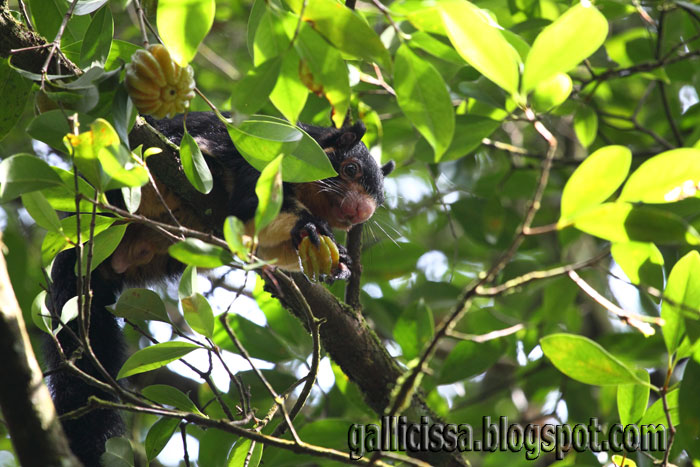
Grizzled Giant Squirrel
This chose to ignore us and nibble away at a fruit of the Malabar Tamarind Garcina gummi-gutta (Goraka in Sinhala), which is a resident tree species in Sri Lankan rain forests. Its fruit is a regular curry condiment in cuisine in our part of the world. Which I think makes this squirrel is a curry muncher! Or a real Gorakaya, if you like.

Anyway, this squirrel is one of the favourite prey species of the Mountain Hawk Eagle. Detecting one of these eagles soaring above the canopy, it would make “a blood-curdling” alarm call, which is not a strange to people who frequent rain forests. As a matter of fact, I use that call as a reliable indicator to spot airborne birds of prey.

I have planted a Goraka tree in my garden. It has reached nearly twelve metres, but is yet to bear fruit.

Striped Bronzeback 

Striped Bronzeback
This is one of the nine individual snakes we encountered, thanks largely to the superb snake-spotting skills of our local guide Dee. I have better shots of this snake taken on previous visits, just for the record. 

Sri Lanka Keelback

Sri Lanka Keelback
We found three individuals of this water snake at two sites.

Cruiser

Cruiser, male
Here’s another pretty Nymphalid butterfly that we saw at close quarters. It is christened Vindula erota scientifically, presumably because of its erotic nature.

Blue Glassy Tiger 

Blue Glassy Tiger
Although supposed to be "not found more than 20 miles from the coast" according to "The Butterflies of Ceylon" by Bernard d' Abrera, this butterfly is found at Sinharaja rain forest, which is more than 70 miles inland from coast.

Toque Macaque

Toque Macaque at Sinharaja
The Toque Macaques in Sinharaja are not forthright and confiding as those found in cultural sites, where they accost humans for handouts, and often commit snatch theft on anything that they see as food. The ones in Sinharaja are quite wary of humans, presumably because villagers have/are hunting them (in villages close to the forest) for bush-meat.

The Land Snail Arcavus superbus

The Land Snail Arcavus superbus
Here's a Gondwanaland relic land snail species in an endemic Nelu tree (Strobilanthes sp.) in bloom.

Apart from above specials, I also was able to photograph the Sinhalese Bushbrown—a butterfly lifer for me. And I got a decent sound recording of the Sri Lanka Scaly Thrush. Our birding highlights included Serendib Scops Owl and Sri Lanka Spurfowl, arguably two of the toughest endemic birds to see. And we saw a brooding male Sri Lanka Frogmouth in a nest.

Change of topics, who do you think will win the Rugby World Cup 2011? My money is on Ireland Australia! New Zealand!!

Friday, 2 September 2011

Purple-rumped Sunbird


This Purple-rumped Sunbird male comes regularly to sit outside my room's window. After doing so, it would deliver a low, rhythmic call for a while. (That's when I go to grab my camera.) Soon, it would start a fight with its own reflection. It does this by pecking at the window while hovering. This would go on and on throughout the day at regular intervals, with a clear combat peak at midday. Sunbirds, like their American cousins hummingbirds, are quite territorial and males have very little tolerance towards rivals in their patch. I feel pity for this bird, as it spends a considerable time of the day in this wasteful behaviour. I think I may have to cover the window from outside as a last resort!

Tuesday, 2 August 2011

The Yatala Stupa Fouteen Minutes Apart

This is Yatala Stupa at Tissamaharama as seen at 6.07 p.m. on 25 January, 2011. I photographed it while birding at the vicinity of this stupa with Jan and Britt last January. 


This is the same fourteen minutes later at 6.21 p.m.


A stupa is a funerary monument built to enshrine bodily relics of the Buddha and such important Buddhist persons. According to the book, "The Stupa of Ceylon" by the eminent archeologist Senarath Paranavitana, all stupas, including those built in modern times, are supposed to enshrine a particle, in most cases a minute one, of the corporeal remains of the Buddha, or a saint, from which they derive their sacred character.

The modern day Tissamaharama lies superimposed on the ancient capital city Magama of the Ruhuna Kingdom (of southern Sri Lanka), which was one of the three principal territorial divisions from 3rd century B.C. to 12th century A.D.  This stupa was believed to be built 2300 years ago by King Yatala Tissa of the Ruhuna Kingdom in the place where his wife gave birth to their son.

In the classification of stupas according to their shapes, Yatala Stupa is believed to be a "bubble-shaped" one. The restoration work was undertaken in 1883, and during that, four relic caskets made of chrysoberyl, amethyst, clear crystal, and rock crystal were found in the debris around the stupa. They were all enshrined in the new relic chamber that was built during the restoration.

This year's provincial T20 tournament in Sri Lanka was won by Ruhuna who defeated reining champions Wayamba in a close game. By the virtue of this win, Ruhuna booked their place in the qualifier stage of the Champions League T20 Tournament to be played in India this year.
Related Posts with Thumbnails