Saturday, 18 July 2009

Sewage birding

Early this year, news reached me through a Ceylon Bird Club source about a Ruddy-breasted Crake near the Lunawa Lagoon at Ratmalana. Crakes are secretive birds that are usually difficult to see either due to their rarity or because of their skulky nature. So the bird watchers have a special liking for them because of the challenge they present.

I visited this site one balmy afternoon with my trusty tuktuk companion Sarath. Directions were provided over the phone by my friend Namal Kamalgoda, who had been there earlier to check the site but not seen the bird. After reaching the site I was further guided by the owner of the house in front as to where I should stand exactly if I want to see the bird!

And, after heeding his advice, this, was what greeted my eyes—a sewage canal.
Not a pleasant sight! But crakes are indifferent to such insalubrious sites. So, here, I waited.

the site
The man was dead right; I hardly had to wait for 2 minutes before I set my eyes on a Ruddy-breasted Crake wading in the sewage water. It was easily my best view of this scarce bird.

Ruddy-breasted Crake
The resident populations of Ruddy-breasted Crake are boosted by migrants during the winter; therefore, its status ought to be described as “scarce resident and migrant”.

I had my second Ruddy-breasted Crake for the 2008/2009 bird watching season, from a safari jeep, while guiding Andreas Prevodnik (in February 2009) at Bundala National Park.

Monday, 13 July 2009

Macro Monday

Diya Na

Among the numerous meanings of the word flush there are two to do with botany. The fresh growth of young leaves in trees and such newly emerged leaves are referred as flush (as a verb and as a noun). These are not commonly known even by native English speakers and some of them flush at times hearing it from me for the first time. I think this word is quite appropriate to describe the young leaves of trees in the rain forest that appear in red or shades of red.

Nathaniel Dominy of the University of Chicago and his colleagues pooled existing information on the leaves of hundreds of tree and shrub species from Central America, Africa and South-East Asia and discovered that in as many as 62% of them, young leaves tend to be coloured anything from pale pink to deep red.

Red is a colour of warning in nature. The young leaves lack chlorophyll the green pigment found in mature leaves and are packed with toxins that are distasteful for leaf eaters. The bright red colours therefore work as a warning to repel folivorous (leaf eating) animals from making a meal of them. This gives a chance for the young leaf to grow into a mature stage to fulfill its duties of photosynthesis and transpiration. The reddish hues are also capable of reflecting harmful UV rays of the sunlight, than absorbing them, protecting young leaves with such colours further from the effects of sun.

As the leaves mature they turn less red and more greener – often taking yellowy-green and reddish-green hues. (It is those leaves of intermediate stages that folivorous animals such as Leaf-Monkeys pick for their diet).

A good example for such a tropical tree with reddish flush is Na (English: Iron Wood tree), which is botanically known as Mesua ferrea (formerly, M. nagassarium). This tree is native to Sri Lanka and is also named as the National Tree of Sri Lanka.

When we talk about plants and animals, we use the terms “native”, “resident” and “indigenous” generally to refer to ones that are found in country/territory as natural breeding populations but is also found in another country/territory the same way. The term “endemic” in contrast is used to refer when a plant or an animal is restricted to a particular geographic area – in our case, Sri Lanka.

Sri Lanka is blessed with over 3,600 flowering trees and plants that are termed as native/indigenous/resident out of which nearly 900 are endemic. I know it does not matter too much for world peace, but with such staggering endemism, I think we should have an endemic tree to represent as our National Tree. No?

In this respect, there is no better tree to be named a National Tree of Sri Lanka than Diya na – an endemic Ironwood beauty found in the lush valleys alongside streams in the rain forests in Sri Lanka, botanically known as Mesua thwaitesii (formerly, M. ferrea).

I have planted two Diya Na trees in my garden – one older and one younger (now aged 8 & 6 years respectively). The older one, which was about 3 feet tall when I bought it, was planted in a spot exposed to direct sunlight. The younger plant, which I got two years later, barely a foot tall, was planted in a shady spot. Most rain forest trees need shade at their early stages of growth. Proving this point, the younger plant has now grown very much taller & broader than the older one and looks in really good shape.

The picture at the top is an extreme close up (shot at 3 times the life size, if I remember right) of a young leaf of Diya Na, matured slighly to lose the deep purplish red hue seen in flush at early stages, as in the picture below.

Diya Na

The surrounding green represents the colour of the leaves when matured.

Note for native readers: The prefix “Diya” in Diya Na as you know refers to water – as this tree grows in riverine habitats. When you isolate the word “Na” I am sure you will agree that it gives a meaning approaching “bathed”. Combining these two meanings, I like the how the name Diya Na sounds in literal sense as “bathed in water”.

When I glance at a Diya Na tree in late stages of flush for long, the dense, droopy clusters of its elongate leaves with their slightly scalloped margins and beautiful highlights created by the flush make the poet in me see them as long dangling hair of a brunette who has bathed at the nearby stream and has just wiped her curly hair clean.

These are the kind of things I think when I am marooned in rain forests with too many male bird watchers.

Macro Monday HQ is at Lisa's Chaos.

Friday, 10 July 2009

Monsoon Birding

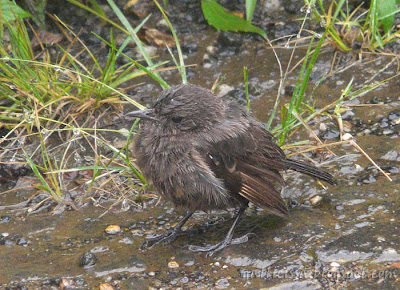
a forlorn Pied Bushchat female
I guided three avid birders on a monsoon birding trip from late June to early July. The main organiser, Pieter van der Luit from Inezia Tours, and his colleague, Teus (Dr. Teus Luijendijk) came from the Netherlands. They both were terrific birders and had 3,138 and 3,777 birds in their respective life lists. Pieter won one of the books that I gave away at a quiz that I did in the IATB #75—birding blog carnival.

The third person, Philip Johnson, was a client of Pieter's. Phil is a Professor at the University of Alabama in the department of civil engineering. He was determined to reach 5,000 birds before he turns 60—on the 30th December. After visiting five other countries in the oriental region since May, birding, Phil’s life list stood at 4,897 birds when he arrived in Sri Lanka. He left Sri Lanka with a tally of 4,950. Pieter and Teus bagged 138 and 51 lifers respectively.

The monsoon really had a dampening effect at some of the key birding sites we visited. Nevertheless, we trudged along and achieved a tally of 194, which included thirty-one endemics, and eight of the fifteen resident night birds. We missed out on two endemics: Sri Lanka Spurfowl and Serendib Scops Owl—both were stubbornly silent.

We did quite well with mammals, seeing a total of twenty-six species including Sri Lanka’s big three: Elephant, Sloth Bear and Leopard. Being a target-driven world birder, non-birdie subjects to Phil were as unattractive as non-estrous females to a Silverback.

Of course, he did not resort to chest-beating and grunting to show his displeasure, but instead he conveniently lumped them in a catch-all category named NFF—No F***ing Feathers! And moved on to find his next life bird.

Despite his avowed indifference to creatures with no feathers, Phil kept on stumbling some rarest non-birdie gems—for people like us. And he was nice enough to share them. The star among these serendipitous finds by him, was an adorable Red Slender Loris, that he spotted while it was moving slow and low in a thicket in the amazing Sinharaja rain forest. This nocturnal endemic mammal is rather rare, and all of us had great views of it.

His next best exploit was chancing upon a Muntjak at Welimada, which is not as rare, but cool nevertheless.
Moving on to birding specifics, our search for the Sri Lanka Bush-Warbler near a pool at the cloud forests of Horton Plains National Park (2,100m) to me was the most memorable birding experience of the trip. It was in a very cold morning with temperatures in single digit ºC, when intermittent downpours, and foggy conditions conspired with high gusts to spell very little hope for our cause.

Yet we stood there tenaciously, with bins firmly in our grips, ready to lift them at the slightest detection of a movement in the low-vegetation that stood before us. A movement that would betray the presence of this endemic LBJ – that can prove pain in the neck at elevations lower down. Our agonizing vigil was interrupted by my pep talk how I have shown cracking views of it at this site before on previous tours. And how we should not call off play, on account of the elements. And stay positive just like this Sambar.

a begging Sambar
Fifteen minutes on, there was no let up; it was bitterly cold.

I then I decided to take a stroll with the team to see whether we could pick its metallic call in the low shrubs. No hope. Even the bubbly Yellow-eared Bulbuls remained stubbornly silent. And the gregarious Sri Lanka White-eyes too seemed to be on a token strike, protesting the weather. Not even a Dull-blue Flycatcher sang its sonorous call—which would have been fitting for the moment. We didn’t need that Flycatcher. Phil spotted it the day before at Welimada to give great views for all of us. In fact, we had three individuals, which included a newly fledged one. One good view is just enough for hardcore birders. The name of the game is to move on to look for new birds.

With little success from the walk, I called that we should go back to check the pond.

Minutes after arriving back at the original position, our hopes were raised when Phil detected a movement of something birdie, in the low thickets, but lost it before he could find it in his binoculars. It was too misty and gloomy. Phil finds it a bit difficult to see things in low-light. And the optics gathered water droplets whenever we took off the protective covers to scan the surroundings, impairing our vision further.

With this being the state of affairs, seconds later, the bird rematerialised in a reedy patch at the edge of the pond—seemingly on transit. It was good enough for the Dutch duo to get their fills of this rare skulker. But, Phil was not on it, still struggling with his bins, wiping the mist on his glasses, and all that. Quite frustratingly, before we could show him this LBJ, it flew off across the pond, and disappeared into the bordering thickets. Only UTVs—Un-Tickable-Views. That means, it will not be counted as seen.

I alerted to stay focused as it might pop out again. Soon, as predicted, I picked up a slight movement across the pond—bingo—I got Phil on it this time. I could read its details just enough through my Swarovski EL 8.5 x 42. But then, Phil claimed he could still see only the dark blurry profile of the bird just to say that it looked like a Bush-Warbler but nothing beyond. That hinted that it was still a UTV as far as he was concerned!

I then gave him my bins to try. And that worked.  He at once claimed to see its details much clearer than through his 10 x 42s, (which were pretty worn out). The Dutch duo too were sporting Swarovski EL 10 x 42 binoculars. Pieter and Teus too took turns to look through my bins at a now preening Sri Lanka Bush Warbler, out in the open— to confirm what Phil observed. The superior light gathering ability of Swarovski EL 8.5 x 42 does have its uses in low-light forest birding.

Although the weather improved very little thereafter, birds, however, began to come out as the day wore on. It seemed like they had resigned to the fact that things will not get any better. Raising our hopes, Sri Lanka White-eye, Velvet-fronted Nuthatch, Indian Blackbird, Orange-billed Babbler, Grey Tit, Dark-fronted Babbler, Sri Lanka Scimitar Babbler, Common Tailorbird, Dull-blue Flycatcher, all came in quick order as we pressed on.

A short respite from the rain, brought a couple of Sri Lanka Bush-Warblers to an eye-level perch for much improved views. Shortly afterwards, another one low-down. Way better.

Due to weather induced misfortunes, the Sri Lanka Whistling Thrush kept eluding us until our final morning at Nuwara Eliya, when I gambled to check a new site. It worked. And the male Sri Lanka Whistling Thrush that I found for everybody not only gave jaw-dropping views, sitting on an open branch, but also entertained us with its song—which I heard well for the first time. Teus and I got decent sound recordings of it.
Whistling Thrushes are ultra-elusive birds and seeing them involve a sound technique.

I parted some tips in Finding the Malayan Whistling Thrush to Phil whose next stop was Malaysia.

Monday, 22 June 2009

Macro Monday

Lantana camera

This is a close up of a flower bud of the alien-invasive, Lantana camara in my garden. The flowers of this plant attract a lot of butterflies.

Macro Monday HQ is at Lisa's Chaos.

Wednesday, 10 June 2009

Thursday, 4 June 2009

Dawn of a Dropwing

The front covers of the only two books dedicated to the dragonflies and damselflies of Sri Lanka has one thing in common. They both feature a widespread Oriental dragonfly Dawn Droping Trithemis aurora. Sri Lanka is home to 117 species of dragonflies and damselflies out of which a whopping 53 54 are endemic. Some of these endemics too are strikingly coloured. How then can you explain this species of dragonfly being chosen to adorn the front covers of the said books? They say not to judge a book from its cover. But, on this, it is hard not to.


I am happy to announce that my dragonfly pond has produced the desired results—attracting more dragonflies, getting them to breed in the pond, and photographing them.

Of the numerous dragonflies that have shown interest at my pond, the Dawn Dropwing has shown a remarkable breeding success during April and May. Its emergence, as most other dragonflies, happen at night, in the cover of darkness—typically at around 8.00 p.m—when I do not like anything to come between me and prime time news.

Dragonflies and Damselflies lay their eggs in fresh water where their larva (aka. nymph/naid) grow. To transform into a dragonfly, the nymph should to leave the aquatic world, and attach itself to a leaf, rock or twig near the water. In my pond, the cradle often takes the form of the outer wall of the raised rectangular rim.

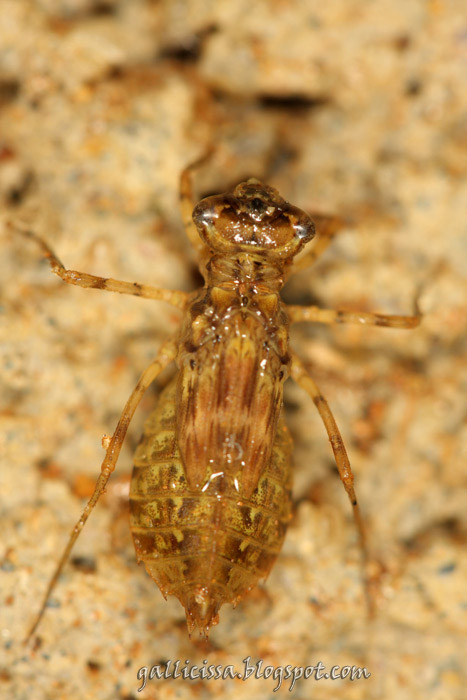
This is how the nymph of Dawn Dropwing looks like when it has surfaced out to the open.

Dawn Dropwing Nymph
Would it ever make to a front cover of a popular natural history book on dragonflies?
Sorry, I am being mean.

Most of these photographs were taken in April, which is the hottest month here. Even working at night made no difference as it was very humid. This was made worse by the mosquitoes, which forced me to be fully clothed in outdoor wear to prevent them from causing havoc. From the moment the dragonfly nymph surfaces out of the water to the time it ends its metamorphosis as a teneral or a young dragonfly can take several hours. So I can tell you that these pictures were obtained in pretty sweaty circumstances.

Anyway, this is how it looks when the teneral dragonfly begins to emerge breaking the larval skin during the early stages of its final metamorphosis.

Dawn Dropwing emerging
The sand particles sticking on the nymph's moist body give it a good camouflague by disguising its real profile against potential predators. But, the ghostly teneral that emerges is pale in comparison, and could be easily spotted by predators. This is a critical stage of its metamorphosis. As the helpless teneral emerge, it becomes easy prey for predators lurking near the water. Look how the ants gang up against one sorry teneral Dawn Dropwing—which never saw the light of the dawn. (Kim, it was too late when I found this!)

Dawn Dropwing emerging
Post-mortem: the ants have punctured a hole the young dragonfly's body in the thorax as its blood (hemolymph) was being pumped during the process of metamorphosis. This drained vital supplies needed for its body to expand and halted the process of growth. Click on the image below to view a large image to see a drop of its blood in the back of its thorax.

Dawn Dropwing
Eventually, the ants succeeded in inflicting a slow death on the teneral through this fatal bite. They marched away with their prized catch soon after.

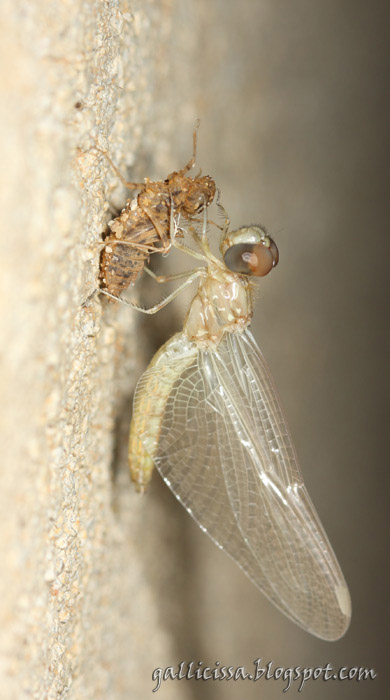
Coming back to regular cases of metamorphosis, as the nymph works its way out of the exoskeleton the end of the abdomen remains inside the exoskeleton. The dragonfly then flips itself upward by a move that is similar to an upside down sit-up. It then grabs onto the lifeless exoskeleton, and pulls out the remainder of its abdomen. After a while it looks like this.

Dawn Dropwing emerging
The wings, when the dragonfly first emerges, are shriveled and opaque. The wings are pumped full of fluid to expand them, and when fully expanded, they harden and finally become transparent.

Dawn Dropwing emerging
Here's a different angle of the above.

Dawn Dropwing emerging
The young male Dawn Dropwing obelisking below looks similar to the female in colours. It takes several days before it assumes the guady colours of the adult males as in the very first picture.

Dawn Dropwing juvenile male

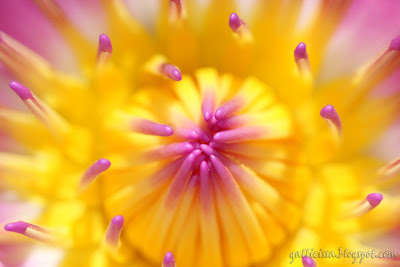
By the way, this water lily species (?a hybrid of Nymphaea nouchali) is doing very well in my pond. Here's a close up of its anthers.

Blue Water-lily
I conclude this post with an abstract of a male Dawn Dropwing that I photographed sometime ago. It doesn't show its real life colour though, which is why it is an abstract! I am looking forward for more captures of the adult showing its real life colours. The one shown at the very top was taken way back in the ancient history using a Nikon Coolpix 4500—my first digital camera that I got for digiscoping birds.

Dawn Dropwing
Related Posts with Thumbnails